Overview
Few creatures embody the spirit of wild North America quite like the American mink (Neogale vison). This small but fierce semi-aquatic mammal has captured the imagination of naturalists, trappers, and wildlife enthusiasts for centuries. With its lustrous dark fur, lightning-quick reflexes, and remarkable adaptability, the American mink occupies a unique and important role in the ecosystems it inhabits. From the cold, rushing streams of the Canadian boreal forest to the cypress-lined bayous of the American South, the mink is a survivor in every sense of the word — a predator finely tuned by evolution to thrive at the water's edge.
Understanding the American mink means appreciating both its biological brilliance and the complex relationship it has shared with human civilization. Its dense, water-resistant coat drove one of North America's most storied fur-trading traditions, and its presence in a watershed is widely regarded as a reliable indicator of environmental health. Whether you are a trapper, a wildlife biologist, a curious hiker, or simply someone who loves the natural world, the American mink is an animal well worth knowing.
Biological Traits
The American mink is a member of the family Mustelidae, which also includes otters, weasels, badgers, and wolverines — a family renowned for producing some of nature's most tenacious and skilled predators. Its scientific name, Neogale vison, reflects its classification within a genus of New World minks, distinguishing it from the now largely extinct European mink (Mustela lutreola).
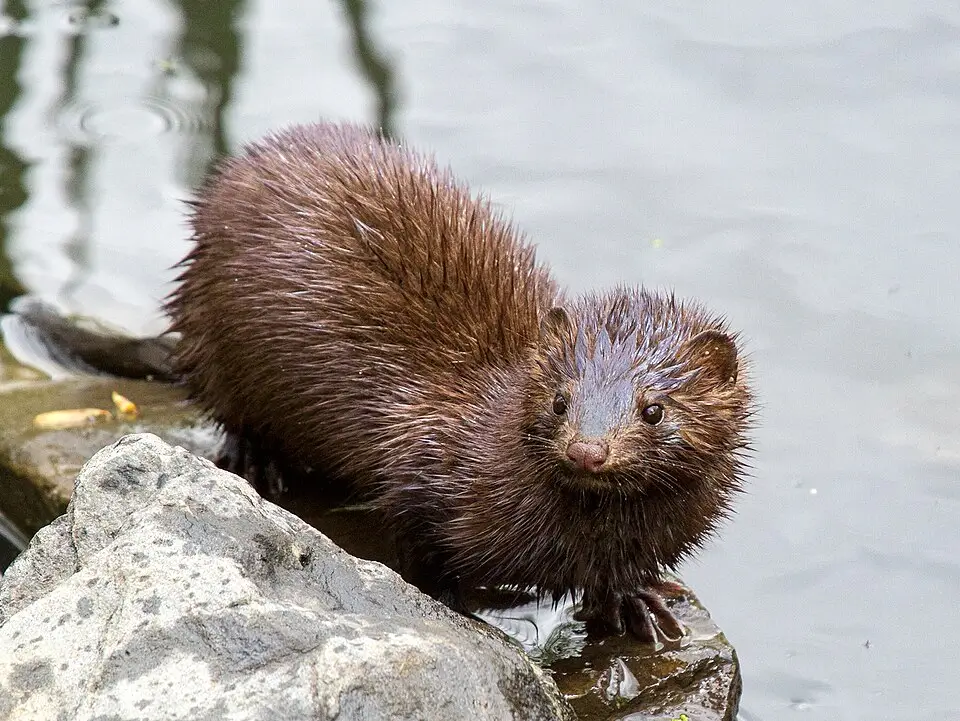
In terms of physical appearance, the American mink is a slender, muscular animal with short legs, a long neck, a somewhat flattened head, and a moderately bushy tail. Its fur is famously dense and soft, typically presenting in rich shades of dark brown to nearly black, often with small patches of white on the chin or throat. The coat consists of two distinct layers: a coarse outer layer of guard hairs that repels water, and a fine, dense underfur that provides exceptional insulation. This two-layered coat is what made American mink fur so prized in the global fur trade and so effective for the animal itself in cold aquatic environments.
Males are notably larger than females, a characteristic common across mustelids. Adult males can reach lengths of roughly 20 to 28 inches from nose to tail tip and weigh anywhere from 1.5 to 3.5 pounds, while females are generally smaller and lighter. Despite their modest size, minks are extraordinarily strong and bold for their body weight, capable of taking prey considerably larger than themselves.
The mink's senses are well-suited to life as a predator. Their eyesight is reasonably sharp, and their sense of smell is acute — critical for tracking prey through dense vegetation, underwater, or in the dark of night. Like many mustelids, American minks possess paired anal scent glands that produce a pungent musk, which is used for territorial marking and communication. This musky odor is a well-known characteristic of the species and can be detected near dens and frequently traveled pathways.
American minks are solitary and largely territorial animals. Males maintain home ranges that may overlap with the smaller territories of females but rarely with those of other males. They are primarily crepuscular and nocturnal hunters, though sightings during daylight hours are not uncommon, particularly during breeding season or when prey is abundant.
Breeding typically occurs in late winter, generally between February and April. Minks are known for a fascinating reproductive strategy called delayed implantation, in which the fertilized egg does not immediately implant in the uterus but instead undergoes a period of dormancy before development resumes. This adaptation allows minks to time births so that kits — typically four to six per litter — arrive in late spring when food resources are plentiful. Young minks grow quickly and are generally independent by late summer or early fall, at which point they disperse to establish their own territories.
The diet of the American mink is impressively diverse. As an opportunistic apex predator at the small-to-medium scale, the mink preys on fish, crayfish, frogs, aquatic invertebrates, muskrats, rabbits, birds, and small rodents. Their partially webbed feet and streamlined bodies make them excellent swimmers, capable of diving and pursuing fish with agility. On land, they are quick and lithe, able to pursue prey through dense brush and into burrows.
Habitat & Range
The American mink is a creature of the waterway. It is almost always found in close association with streams, rivers, lakes, marshes, and wetlands. Riparian corridors — the vegetated zones along watercourses — provide the mink with everything it needs: abundant prey, cover from predators, den sites, and reliable access to water year-round. They are particularly drawn to areas with overhanging banks, root tangles, fallen logs, and dense streamside vegetation, all of which offer shelter and hunting opportunities.
The species has an expansive native range that covers most of North America. From Alaska and the Canadian territories south through the continental United States, the American mink is found in virtually every region where suitable wetland habitat exists. It is absent from the driest desert regions and the highest mountain elevations, but otherwise its adaptability has allowed it to colonize a remarkably broad geographic area.
In Texas, the American mink is part of the broader wildlife community of the state's eastern and northeastern regions, where forested wetlands, river bottomlands, and coastal marshes provide appropriate habitat. Texas is a state of extraordinary ecological diversity — stretching from the pine forests and bayous of the East Texas Piney Woods to the semi-arid brush country of the south and the arid deserts of the Trans-Pecos region in the west. The mink, as a semi-aquatic species, is naturally more associated with the wetter, more heavily vegetated eastern and coastal portions of the state. The Sabine, Neches, Trinity, and Sulphur River systems, along with their associated oxbow lakes and bottomland hardwood forests, represent classic mink territory in Texas.
Hunting and Trapping Information
The American mink has a long and significant history in North American trapping culture. For generations, trappers have pursued mink along creek banks and marshes, prizing the animal's thick, glossy pelt. Mink pelts were among the most valuable commodities in the North American fur trade, driving exploration and commerce across the continent. While the commercial fur trade has evolved considerably over the decades, mink trapping remains a legal and regulated activity in many parts of North America and continues as a traditional and recreational pursuit for many outdoor enthusiasts.
For those interested in hunting or trapping American mink in Texas, it is important to consult the Texas Parks and Wildlife Department (TPWD) directly for the most current regulations, season dates, and licensing requirements. The TPWD is the state authority for all wildlife-related activities in Texas and provides up-to-date guidance on furbearer seasons and trapping rules. As of the available source data, no specific season dates or license requirements for American mink in Texas were listed, which underscores the importance of checking directly with TPWD before pursuing any furbearer trapping or hunting activity in the state.
TPWD's official platforms — including their website, mobile applications, and harvest reporting tools — offer comprehensive resources for hunters and trappers. The department requires mandatory harvest reporting for certain species and seasons, and compliance with all reporting requirements is an essential part of responsible and ethical participation in Texas hunting and trapping traditions. Staying informed and following all applicable regulations ensures that these activities remain sustainable for future generations.
General best practices for mink trapping include the use of appropriately sized foothold traps or body-gripping traps placed along travel corridors near water, typically at the entrance to bank dens, under overhanging cover, or near fish runs and muskrat activity. Trappers should always adhere to state-specific regulations regarding legal trap types, setback requirements, and checking intervals.
Conservation
The American mink is currently classified as a species of least concern by the International Union for Conservation of Nature (IUCN), reflecting its broad range, adaptability, and relatively stable populations across North America. Unlike many wildlife species that have suffered dramatic declines due to habitat loss and human development, the American mink has demonstrated considerable resilience.
That said, like all wetland-dependent wildlife, the American mink is not entirely insulated from environmental pressures. Wetland drainage, water pollution, and the degradation of riparian habitats can reduce mink populations locally. Because mink occupy high trophic levels in aquatic food webs, they can also be susceptible to bioaccumulation of environmental contaminants such as heavy metals and organochlorine compounds, which concentrate as they move up the food chain.
Conservation efforts that benefit the mink include wetland protection and restoration, sustainable land use along riparian corridors, and water quality improvement initiatives. In Texas, the extensive network of river systems and coastal wetlands provides vital habitat not only for mink but for a rich diversity of wildlife. Supporting the work of agencies like TPWD and conservation organizations that protect these habitats ultimately benefits the entire ecological community.
Interestingly, while the American mink thrives in its native range, it is considered an invasive species in parts of Europe and South America, where escaped or released farm-raised minks have established feral populations with significant impacts on native wildlife, particularly ground-nesting birds and the critically endangered European mink. This underscores the ecological importance of responsible wildlife management and the far-reaching consequences of species introductions outside their native range.
For Texas residents and visitors, encountering an American mink darting along the bank of a woodland stream or surfacing with a fish in a bottomland lake is a memorable wildlife experience — a glimpse of one of nature's most perfectly adapted predators going about its timeless business.