Overview
Few birds capture the imagination of wildlife enthusiasts and upland hunters quite like the American woodcock (Scolopax minor). This distinctive, rotund shorebird-turned-woodland-dweller occupies a unique ecological niche, bridging the worlds of the forest floor and the open sky in ways that have fascinated naturalists, birdwatchers, and hunters for generations. Known by a colorful array of nicknames — timberdoodle, bogsucker, Labrador twister, and mud snipe among them — the American woodcock is one of North America's most intriguing game birds, combining cryptic camouflage, extraordinary sensory adaptations, and a spectacular courtship display into one compact, unforgettable package.
For hunters across the eastern half of North America, the woodcock represents a beloved and cherished quarry. The pursuit of this elusive bird through dense alder thickets and young forest stands is a tradition steeped in history and camaraderie, often carried out alongside pointing dogs whose style and intensity are perfectly matched to the woodcock's habit of holding tight before flushing. In Texas and across the broader Southern United States, the woodcock plays an important role in both the hunting heritage and the broader ecological landscape, migrating through and wintering in habitats that span from piney woods to bottomland hardwoods.
Understanding the American woodcock — its biology, behavior, habitat needs, and conservation status — is essential for anyone who hopes to appreciate or pursue this remarkable bird. This article offers a comprehensive look at Scolopax minor, drawing on established scientific knowledge and wildlife management principles to paint a full picture of one of North America's most distinctive avian species.
Biological Traits
The American woodcock belongs to the family Scolopacidae, the sandpipers and allies, a taxonomic placement that reflects its evolutionary heritage as a shorebird even though it now lives predominantly in forested upland and wetland edge habitats. It is the only species in its genus native to the Americas, distinguishing it from the Eurasian woodcock (Scolopax rusticola) and other Old World relatives.
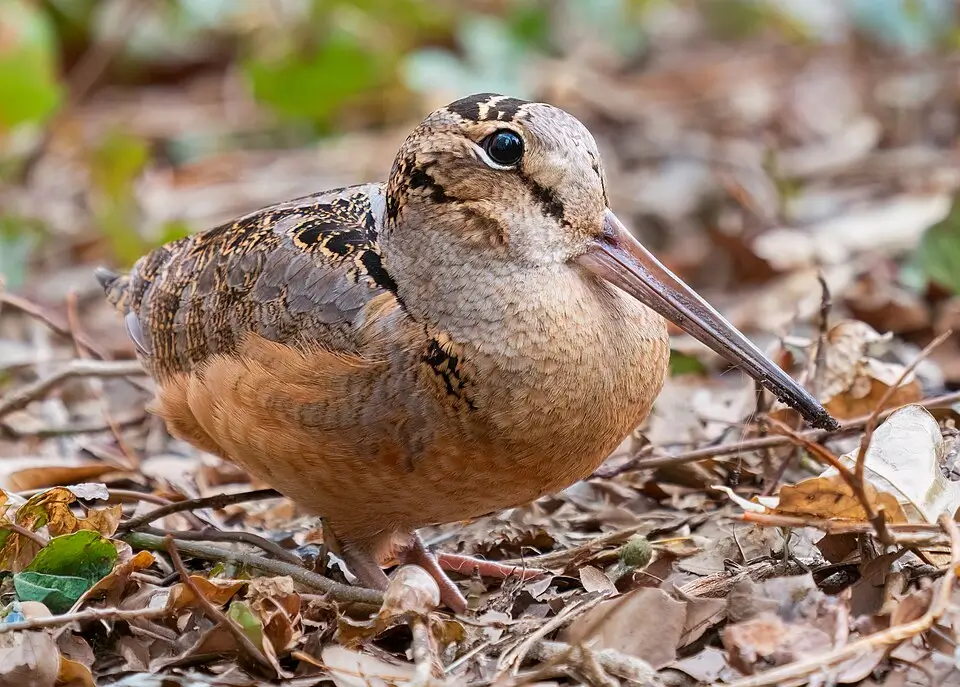
One of the woodcock's most immediately recognizable physical features is its long, flexible bill, which can reach approximately 2.5 to 2.75 inches in length. This remarkable instrument is not merely for probing the soil — the tip of the bill contains a dense network of sensory receptors known as Herbst corpuscles, which allow the bird to detect the subtle movements of earthworms deep in soft ground without needing to see or hear them. The upper mandible is prehensile at the tip, meaning the woodcock can open just the tip of its bill underground to grasp and extract prey without fully withdrawing the bill. This extraordinary adaptation makes the woodcock one of the most specialized insectivore-to-invertebrate feeders among North American birds.
The woodcock's eyes are positioned high and far back on its large, rounded head, providing a nearly 360-degree field of vision. This wide visual coverage allows the bird to watch for aerial predators even while its bill is buried in the ground — a clear evolutionary advantage for a bird that spends considerable time feeding in a highly vulnerable posture. Interestingly, this eye placement also means that the woodcock's binocular vision is actually better behind its head than in front of it, giving it an unusual visual perspective compared to most birds.
The plumage of the American woodcock is a masterwork of natural camouflage. Dead leaves, bark, and forest floor debris are mimicked in intricate patterns of russet, buff, brown, and black across the bird's upperparts. When a woodcock crouches motionless on the forest floor, it is extraordinarily difficult to detect, even at close range. This cryptic coloration is the bird's primary defense mechanism, and it frequently relies on it right up until the moment a predator or hunting dog is nearly upon it.
In terms of size, the woodcock is a compact, chunky bird. Adults typically weigh between 5 and 8 ounces, with females generally larger than males — a pattern of reversed sexual size dimorphism seen in a number of shorebirds and raptors. The wingspan ranges from roughly 17 to 19 inches, and in flight, the bird produces a characteristic twittering sound caused by air passing through its three narrow outer primary feathers.
Perhaps the most celebrated aspect of woodcock biology is the male's elaborate spring courtship display, known as the "sky dance." At dusk and dawn during the breeding season, male woodcock gather in open areas — old fields, forest clearings, logging roads — and deliver a repeated nasal "peent" call from the ground. After a series of these calls, the male launches into a spiraling, climbing flight that can take him several hundred feet into the air. At the peak of his ascent, the twittering of his wings is joined by a liquid, chirping vocalization, and he then tumbles back to earth in a swooping descent, landing close to his original calling spot to begin the performance again. This display is one of the most memorable wildlife spectacles in the eastern North American countryside.
Habitat & Range
The American woodcock breeds across the eastern half of North America, from the Atlantic coast westward through the Great Lakes region and into the central states and provinces. Its core breeding range encompasses much of the northeastern United States and southeastern Canada, where young forest stands, alder thickets, and moist woodland edges provide ideal nesting cover and foraging habitat.
The species is closely associated with early successional forest habitat — young, dense stands of trees and shrubs that provide both cover and the soft, moist soils rich in earthworms and other invertebrates that form the bulk of its diet. Earthworms, in fact, are estimated to comprise the vast majority of the woodcock's food intake, though the bird also consumes insects, millipedes, and plant material. The availability of soft, workable soil is therefore a primary driver of woodcock habitat selection throughout the year.
As a migratory species, the American woodcock follows well-established flyways southward each autumn, moving through the central and Atlantic states to wintering grounds across the Gulf Coast states, including Louisiana, Mississippi, Alabama, and Texas. In Texas, wintering woodcock are found primarily in the eastern and southeastern portions of the state, where bottomland hardwood forests, riparian corridors, and moist woodland habitats provide suitable conditions. The dense timber country of the Pineywoods region of East Texas is particularly notable as woodcock wintering habitat, offering the combination of cover and foraging ground the species requires.
Migration timing varies with weather conditions, and woodcock are known to move in pulses ahead of cold fronts, making their southward passage somewhat unpredictable but concentrated during autumn months. The birds are largely nocturnal migrants, traveling under cover of darkness and dropping into suitable habitat at dawn to rest and feed.
Hunting Information
The American woodcock has a long and distinguished history as an upland game bird, and its pursuit remains a beloved tradition among bird hunters across its range. Hunting woodcock is an experience unlike any other in the upland world — the dense, brushy habitats the birds favor demand persistence and agility from the hunter, and the explosive, twisting flush of a woodcock from beneath a pointing dog's nose is one of the great thrills in all of bird hunting.
Woodcock hunting is typically conducted with flushing or pointing breeds, with English setters, Brittanys, and German shorthaired pointers among the most popular choices. The birds' tendency to hold tight before flushing makes them well-suited to hunting over pointing dogs, and the bond between hunter, dog, and bird that develops over a season in woodcock cover is one the sport's most cherished traditions.
In Texas, woodcock are present primarily as winter residents, with birds arriving from northern breeding grounds during the autumn migration. The eastern portions of the state, particularly the Pineywoods and adjacent river bottoms, offer the most reliable woodcock habitat during the winter months. Hunters should consult the Texas Parks and Wildlife Department (TPWD) for current season dates, bag limits, and licensing requirements before pursuing woodcock, as these regulations are set in coordination with federal migratory bird management frameworks and may change from year to year. As with all migratory game birds in the United States, a valid federal migratory bird hunting and conservation stamp (commonly known as the Federal Duck Stamp) is generally required in addition to any applicable state licenses.
Weather plays a significant role in woodcock hunting success. Cold fronts that push birds southward can concentrate woodcock in cover patches that might otherwise hold few or none, and experienced hunters learn to time their outings to coincide with these movements. Scouting — identifying moist, brushy habitats near water, looking for the distinctive whitewash droppings ("chalk") and circular probe marks ("borings") woodcock leave in soft soil — is essential to finding birds consistently.
Conservation
The American woodcock is currently listed as a species of conservation concern by several wildlife management agencies and organizations, reflecting a long-term population decline that has been documented through annual survey data. The primary driver of this decline is habitat loss — specifically, the maturation and loss of the young forest habitats on which the species depends. As forests age and early successional cover gives way to closed-canopy woodland, woodcock lose the brushy, semi-open habitats they need for nesting, brood-rearing, and foraging.
Active habitat management — including timber harvesting, prescribed fire, and shrubland creation — is widely recognized as essential for maintaining and improving woodcock populations. Many state wildlife agencies, conservation organizations, and private landowners have undertaken habitat improvement projects specifically designed to benefit woodcock and other early successional species. In Texas and across the Gulf Coast wintering range, maintaining healthy bottomland and riparian habitats is equally important to supporting wintering populations.
Hunters have long been active partners in woodcock conservation, contributing through license fees, excise taxes on sporting goods under the Federal Aid in Wildlife Restoration Act (Pittman-Robertson Act), and voluntary habitat work. Organizations such as the American Woodcock Society work specifically to advance woodcock research, monitoring, and habitat conservation across the species' range.
The woodcock's dependence on healthy, connected forest habitats across its entire migratory corridor — from Canadian breeding grounds through the eastern states to Gulf Coast wintering areas — means that its conservation is inherently a landscape-scale challenge requiring cooperation across state and national boundaries.
Conclusion
The American woodcock is a bird of contradictions and surprises — a shorebird that lives in the forest, a camouflage master that performs one of nature's most theatrical aerial displays, a humble-looking creature equipped with one of the most sophisticated sensory bills in the avian world. For hunters, naturalists, and wildlife advocates alike, Scolopax minor represents one of North America's most compelling wildlife stories. Whether you encounter a woodcock flushing in a burst of twittering wings from a Mississippi bottomland or watch a male spiraling skyward in the half-light of an April evening in Maine, the experience is one that stays with you. Supporting the habitats that sustain this extraordinary bird — and appreciating the traditions built around its pursuit — is a worthy endeavor for all who love the wild places of North America.