Overview
Few animals in North America command as much immediate recognition — and respectful distance — as the striped skunk (Mephitis mephitis). With its bold black-and-white coloration and legendary chemical defense, this medium-sized mammal has carved out a fascinating ecological niche across the continent. Whether you encounter one on a moonlit Texas evening or simply spot its distinctive tracks along a creek bed, the striped skunk is a creature worthy of deeper appreciation. Far more than just a cautionary tale for curious dogs and unsuspecting hikers, the striped skunk plays a meaningful role in the ecosystems it inhabits, serving as both predator and prey, and contributing to the balance of insect and small rodent populations across its wide range.
The striped skunk is perhaps the most widely recognized of all North American skunk species, partly because of its striking appearance and partly because of its remarkable defensive chemistry. Its scientific name, Mephitis mephitis, comes from the Latin word mephitis, meaning a noxious or poisonous exhalation from the ground — a fitting tribute to the animal's most famous attribute. Understanding this animal beyond its reputation reveals a surprisingly complex, adaptable, and ecologically valuable mammal.
Biological Traits
The striped skunk (Mephitis mephitis) belongs to the family Mephitidae, which includes all skunks, and is one of the most studied members of that family due to its widespread distribution and close proximity to human populations. It is a member of the order Carnivora, though like many carnivores, it is highly omnivorous in practice.
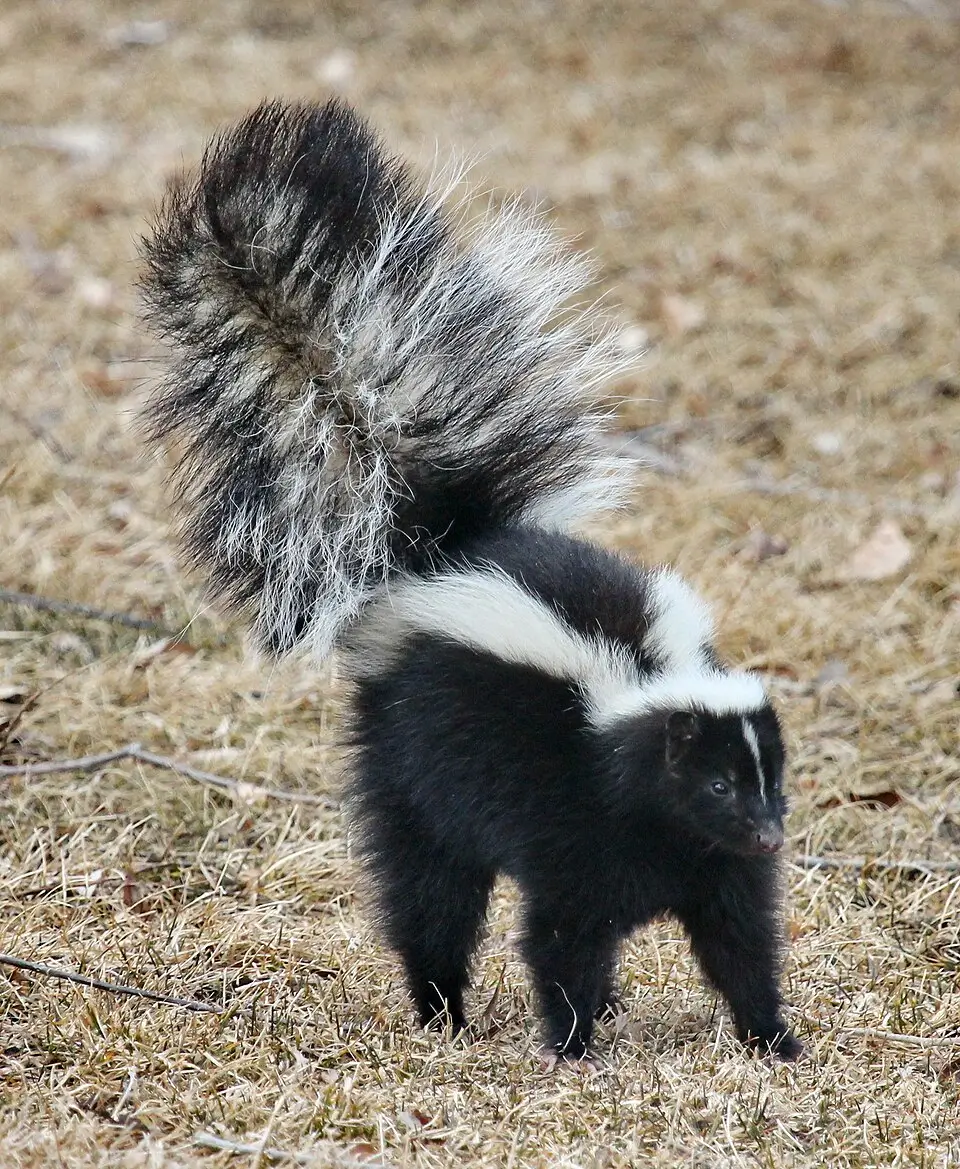
In terms of physical appearance, the striped skunk is immediately identifiable by its glossy black fur adorned with a prominent white stripe that typically runs from the top of the head, splits at the shoulders, and continues in two parallel lines down the back toward the tail. The tail itself is bushy and often displays a mix of black and white fur. There can be considerable individual variation in this pattern — some individuals show more white than others — but the general design remains consistent and serves as a clear warning signal to potential predators.
Adult striped skunks are roughly the size of a domestic cat. They have a compact, muscular body built for digging, short but powerful legs, and long, curved claws on their front feet that are ideal for excavating insects and grubs from the soil. Their heads are small and triangular, with small eyes that reflect the fact that this is primarily a nocturnal species with relatively limited visual acuity. However, their senses of smell and hearing are well developed, compensating admirably for their modest eyesight.
The striped skunk's most famous feature is, of course, its musk glands. Located beneath the base of the tail, these paired scent glands can discharge a sulfur-containing chemical mixture — most notably (E)-2-butene-1-thiol and 3-methyl-1-butanethiol — with remarkable accuracy at distances of up to 10 feet or more. Before deploying this defense, a skunk will typically give a series of warnings: foot stamping, hissing, and raising its tail. If these signals are ignored, the skunk can spray with considerable precision. The spray causes intense irritation to the eyes and skin and produces an odor that can be detected by humans from considerable distances. Remarkably, skunks are somewhat sparing with their musk, as it takes several days to fully replenish their supply.
Striped skunks are omnivores with a broad and opportunistic diet. They consume insects — particularly beetles, grasshoppers, and crickets — as well as grubs, earthworms, small rodents, bird eggs, berries, nuts, and various plant matter. This dietary flexibility is one of the key reasons for their success across such a wide geographic range and variety of habitat types. In agricultural areas, they provide a genuine service by consuming large numbers of crop-damaging insects and small rodents.
Breeding typically occurs in late winter, and after a gestation period of roughly 60 to 75 days, females give birth to litters that commonly range from four to seven young, known as kits. The kits are born blind and helpless but develop quickly under their mother's care. They begin following their mother on foraging trips by midsummer and are typically independent by early fall. Female skunks are devoted mothers and will aggressively defend their young if threatened.
Striped skunks do not truly hibernate, but they do enter periods of torpor during cold winter months, particularly in the northern parts of their range. They may share communal dens during winter, with several females sometimes denning together along with a single male. In warmer climates such as Texas, this torpor period may be shortened or absent entirely, allowing skunks to remain active throughout much of the year.
Habitat & Range
The striped skunk is one of the most broadly distributed mammals in North America. Its range extends from southern Canada through most of the contiguous United States and into northern Mexico. This vast distribution speaks to the animal's remarkable adaptability. It thrives in a wide variety of environments, including open prairies, mixed woodlands, farmland, suburban neighborhoods, brushy areas, and riparian corridors.
In the state of Texas, the striped skunk is found throughout virtually the entire state. Texas's diverse landscape — ranging from the piney woods of East Texas to the desert scrublands of the Trans-Pecos, the rolling prairies of Central Texas, and the coastal marshes of the Gulf Coast — provides a wealth of suitable habitat. Skunks tend to favor edge habitats, where forest meets open ground, as these transitional zones offer both cover and abundant food sources. They are also commonly found near water, where invertebrate prey is plentiful.
Skunks typically den in burrows, often those originally excavated by other animals such as armadillos or foxes. They may also den under buildings, wood piles, brush piles, or in hollow logs. Their home ranges are relatively modest, often covering a mile or two depending on habitat quality and season. Males generally range more widely than females, especially during the breeding season when they may travel considerable distances in search of mates.
Hunting Information
In Texas, the striped skunk is classified as a non-game furbearer under the jurisdiction of the Texas Parks and Wildlife Department (TPWD). As a furbearer, it falls within a category of wildlife that includes animals with commercially valuable pelts or those important to the state's trapping and hunting heritage.
According to information available from the Texas Parks and Wildlife Department, the state provides regulatory frameworks for hunting and trapping various species throughout the year. However, the specific season dates and licensing requirements for striped skunk in Texas are not detailed in the currently available TPWD hunting season information. Hunters and trappers interested in pursuing striped skunk in Texas are strongly encouraged to consult the most current TPWD hunting and trapping regulations directly at the official Texas Parks and Wildlife Department website before going afield.
Historically, striped skunks have been trapped primarily for their fur, which has been used in the garment industry, though market demand for skunk pelts has varied considerably over the decades. Trappers who pursue skunks typically use cage traps or foothold traps set near known den sites, trails, and areas of abundant food. As with all trapping activities, safety and ethical practices are paramount, and proper handling techniques are essential to avoid being sprayed.
Beyond fur trapping, some landowners and pest control operators may address skunks when they take up residence under homes or outbuildings or when they pose concerns related to disease transmission, particularly rabies. Skunks are among the most common wildlife reservoirs for rabies in North America, which is an important consideration for anyone who encounters or handles them. Any skunk behaving abnormally — active during daylight hours, appearing disoriented or aggressive — should be reported to local wildlife authorities.
Conservation
The striped skunk is currently listed as a species of least concern by the International Union for Conservation of Nature (IUCN), reflecting its broad distribution and generally stable populations across most of its range. It has demonstrated impressive adaptability to human-altered landscapes, and populations appear robust throughout much of North America, including Texas.
That said, skunks do face a variety of natural and human-caused pressures. Road mortality is a significant source of skunk deaths across their range, as these nocturnal animals frequently cross roads during their nightly foraging and are often struck by vehicles. Habitat loss through urban development and agricultural intensification can reduce the diversity of prey available to skunks and fragment their populations, though skunks often adapt surprisingly well to suburban environments.
Predators of the striped skunk include great horned owls — perhaps their most significant natural predator, as these birds lack the well-developed sense of smell that deters most mammalian predators. Coyotes, bobcats, foxes, and badgers may also occasionally prey on skunks, typically targeting young animals or individuals caught in the open.
From a conservation standpoint, maintaining healthy striped skunk populations is beneficial for ecosystem health. Their role as insect and rodent predators provides natural pest control services, and their digging activity helps aerate soil and recycle nutrients. Like many generalist mammals, the striped skunk is a quiet but important thread in the ecological fabric of North American landscapes, including the diverse and biologically rich state of Texas.