Overview
Among the many remarkable members of the deer family, few are as visually striking and behaviorally complex as the Sika deer (Cervus nippon). Known for their spotted coats, haunting vocalizations, and impressive antlers, Sika deer have captured the imagination of wildlife enthusiasts, naturalists, and hunters across the globe for centuries. Originally native to East Asia, these elegant animals have successfully established populations far beyond their ancestral homeland, including on the sprawling ranches and exotic game preserves of the Lone Star State. Whether encountered in their native forests of Japan and mainland Asia or on a Texas hunting lease, Sika deer are a species that commands respect and admiration.
The Sika deer's scientific name, Cervus nippon, reflects its deep historical connection to Japan — "nippon" being one of the Japanese words for Japan itself. This naming convention speaks to the species' long cultural and ecological significance in its native range, where it has been revered in art, religion, and tradition for thousands of years. Today, however, the Sika deer's story extends far beyond Asia, making it one of the most widely distributed deer species on the planet.
In Texas, where hunting culture is deeply woven into the fabric of daily life and the state manages one of the most diverse and abundant wildlife resources in North America, Sika deer have found a welcoming home. The Texas Parks and Wildlife Department (TPWD) oversees wildlife management across the state's vast 268,596 square miles, a landscape of extraordinary ecological diversity that ranges from coastal marshes along the Gulf of Mexico to rugged high desert in the west. Within this context, Sika deer occupy a unique and interesting niche that deserves a thorough exploration.
Biological Traits
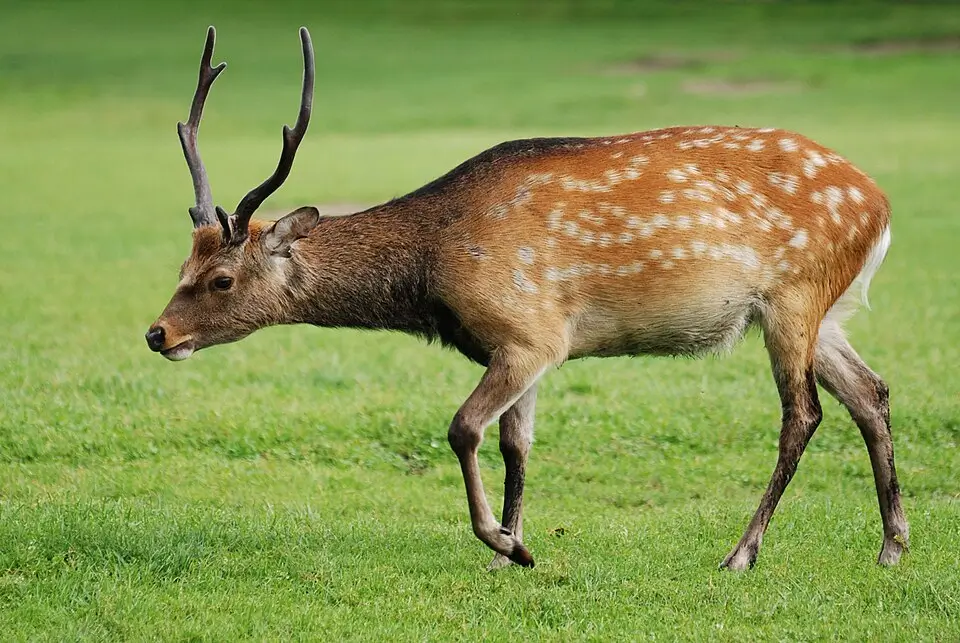
Sika deer are members of the family Cervidae and belong to the genus Cervus, placing them in close taxonomic company with red deer and elk. They are a medium-sized deer, and one of the most immediately recognizable features of the species is its spotted coat. Unlike many deer species that lose their spots upon reaching adulthood, Sika deer often retain some degree of spotting throughout their lives, particularly along the back and flanks. This characteristic gives them a distinctly beautiful appearance and sets them apart from most other cervids at a glance.
The coat of a Sika deer changes somewhat with the seasons. During summer months, the coat tends to be a rich reddish-brown color with more prominent white spots. In winter, the coat darkens considerably, becoming a thick, grayish-brown that provides both warmth and camouflage in cooler, more barren environments. A distinctive white rump patch, which can be flared outward when the animal is alarmed — much like a whitetail deer's flag — serves as an important visual communication signal among individuals in a group.
Male Sika deer, known as stags, grow branched antlers that are typically hard and upright in structure. These antlers are shed and regrown each year, following the well-known cervid cycle of growth driven by changing photoperiod and hormonal fluctuations. Stags use their antlers primarily during the rut, the annual breeding season, when competition among males is intense. Female Sika deer, called hinds, do not grow antlers and are generally smaller and more lightly built than stags.
One of the most fascinating behavioral traits of Sika deer is their vocal repertoire. They are among the most vocal of all deer species, producing a wide range of sounds that include whistles, screams, and grunts. During the rut, stags emit a haunting, high-pitched whistle that carries far through the forest — a sound that has startled and thrilled many a hunter and wildlife watcher fortunate enough to hear it. This vocalization is quite different from the deep grunt of a whitetail buck and adds an almost otherworldly quality to the Sika deer's personality in the field.
Sika deer are primarily grazers and browsers, consuming a wide variety of grasses, forbs, agricultural crops, and woody browse depending on the season and availability of food sources. Their dietary flexibility is one of the traits that has allowed them to adapt successfully to a variety of environments around the world. They are generally considered to be crepuscular animals — most active during the dawn and dusk hours — though they can be observed moving and feeding at virtually any time of day or night, particularly where human pressure is low.
Social structure among Sika deer is somewhat fluid. Outside of the rut, stags and hinds typically live separately, with hinds often forming loose family groups and stags either living alone or in small bachelor groups. As the rut approaches, stags become increasingly territorial and aggressive, establishing rutting stands and competing vigorously for access to hinds.
Habitat and Range
In their native range, Sika deer are associated with a variety of forest and woodland habitats across East Asia. Their original distribution encompasses Japan, China, Taiwan, Korea, Vietnam, and parts of Russia. In Japan in particular, Sika deer have thrived in temperate forests, mountainous terrain, and coastal lowlands, becoming deeply embedded in the natural and cultural landscape of the country.
Beyond their native range, Sika deer have been introduced to numerous countries around the world, including the United Kingdom, Ireland, New Zealand, Australia, and the United States. These introductions have occurred through a combination of deliberate releases on private estates and game parks, as well as escapes from captive facilities. In some regions, introduced Sika deer have hybridized with related native deer species, raising important conservation considerations.
In the United States, Texas stands out as one of the primary strongholds for free-ranging and ranch-held Sika deer populations. The state's long tradition of exotic wildlife ranching has made it home to some of the largest concentrations of non-native deer species anywhere in the world. The Hill Country of central Texas, with its limestone terrain, mixed brush, and mild climate, has proven particularly hospitable to Sika deer, and populations have established themselves across a wide area of private land. The sheer size of Texas — larger than many countries — provides ample space for these adaptable animals to thrive.
The landscapes of Texas offer Sika deer access to a diverse array of food sources, cover types, and water resources. From the dense cedar brakes and live oak mottes of the Edwards Plateau to the grasslands and brush country of South Texas, the state's ecological diversity mirrors in some ways the varied habitats Sika deer occupy in their native range, likely contributing to their success as an introduced species here.
Hunting Information
Hunting for Sika deer in Texas takes place primarily on private ranches and exotic game preserves, where the animals are managed as a non-native, or "exotic," species. This classification is important from a regulatory standpoint. In Texas, exotic deer species like Sika deer are generally not subject to the same season dates and bag limits that govern native white-tailed deer hunting. As a result, hunting opportunities for Sika deer on private land in Texas can be available year-round, making them an attractive target for hunters seeking a unique and challenging experience outside of the traditional deer season.
Hunters pursuing Sika deer in Texas should always consult with the Texas Parks and Wildlife Department (TPWD) and the specific ranch or outfitter they plan to hunt with to understand the current regulations and licensing requirements applicable to their specific situation. The TPWD provides up-to-date hunting season information, licensing details, and harvest reporting requirements on its official website and through its hunting regulatory resources.
Sika deer are widely regarded as exceptional hunting quarry. Their keen senses — particularly their sharp eyesight and sensitive hearing — combined with their tendency to inhabit dense brush and their elusive nature make them a challenging and rewarding pursuit. Stalking within range of a mature Sika stag during the rut, when his eerie whistling echoes through the brush, is an experience that many hunters describe as among the most memorable of their outdoor careers.
Trophy quality among Sika stags is typically evaluated based on antler development, including mass, tine length, and overall configuration. Mature stags can develop impressive headgear, and specimens taken from well-managed Texas ranches are frequently of high quality. Both rifle and archery hunting are popular methods for pursuing Sika deer in Texas, with many ranches offering guided hunts tailored to the preferences and skill level of the individual hunter.
Conservation
The conservation status of Sika deer varies considerably depending on location. In some parts of their native range in Asia, certain subspecies of Cervus nippon have experienced significant population declines due to habitat loss, overhunting, and competition with livestock. However, in other areas — including Japan — Sika deer populations have grown substantially and are now managed carefully to prevent overgrazing and habitat degradation.
In regions where Sika deer have been introduced, their conservation impact is a nuanced topic. On one hand, their adaptability and reproductive success have allowed stable populations to persist outside of their native range, ensuring that the species as a whole faces no imminent threat of extinction globally. On the other hand, introduced Sika deer populations can exert ecological pressure on native plant communities and, in some areas such as the British Isles, can hybridize with native red deer (Cervus elaphus), complicating conservation efforts for genetically pure native populations.
In Texas, the management of Sika deer on private land is primarily guided by the goals of individual landowners and ranch managers, often in coordination with the TPWD's exotic species guidelines. Responsible ranch management, thoughtful stocking practices, and regulated hunting all contribute to maintaining healthy, sustainable Sika deer populations that can be enjoyed by future generations of hunters and wildlife enthusiasts.
The broader story of Sika deer is one of remarkable adaptability — a species that has navigated dramatic changes in its environment over centuries and continues to thrive across a remarkable range of habitats and climates. For hunters and wildlife lovers in Texas, the presence of these beautiful, vocal, and challenging animals represents a genuine treasure, one well worth celebrating and protecting.