Overview
Few birds capture the imagination of woodland hunters and wildlife enthusiasts quite like the Ruffed Grouse (Bonasa umbellus). Known by many names — the partridge, the drummer of the forest, or simply "ruffie" among devoted upland hunters — this medium-sized game bird has earned a storied reputation across North America's forested landscapes. With explosive flushes that can startle even the most seasoned outdoorsman and a haunting, resonant drumming display that echoes through spring woodlands, the Ruffed Grouse is widely considered one of the most challenging and rewarding upland game birds to pursue.
Whether you are a lifelong grouse hunter who has tracked this elusive bird through birch forests and alder thickets, or simply a nature lover curious about one of North America's most distinctive woodland residents, the Ruffed Grouse offers a compelling story of biological adaptation, ecological importance, and enduring appeal. This article takes a deep dive into the world of Bonasa umbellus, exploring its biology, habitat, hunting tradition, and the conservation efforts that help ensure its future in North American forests.
Biological Traits
The Ruffed Grouse belongs to the family Phasianidae and the order Galliformes, placing it in the same broad family as pheasants, turkeys, and quails. The genus name Bonasa is derived from a Latin word relating to the bison, possibly a reference to the booming sound of the male's drumming display, while umbellus refers to the umbrella-like ruff of feathers around the bird's neck — the feature that gives the species its common name.
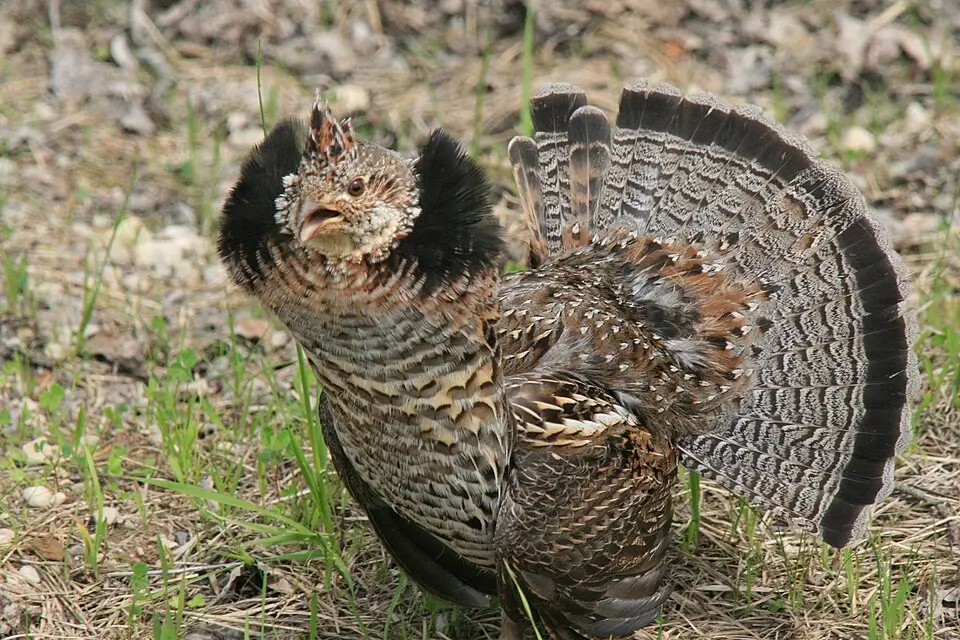
The Ruffed Grouse is a medium-sized bird, generally comparable in size to a small chicken. Adults typically weigh between 17 and 26 ounces, with males being somewhat larger than females on average. The bird displays two main color morphs — a gray phase and a brown (or red) phase — both of which provide exceptional camouflage against the forest floor. This cryptic coloration is one of the bird's most effective survival tools, allowing it to blend seamlessly into leaf litter, bark patterns, and the dappled light of forest understories.
One of the most iconic behaviors of the Ruffed Grouse is the male's "drumming" display, performed most frequently in spring as a means of attracting mates and establishing territory. The male stands on a log, stump, or other elevated surface and beats his wings rapidly in a forward and upward arc, creating a series of deep, accelerating thumps that begin slowly and build to a rapid blur of sound. This drumming can carry surprisingly far through the woods, making it one of the most evocative sounds of the eastern North American forest in early spring.
The Ruffed Grouse is primarily a ground-dwelling bird, foraging for buds, catkins, berries, seeds, ferns, and insects depending on the season. In winter, when deep snow covers the forest floor, grouse rely heavily on the buds and catkins of aspen, birch, and other deciduous trees. They are well adapted to cold climates and have evolved specialized feathering on their feet that acts like natural snowshoes, improving their ability to walk across snow-covered surfaces. In extreme cold, grouse may dive into loose snow to form insulating burrows, using the snow itself as a thermal refuge.
Females nest on the ground, typically at the base of a tree or log, laying clutches of 8 to 14 eggs. Chicks are precocial — meaning they hatch with their eyes open and are capable of moving and feeding themselves very shortly after hatching. This rapid development is critical for survival in environments where ground predators are a constant threat.
Habitat & Range
The Ruffed Grouse is fundamentally a bird of the forest, and its range across North America closely follows the distribution of mixed deciduous and boreal woodlands. The species is found from Alaska and across Canada, south through much of the northern and central United States, including the Appalachian Mountains, the Great Lakes region, New England, and parts of the Pacific Northwest and Rocky Mountain states.
The Ruffed Grouse thrives in young, regenerating forests and mixed-age woodlands, particularly those containing aspen, birch, alder, and a variety of shrub species. Dense understory vegetation is essential for cover and escape from predators. The bird's preference for early successional forest habitats — the kind of young, brushy woodland that grows in the wake of logging, fire, or natural disturbance — makes it something of an indicator species for forest management practices. Where young forests are abundant and diverse in structure, Ruffed Grouse populations tend to be healthy.
Seasonal habitat use shifts considerably throughout the year. In spring, males seek out drumming logs and territories in slightly more open woodland areas. Summer sees hens moving into denser cover to brood their chicks among insect-rich herbaceous vegetation. In fall, grouse often become more wide-ranging as young birds disperse from their natal territories. Winter habitat selection focuses on areas with plentiful buds and catkins in the tree canopy and access to dense conifer stands that offer thermal cover.
Hunting Information
The Ruffed Grouse holds a place of honor in the traditions of North American upland hunting. The bird's tendency to hold tight in thick cover before exploding into fast, twisting flight through the trees makes it one of the most technically demanding game birds to hunt with a shotgun. Hunters often pursue Ruffed Grouse with pointing or flushing dogs — breeds such as English Setters, Brittanys, and German Shorthaired Pointers have long been associated with grouse hunting — though jump-shooting on foot is also a popular method in areas with good bird populations.
Hunting seasons for Ruffed Grouse vary by state and province, reflecting local population dynamics and management goals. Hunters interested in pursuing Ruffed Grouse should always consult current regulations published by their respective state or provincial wildlife agency before heading afield, as seasons, bag limits, and licensing requirements can change from year to year.
Ruffed Grouse in Texas: It is important for Texas hunters and wildlife enthusiasts to understand that the Ruffed Grouse is not a native resident of Texas. The species' natural range does not extend into the Lone Star State, as Texas's landscape — dominated by prairies, deserts, scrublands, and subtropical regions — does not provide the dense, cool, deciduous and boreal forest habitats that Ruffed Grouse require. The Texas Parks and Wildlife Department (TPWD) oversees wildlife and hunting regulations in Texas, and hunters seeking upland bird opportunities in Texas are better directed toward native species such as Northern Bobwhite Quail, White-winged Dove, Mourning Dove, and Wild Turkey, all of which have well-established seasons and populations within the state.
For hunters outside of Texas who wish to pursue Ruffed Grouse, prime destinations include the northern tier states such as Minnesota, Wisconsin, Michigan, Maine, New Hampshire, Vermont, and Pennsylvania, as well as Canadian provinces including Ontario, Quebec, and British Columbia. Many of these destinations offer accessible public lands with healthy grouse populations, particularly in areas actively managed for early successional forest habitat.
Conservation
The Ruffed Grouse has been a subject of significant wildlife management attention across its range. Like many species tied to early successional forest habitats, grouse populations are closely linked to forest management practices. Where timber harvesting creates young, diverse forest structures, grouse often thrive. In areas where forests have matured and closed canopy conditions have reduced understory vegetation, populations may decline.
Conservation organizations such as the Ruffed Grouse Society have played an important role in promoting habitat management practices that benefit not only grouse but a wide array of forest wildlife species. These efforts include advocating for managed timber harvesting, prescribed burns, and other tools that regenerate early successional habitat. Hunters have historically been strong supporters of Ruffed Grouse conservation, recognizing that healthy bird populations depend on proactive habitat stewardship.
Research into Ruffed Grouse population dynamics has also shed light on the well-known "ten-year cycle" — a roughly decennial pattern of population boom and bust observed in many parts of the species' range, particularly in Canada and the northern United States. While the precise causes of this cycle remain a subject of scientific investigation, factors including predator-prey dynamics, habitat conditions, and disease have all been implicated.
Climate change is an emerging concern for Ruffed Grouse populations, particularly in the southern portions of the species' range, where warming temperatures may reduce the extent of suitable boreal and cool temperate forest habitat over time. Monitoring and adaptive management will be important tools for ensuring the long-term sustainability of Ruffed Grouse populations across North America.