Overview
Few animals embody the spirit of the American West quite like the pronghorn (Antilocapra americana). Swift, alert, and uniquely adapted to life on the open range, this remarkable creature is one of North America's most iconic wildlife species. Often mistakenly called an "antelope" — a name that has stuck in popular culture — the pronghorn is, in fact, the sole surviving member of the family Antilocapridae, a lineage that stretches back millions of years on this continent. It is neither a true antelope nor a deer, but rather something entirely its own: a living relic of a prehistoric fauna that once rivaled the savannas of Africa in its diversity and grandeur.
For hunters, wildlife enthusiasts, and conservationists alike, the pronghorn occupies a special place in the American outdoor tradition. Its blazing speed, extraordinary eyesight, and dramatic black-and-white markings make it one of the most exciting large mammals to observe and pursue across the sweeping grasslands and semi-arid plains of North America. Understanding this animal — its biology, its habits, and its place in the ecosystem — deepens our appreciation for one of the continent's most extraordinary evolutionary success stories.
Biological Traits
The pronghorn is a study in superlatives. It is the fastest land animal in the Western Hemisphere and the second fastest land animal on Earth, surpassed only by the cheetah. Unlike the cheetah, however, the pronghorn does not rely on short explosive bursts of speed. Instead, it is built for sustained high-speed travel, capable of maintaining impressive velocities over long distances — a trait that evolved in response to now-extinct predators such as the American cheetah and other Pleistocene hunters that once stalked these plains.
Scientifically classified as Antilocapra americana, the pronghorn is the only living member of its family. The name Antilocapra translates roughly to "antelope goat," reflecting early naturalists' attempts to categorize an animal that defied easy classification. Pronghorns are most closely related to giraffes and okapis within the broader order of even-toed ungulates (Artiodactyla), though they occupy a distinctly North American evolutionary branch.
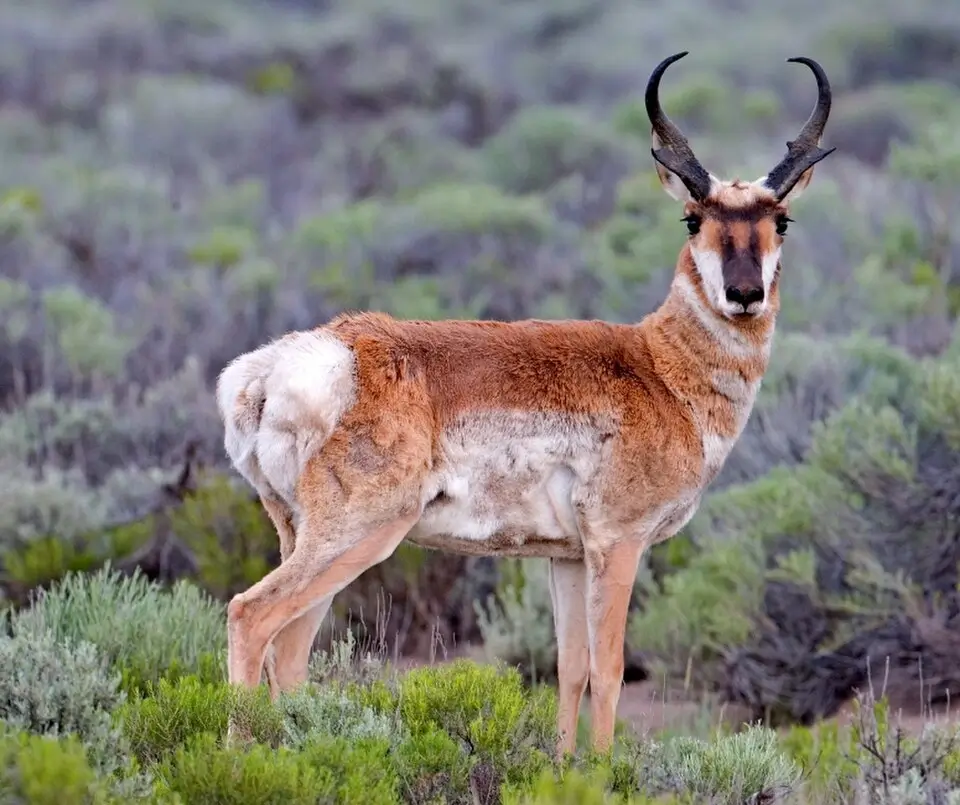
One of the pronghorn's most distinctive biological features is its horn structure — a characteristic so unique it warranted the creation of its own taxonomic family. Unlike the antlers of deer, which are shed and regrown annually from bony structures, or the permanent horns of cattle and true antelopes, the pronghorn possesses pronged, sheath-bearing horns that are shed and regrown each year. The outer sheath is made of keratin (the same protein that forms human fingernails), while the inner core is a permanent bony structure. This combination of features — true horns that are also shed annually — is found nowhere else in the animal kingdom.
Both males and females typically possess horns, though the male's are significantly larger and more prominently pronged. The males, called bucks, display bold black markings on the face and neck, which contrast sharply with their tan-and-white body coloration. The white rump patch is another famous feature: the pronghorn can flare these white hairs outward as a warning signal, flashing a visible alarm to other pronghorns across great distances — a communication system perfectly suited to life in open terrain where visibility is paramount.
The pronghorn's eyes are among the most impressive in the ungulate world. Set wide on the sides of its head, they are proportionally large — roughly the size of an elephant's — giving the animal an extraordinarily wide field of view. This exceptional vision, estimated to be equivalent to eight-power binoculars in terms of resolving power, allows pronghorns to detect movement and potential threats at remarkable distances.
Pronghorns are also notable for their unusual reproductive strategy. Does (females) typically give birth to twins, and the fawns are remarkably precocial — able to outrun a human within days of birth. This rapid development is another adaptation to life in open, exposed environments where slow-maturing young would be highly vulnerable to predation.
Habitat & Range
The pronghorn is quintessentially a creature of open spaces. It thrives in the grasslands, sagebrush flats, desert scrublands, and semi-arid plains that stretch across the interior of North America. Historically, pronghorns ranged across much of the western and central portions of the continent in enormous numbers, rivaling the bison in sheer abundance before the arrival of European settlers.
Today, pronghorns are found primarily across the Great Plains, the intermountain basins of the Rocky Mountain West, and the high desert plateaus of the Southwest. Their range extends from southern Canada through the western United States and into northern Mexico. Key strongholds include Wyoming, Montana, Colorado, New Mexico, Arizona, Nevada, and — of particular relevance to this article — the state of Texas.
In Texas, pronghorns occupy the Trans-Pecos region and the western portions of the Panhandle and High Plains — landscapes characterized by open grasslands, short-grass prairies, and the rugged terrain of far West Texas. This environment, with its vast open vistas and sparse vegetation, suits the pronghorn perfectly. Texas sits at the southern and southeastern edge of the pronghorn's primary range, and the herds that inhabit the Lone Star State represent an important population for the long-term viability of the species across the broader Southwest.
One fascinating and somewhat poignant aspect of pronghorn habitat use is the species' relationship with fences. Because pronghorns evolved on open plains without significant physical barriers, they have not developed the instinct to jump fences as readily as white-tailed deer. Instead, they tend to crawl under wire fences — a behavior that can create challenges in heavily fenced agricultural landscapes. Wildlife managers and landowners in Texas and across the West have increasingly worked to modify fences with raised bottom wires to facilitate pronghorn movement, a conservation measure that has yielded meaningful benefits for local populations.
Hunting Information
Hunting pronghorn is widely regarded as one of the premier experiences available to big game hunters in North America. The combination of challenging terrain, the animal's extraordinary senses, and the thrill of pursuing the continent's fastest land mammal across wide-open country makes a pronghorn hunt an adventure unlike any other.
In Texas, pronghorn hunting occurs primarily in the Trans-Pecos and Panhandle regions, where the species' native range overlaps with accessible hunting lands. Texas Parks and Wildlife Department (TPWD) is the governing body responsible for managing pronghorn hunting in the state, and prospective hunters are strongly encouraged to consult TPWD's official resources for the most current, accurate, and up-to-date information on season dates, licensing requirements, and any applicable regulations.
As with all hunting in Texas, proper licensing is a fundamental requirement, and specific seasons and rules for pronghorn hunting are established by TPWD and are subject to change from year to year based on population assessments and management goals. Because pronghorn populations in Texas are more limited in range and density compared to states like Wyoming or Montana, tags may be issued on a limited or managed basis in certain areas. Hunters interested in pursuing pronghorn in Texas should plan well in advance, connect with TPWD directly, and consider working with a licensed outfitter or landowner who has experience managing pronghorn on Texas properties.
Successful pronghorn hunting typically requires skill in long-range shooting, proficiency in stalking across open terrain, and an understanding of the animal's keen senses and behavioral patterns. Because of the open nature of pronghorn habitat, spot-and-stalk hunting with quality optics is one of the most common and effective strategies. Patience and the ability to close distance without being detected — no easy feat given the pronghorn's eyesight — are essential skills for the pronghorn hunter.
Conservation
The pronghorn's conservation story is one of the great wildlife recovery successes in American history. By the early twentieth century, rampant market hunting, habitat loss, and competition with livestock had reduced pronghorn populations from an estimated tens of millions to fewer than twenty thousand animals — a staggering collapse that brought the species to the brink of extinction.
Through the efforts of conservationists, wildlife managers, and the hunting community working under the North American Model of Wildlife Conservation, pronghorn populations have rebounded dramatically. Today, hundreds of thousands of pronghorns roam across their native range, a testament to what science-based wildlife management and the commitment of hunters and conservationists can achieve together.
In Texas, pronghorn management is an ongoing priority for TPWD, which monitors populations and adjusts hunting regulations accordingly to ensure the long-term health of the state's herds. Challenges remain, including habitat fragmentation, prolonged drought, and the fencing issues mentioned earlier. But the pronghorn's resilience — forged over millions of years of evolution on a demanding continent — gives reason for optimism.
For the hunter, the naturalist, or anyone fortunate enough to watch a pronghorn flash across a West Texas plain in the golden light of early morning, this animal represents something irreplaceable: a living connection to the wild heart of America, a reminder of how much we stand to lose, and how much we have already fought to save.