Overview
When most people think of African or Indian wildlife, they rarely expect to find it roaming freely across the sun-baked plains of South Texas. Yet the nilgai — a massive, striking antelope native to the Indian subcontinent — has established itself as one of the most distinctive and fascinating large game animals in the entire United States. Known locally as the "blue bull," the nilgai (Boselaphus tragocamelus) represents a remarkable chapter in the story of exotic wildlife in North America, blending Old World biology with the wide-open landscapes of the Lone Star State.
Whether you are a wildlife enthusiast captivated by unusual species, a hunter seeking a challenging and rewarding pursuit, or simply a curious reader interested in the natural world, the nilgai offers something compelling for everyone. This guide explores the biology, habitat, hunting culture, and conservation story of one of Texas's most unique and celebrated wild animals.
Biological Traits
The nilgai is classified under the family Bovidae and is the sole member of the genus Boselaphus, making it taxonomically unique among the world's antelopes. Its scientific name, Boselaphus tragocamelus, roughly translates from Latin and Greek to "cow-deer goat-camel," a wonderfully descriptive nod to the animal's unusual, almost composite appearance. Indeed, the nilgai has long puzzled and fascinated observers with its seemingly mismatched body parts.
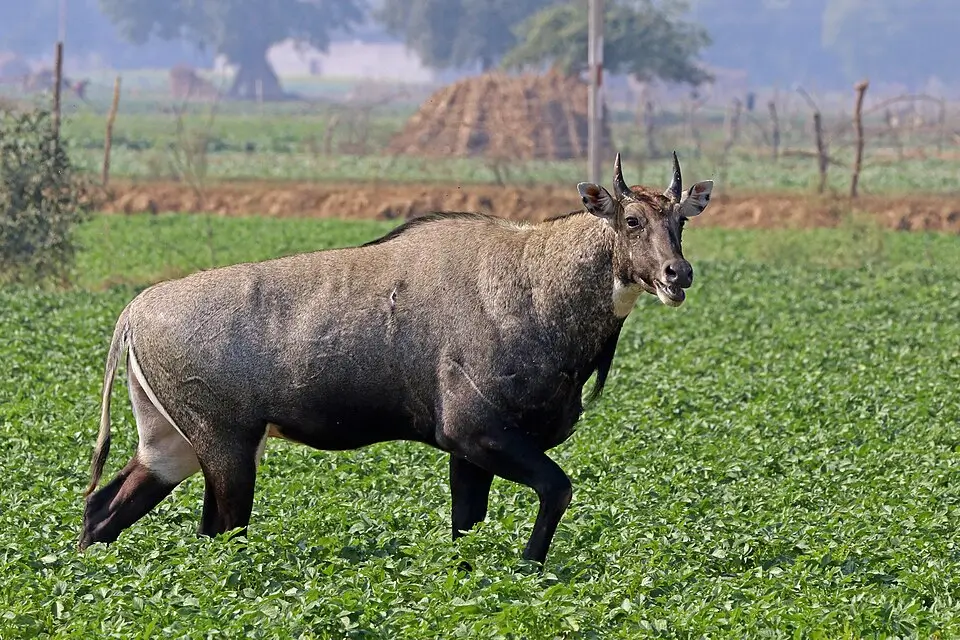
Adult nilgai are the largest antelope species found on the Asian continent and, by extension, one of the largest antelope species now established in the wild in North America. Males, called bulls, are notably larger than females, a trait common to many bovid species. Bulls display a striking blue-gray coat that deepens with age, which is the origin of the animal's popular "blue bull" nickname. Females and younger animals tend to be tawny or light brown in color, providing a degree of camouflage in open grassland environments.
One of the nilgai's most recognizable features is its steeply sloped back, with the hindquarters sitting noticeably lower than the powerful shoulders and neck. This gives the animal a somewhat ungainly silhouette that belies its remarkable athleticism. Nilgai are capable of reaching high speeds and are known for their stamina and endurance, qualities that make them formidable prey for any predator — or hunter.
Male nilgai possess short, conical horns that curve slightly forward. Though modest in length compared to many trophy antelope species, these horns are sturdy and functional. Both sexes feature a distinctive tuft of hair beneath the throat, and males often develop a prominent white patch on the throat as well as white markings on the legs and face, creating a bold contrast against their dark coats.
As members of the family Bovidae, nilgai are ruminants, meaning they have a multi-chambered stomach that allows them to digest tough, fibrous plant material efficiently. They are predominantly grazers and browsers, consuming a wide variety of grasses, shrubs, leaves, and fruits depending on seasonal availability.
Habitat & Range
In their native range across the Indian subcontinent — primarily India, Nepal, and Pakistan — nilgai inhabit open or lightly wooded grasslands, scrub forests, and agricultural edges. They are highly adaptable animals, capable of thriving in semi-arid conditions as well as more productive grassland environments. This adaptability is a key reason why nilgai have been so successful as an introduced species outside their native range.
In Texas, nilgai are concentrated primarily in the southern portion of the state, particularly in the brush country of the Rio Grande Plain and the coastal prairies stretching along the Gulf of Mexico. The vast ranches of South Texas, including areas around the King Ranch — one of the largest ranches in the world — provided the original foundation populations from which Texas nilgai spread and flourished. The warm climate, extensive thorny brush, and open grasslands of this region closely mirror aspects of the nilgai's native South Asian habitat, allowing the animals to adapt with striking success.
Texas sits at the crossroads of multiple ecological zones, bordered by Louisiana to the east, Arkansas to the northeast, Oklahoma to the north, New Mexico to the west, and sharing a long international border with Mexico to the south and southwest along the Rio Grande. This geographic diversity, combined with its immense size of approximately 268,596 square miles, makes Texas uniquely suited to support a wide range of wildlife species, both native and introduced.
Nilgai populations in Texas are largely found on private ranch lands, which encompass the vast majority of land in South Texas. This means that access to nilgai hunting and wildlife observation is typically managed through private landowner agreements, guided hunts, and outfitter operations rather than through public land access.
Hunting Information
Nilgai hunting in Texas has grown into a celebrated tradition among big game hunters, both from within the state and from across the country and world. The blue bull represents a unique opportunity to pursue one of the world's largest antelope species without leaving North American soil, and its reputation as a tough, tenacious animal has only added to its mystique and appeal among serious hunters.
Because nilgai in Texas are classified as exotic or non-native wildlife, they are managed differently from native game species such as white-tailed deer. Hunters interested in pursuing nilgai in Texas should consult the Texas Parks and Wildlife Department (TPWD) for the most current and accurate information regarding license requirements, season dates, and any applicable regulations. The TPWD is the authoritative agency responsible for wildlife management and hunting regulation across the state, and their official resources are the definitive guide for any hunter planning a nilgai hunt.
Nilgai are known among hunters for their exceptional toughness and vitality. These are large, powerfully built animals, and hunters routinely note that nilgai can absorb significant punishment before going down. For this reason, experienced nilgai hunters typically recommend the use of larger caliber rifles and premium, controlled-expansion bullets to ensure clean, ethical harvests. Shot placement is critical, as it is with all large game, and hunters are encouraged to be patient and selective rather than rushing a marginal shot.
Spot-and-stalk hunting is a popular and effective method for pursuing nilgai across the open and semi-open terrain of South Texas. The animals' size makes them visible at long distances, but their keen senses and natural wariness can make a close approach challenging. Hunters may also pursue nilgai from blinds positioned near water sources or natural game trails, particularly during the warmer months when animals regularly visit reliable water.
The nilgai hunt typically takes place on private ranch lands, and most hunters secure access through guided outfitter operations that provide the necessary permissions, knowledge of the local terrain, and logistical support to make a hunt successful. Many South Texas ranches offer nilgai as part of broader exotic game hunting packages, sometimes in combination with native species such as white-tailed deer or wild turkey.
From a culinary standpoint, nilgai meat is widely regarded as excellent table fare. The lean, flavorful venison-like meat is prized by hunters and chefs alike, and a mature blue bull can yield a substantial quantity of high-quality protein. This practical benefit further enhances the appeal of nilgai hunting as a full-experience pursuit that extends well beyond the field.
Conservation
The conservation story of the nilgai is a nuanced and ultimately positive one. On the Indian subcontinent, nilgai remain relatively abundant across much of their historical range, though habitat loss and human-wildlife conflict present ongoing challenges in some areas. The species is currently listed on the IUCN Red List as "Least Concern," reflecting stable wild populations across their native range.
In Texas, the establishment of free-ranging nilgai populations on private ranch lands has created a robust, self-sustaining population that is managed through private landowner stewardship and hunting pressure. This model — often referred to as the "wildlife pays, wildlife stays" approach — has proven highly effective for many exotic species in Texas. When ranchers and landowners can derive economic value from exotic wildlife through hunting and wildlife tourism, they have strong incentives to maintain and improve habitat, control invasive predators, and manage populations responsibly.
The nilgai's success in Texas is a testament to the adaptability of the species and the effectiveness of private land conservation models. While nilgai are not a native Texas species and do interact with native wildlife and vegetation, their management through hunting and private stewardship helps maintain ecological balance on working ranch landscapes.
For hunters and conservationists alike, the nilgai represents an exciting example of how wildlife from around the world can find a sustainable home in Texas, enriching the hunting heritage and biodiversity of the state for generations to come.