Overview
Few animals capture the spirit of the American West quite like the mule deer. With its oversized, mule-like ears, distinctive bounding gait, and impressive antlers, Odocoileus hemionus is one of North America's most recognizable and beloved big game animals. Whether spotted silhouetted against a crimson desert sunset or bounding across a high-elevation mountain meadow, the mule deer occupies a unique and celebrated place in both the natural world and the hearts of hunters, wildlife watchers, and outdoor enthusiasts alike.
Mule deer are named for their characteristically large ears, which bear a striking resemblance to those of a mule. These ears are not merely cosmetic — they serve as highly sensitive acoustic tools that help the animal detect predators across the open terrain it typically inhabits. From the rugged canyonlands of the Colorado Plateau to the high desert basins of Texas, mule deer are a defining feature of western landscapes.
In Texas, mule deer represent a prized and culturally significant game species, particularly in the Trans-Pecos region of far west Texas, where the dramatic terrain of mountains, desert scrub, and wide-open basins provides ideal habitat. Understanding the biology, behavior, habitat needs, and conservation status of mule deer enriches the experience of anyone fortunate enough to encounter them in the wild.
Biological Traits
Mule deer (Odocoileus hemionus) belong to the family Cervidae, the same family that includes elk, moose, caribou, and white-tailed deer. They are closely related to the white-tailed deer (Odocoileus virginianus), with which they share parts of their range, including portions of Texas.
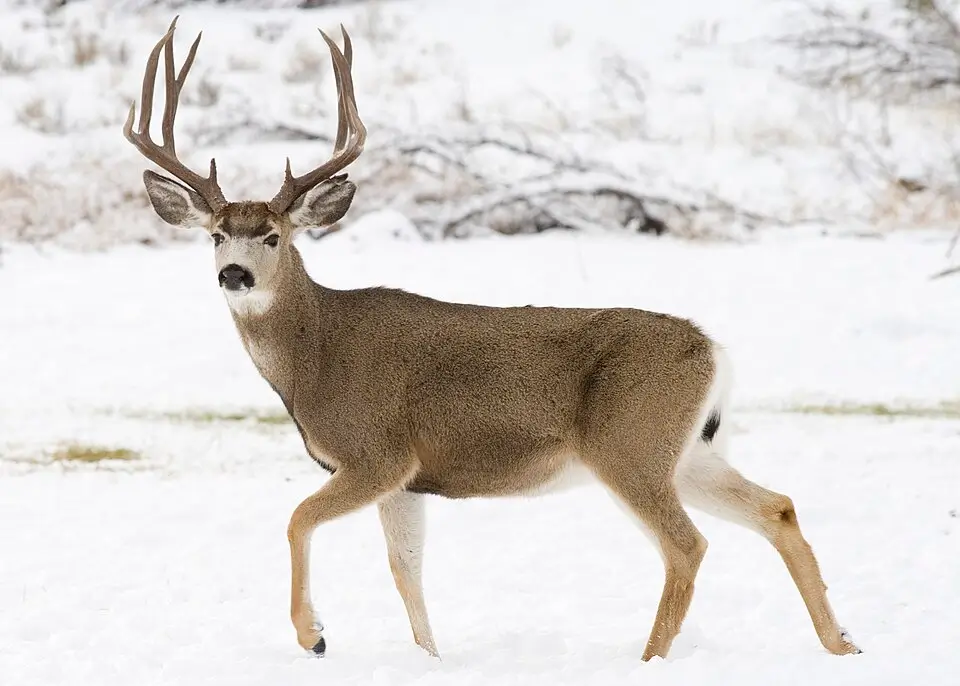
One of the most distinctive physical features of the mule deer is, of course, its large ears. But the species has several other identifying characteristics that set it apart from the white-tailed deer. The mule deer's tail is notably different — it is thin, rope-like, and tipped with black, in contrast to the broad, white-flagging tail of a white-tailed deer. The rump patch of the mule deer is also a pale cream or white, making it relatively easy to identify from a distance.
Mule deer bucks grow antlers that bifurcate, or fork, in a distinctive pattern. Rather than growing from a main beam with tines projecting outward (as is typical in white-tailed deer), mule deer antlers branch into two roughly equal forks, which then each fork again. This gives mature mule deer bucks an impressive, symmetrical rack that is highly sought after by trophy hunters.
Adult bucks can be substantial animals. While body size varies considerably across the species' range and among the numerous recognized subspecies, mature bucks are generally larger than does. Mule deer exhibit sexual dimorphism, with bucks typically being significantly heavier and larger than females. Does are smaller and lack antlers.
Mule deer are well known for their unique method of locomotion called "stotting" or "pronking" — a bounding, all-four-feet-off-the-ground gait that allows them to navigate steep, rocky terrain with remarkable agility. This distinctive movement is unlike the more fluid gallop of a white-tailed deer and is thought to help the animals escape predators in rugged landscapes.
The rut, or breeding season, for mule deer typically occurs in the fall and early winter. During this time, bucks become highly active, sparring with rivals and seeking out receptive does. Fawns are generally born in late spring or early summer, often as twins, and are spotted at birth — a camouflage adaptation that helps them remain hidden from predators in their first weeks of life.
Mule deer are herbivores, feeding on a wide variety of plants depending on the season and the region they inhabit. Their diet includes shrubs, forbs, grasses, and browse — the leaves and twigs of woody plants. In arid environments like west Texas, they are adept at exploiting desert vegetation, including various species of cacti, yucca, and other drought-adapted plants.
Habitat & Range
The mule deer is fundamentally a western North American species. Its range extends from the coastal areas of Alaska and western Canada southward through the Rocky Mountain states, the Great Basin, the Sonoran and Chihuahuan Deserts, and into northern Mexico. In the United States, mule deer are found throughout much of the West, from the Pacific Coast to the Great Plains.
In Texas, mule deer are found primarily in the Trans-Pecos region — the rugged, mountainous, and arid far western portion of the state. This area includes the Chihuahuan Desert and features landscapes of stark beauty: the Davis Mountains, the Guadalupe Mountains, the Chinati Mountains, and the wide desert basins that stretch toward the Rio Grande. The Texas Panhandle also supports a population of mule deer, where the flat to rolling terrain transitions toward the more typical western mule deer country.
Texas sits at the southeastern edge of the mule deer's natural range, and the state's mule deer populations are found in some of the most dramatic and remote landscapes in North America. The Chihuahuan Desert, which extends into far west Texas from Mexico and New Mexico, is one of the largest deserts in North America and provides critical habitat for the region's mule deer herds.
Mule deer are highly adaptable animals. They occupy a broad range of habitats, from low-elevation desert scrubland to high-mountain timber and alpine meadows. They tend to favor edge habitats — areas where different vegetation types meet — which provide both food diversity and cover. Seasonal migration is common in mountain-dwelling populations, with deer moving to lower elevations in winter to avoid deep snow and harsh conditions, then returning to higher ground in summer to take advantage of lush vegetation.
In the desert environments of Texas, mule deer are particularly dependent on access to water sources, especially during the intense heat of summer. Tinajas, or natural rock basins that collect rainwater, stock tanks on ranches, and springs are vital resources for desert mule deer populations.
Hunting Information
Mule deer hunting is a cherished tradition throughout the American West, and Texas is no exception. In far west Texas, pursuing mule deer across the challenging terrain of the Chihuahuan Desert and the rugged mountain ranges is considered one of the most rewarding hunting experiences in the Lone Star State. The combination of dramatic scenery, demanding physical conditions, and the qualities of the animal itself makes mule deer hunting a true adventure.
In Texas, hunting regulations, license requirements, and season dates for mule deer are managed and published by the Texas Parks and Wildlife Department (TPWD). Hunters planning to pursue mule deer in Texas should always consult the most current TPWD Hunting Season Dates and regulations before heading afield, as seasons, bag limits, and license requirements are subject to change from year to year. The 2026–2027 Hunting Season Dates are available through the TPWD website.
Texas requires hunters to hold the appropriate licenses and permits to legally pursue mule deer. As with all hunting in Texas, staying current with TPWD requirements is essential to ensure a legal and ethical hunt. Harvest reporting requirements also apply to various species in Texas; hunters should verify whether mule deer harvest reporting applies to their specific hunt under current TPWD rules.
Mule deer hunting in west Texas is largely conducted on private ranches, many of which offer guided hunting opportunities. The low human population density of the Trans-Pecos region, combined with vast private landholdings, means that access to quality mule deer country often requires working with landowners or outfitters. Some public land hunting opportunities exist as well, including areas within national forests and public lands managed by the Bureau of Land Management in neighboring states, though in Texas itself, public land hunting opportunities for mule deer are more limited.
Glassing — using binoculars and spotting scopes to spot deer from a distance before planning a stalk — is the most common and effective method for hunting mule deer in open western terrain. Still-hunting and stand hunting near water sources are also productive techniques, particularly in the desert environments of west Texas where water is concentrated and predictable.
Conservation
Mule deer conservation is a topic of genuine importance across the species' range. Populations of mule deer have experienced fluctuations over the decades, influenced by factors including habitat change, drought, disease, predator dynamics, and human development. In Texas and across the West, wildlife managers, hunters, ranchers, and conservation organizations work collaboratively to monitor and support mule deer populations.
In the Trans-Pecos region of Texas, the health of mule deer herds is closely tied to the health of the Chihuahuan Desert ecosystem. Invasive grasses, extended drought cycles, and changes in land use all present challenges for maintaining productive mule deer habitat. Water development projects — including the maintenance and development of wildlife water sources on both public and private land — play a particularly important role in supporting desert mule deer populations.
Hunters themselves have historically played a vital role in mule deer conservation. Through license fees, permit revenues, and excise taxes on sporting goods — generated under the Federal Aid in Wildlife Restoration Act (commonly known as the Pittman-Robertson Act) — hunters contribute substantial funding to wildlife management programs across the country, including those that benefit mule deer.
Conservation efforts in Texas are coordinated through the Texas Parks and Wildlife Department, which monitors mule deer populations, conducts research, and works with private landowners to improve habitat and manage harvest sustainably. The agency's commitment to science-based wildlife management ensures that mule deer hunting opportunities are maintained for future generations while the health of the resource is protected.