Overview
Few birds in North America command as much respect from experienced hunters and birdwatchers alike as the Common snipe (Gallinago gallinago). This secretive, elusive shorebird has carved out a legendary reputation over centuries, inspiring not only the word "sniper" — a tribute to the extraordinary skill required to hunt one — but also the timeless prank known as a "snipe hunt," a rite of passage for generations of campers and outdoor enthusiasts. Yet beyond its cultural footprint, the Common snipe is a genuinely fascinating creature, a marvel of evolutionary adaptation that thrives across a remarkable range of wetland environments around the globe.
For hunters, birdwatchers, and wildlife enthusiasts in Texas and across the broader United States, the Common snipe represents a challenging and rewarding pursuit. Its explosive flush, erratic zigzagging flight, and masterful cryptic coloration make it one of the most demanding upland game birds a wingshooter can pursue. Understanding this remarkable bird — its biology, behavior, habitat preferences, and the traditions surrounding its harvest — is the first step toward appreciating why it holds such an enduring place in outdoor culture.
Biological Traits
The Common snipe is a medium-sized wading bird belonging to the family Scolopacidae, the sandpipers and their allies. Its scientific name, Gallinago gallinago, derives from the Latin gallina, meaning "hen," a nod to the bird's somewhat plump, rounded body shape when observed at rest.
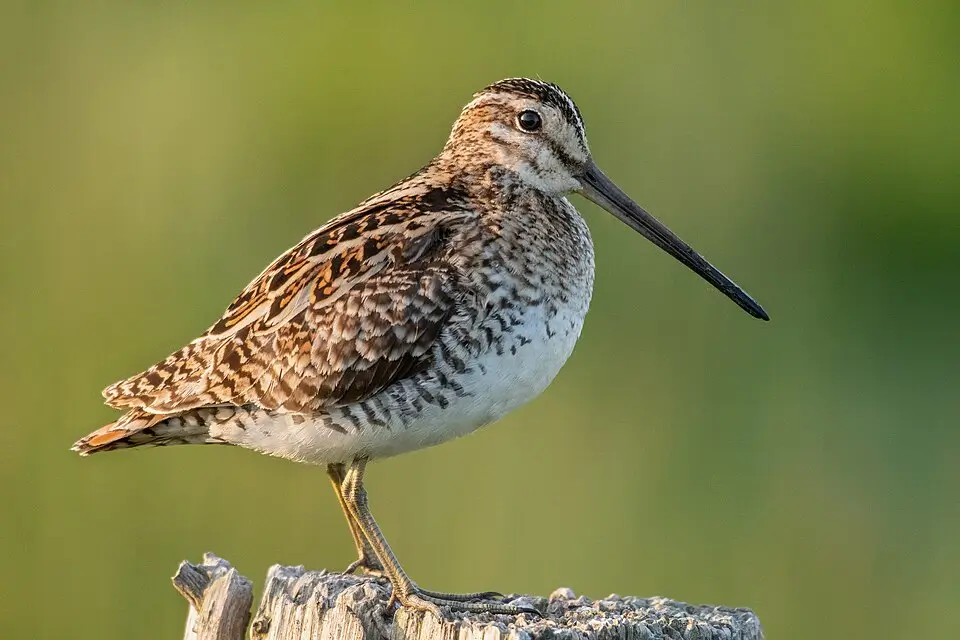
One of the most immediately recognizable features of the Common snipe is its extraordinarily long, straight bill. This remarkable appendage, which can measure nearly a third of the bird's total body length, is a precision feeding instrument. The tip of the bill is highly flexible and richly supplied with sensory nerve endings — a feature known as rhynchokinesis — allowing the bird to detect and grasp invertebrates, worms, and insect larvae deep within soft mud and saturated soil without needing to open its entire bill.
The plumage of the Common snipe is a masterpiece of natural camouflage. Its upperparts are a complex mosaic of rich browns, black, and warm buff tones, with distinctive pale stripes running along the crown and back. This intricate patterning renders the bird virtually invisible when it crouches motionless among grasses, reeds, and marsh vegetation. The underparts are generally paler, streaked and barred with brown. The eyes are set high and far back on the head, giving the snipe an exceptionally wide field of vision — a critical survival adaptation that allows it to watch for approaching predators even while probing face-down into mud.
In terms of overall size, the Common snipe is a compact, sturdy bird, typically measuring between 25 and 27 centimeters in length with a wingspan ranging from approximately 44 to 47 centimeters. The legs are relatively short and greenish-grey in color, suited for wading through shallow marshes and wet meadows rather than prolonged walking on dry land.
One of the most extraordinary behaviors associated with the Common snipe is its aerial display, known as "drumming" or "winnowing." During the breeding season, males climb high into the sky and then dive steeply at an angle, causing the outer tail feathers to vibrate in the rushing air. This produces a haunting, resonant sound — a hollow, pulsating hum — that carries remarkably far across open marshland. This display serves both to attract mates and to establish territorial boundaries, and it is one of the more memorable sounds a naturalist can encounter in a northern wetland at dusk.
When flushed by a hunter or predator, the Common snipe launches itself skyward in an explosive burst, immediately beginning the rapid, erratic, zigzagging flight that has made it the stuff of legend among wingshooters. This evasive flight pattern, combined with the bird's impressive speed, makes it one of the most difficult targets in all of wingshooting — a challenge that has historically demanded elite marksmanship and indeed gave rise to the term "sniper" for a skilled marksman.
Habitat & Range
The Common snipe enjoys one of the widest distributions of any shorebird in the world. It breeds across a vast swathe of the Northern Hemisphere, from Iceland, the British Isles, and Scandinavia, eastward through Russia and Siberia, and across northern North America. It is migratory across much of its range, wintering in sub-Saharan Africa, South Asia, Southeast Asia, and throughout the southern United States, Central America, and South America.
Within North America, the Common snipe is a familiar winter visitor and migrant across the lower 48 states. Its preferred habitats are consistently associated with moisture: freshwater and brackish marshes, wet meadows, bogs, fens, muddy riverbanks, flooded agricultural fields, rice paddies, and the edges of ponds and lakes. The bird requires soft, probe-able substrate for feeding and dense, low-growing vegetation for cover and roosting. It is rarely found in dry upland settings.
Texas is particularly well-positioned as snipe habitat, given its enormous geographic diversity and its location along one of North America's major migratory flyways. The state's vast coastal marshes, inland prairie potholes, flooded rice fields in the upper Gulf Coast region, river bottoms, and wetland complexes provide superb conditions for wintering and migrating snipe. From the piney woods of East Texas to the coastal prairies and marshes stretching along the Gulf of Mexico, Common snipe can be found wherever suitable wetland conditions exist during the fall and winter months. Texas's mild winters make it an especially attractive destination for wintering snipe that have moved south from their breeding grounds in Canada and the northern United States.
The state's Rio Grande delta region, its network of coastal bays and estuaries, and its vast inland reservoirs and river systems all contribute to making Texas one of the premier destinations in the country for snipe hunters and shorebird enthusiasts alike. The sheer scale of the state — covering more than 268,000 square miles — means that suitable snipe habitat is widely distributed and accessible across multiple regions.
Hunting Information
The Common snipe has a long and storied history as a game bird in both North America and Europe. In the 18th and 19th centuries, snipe hunting was considered among the most demanding and prestigious forms of wingshooting, attracting aristocrats, military officers, and serious sportsmen who prized the bird's legendary difficulty as a target. The best snipe hunters of the era were called "snipers" — a term that later entered military vocabulary to describe expert marksmen.
Today, snipe hunting remains a respected and challenging pursuit for dedicated wingshooters. In Texas, the Texas Parks and Wildlife Department (TPWD) oversees the management of migratory game birds, including the Common snipe. Snipe are federally managed migratory birds, meaning that hunting regulations — including season dates, bag limits, and licensing requirements — are set in coordination between the U.S. Fish and Wildlife Service and state wildlife agencies.
Hunters planning to pursue Common snipe in Texas should consult the most current Texas Parks and Wildlife Department hunting regulations for up-to-date season dates, daily bag limits, and licensing requirements, as these details are subject to change each regulatory year. The TPWD provides comprehensive annual hunting guides and online resources, including the official season dates publication, which outlines all migratory bird seasons in detail.
As with all migratory bird hunting in the United States, snipe hunters in Texas are required to comply with both federal and state regulations. This typically includes possessing a valid Texas hunting license as well as a federal Migratory Bird Hunting and Conservation Stamp (commonly known as the Federal Duck Stamp), though hunters are always advised to verify current requirements directly with the TPWD.
From a practical standpoint, hunting Common snipe requires patience, good boots, and a willingness to wade through challenging terrain. Hunters typically work wet fields, flooded pastures, and marsh edges on foot, flushing birds from cover. Because snipe hold tight and flush explosively, a close-working flushing dog can be invaluable. Traditional snipe dogs include certain spaniel breeds and Labrador Retrievers, which excel at working through heavy, wet vegetation. Given the bird's erratic flight, open-choked shotguns and lighter shot loads are generally preferred, though individual choice varies.
Conservation
The Common snipe is currently listed as a species of Least Concern on the IUCN Red List, reflecting its wide global distribution and large overall population. However, like many wetland-dependent species, it faces ongoing pressures from habitat loss driven by wetland drainage, agricultural intensification, and changes in land use across its breeding and wintering ranges.
Conservation efforts for the Common snipe are closely tied to broader wetland conservation initiatives. Programs that protect, restore, and enhance wetland habitats — including those administered through the North American Wetlands Conservation Act, Ducks Unlimited, and various state and federal land management agencies — directly benefit snipe populations along with a host of other wetland wildlife. In Texas, the TPWD and its partners are active in wetland habitat management, which supports migratory shorebirds and waterfowl alike.
Hunters themselves have historically played an important role in wetland conservation through the purchase of Federal Duck Stamps and support for conservation organizations. The revenue generated by hunting licenses, stamps, and excise taxes on sporting equipment funds critical wildlife management programs that benefit the Common snipe and countless other species.
Responsible harvest practices, adherence to established bag limits, and respect for protected areas all contribute to ensuring that Common snipe populations remain healthy and that future generations of hunters and wildlife enthusiasts will continue to enjoy this extraordinary bird's presence in the wetlands of Texas and beyond.