Overview
Few animals capture the rugged spirit of the American Southwest and Latin America quite like the collared peccary. Often mistaken for a wild pig or feral hog by newcomers to the outdoors, this compact, tusked mammal is actually a unique species in its own right — one with a rich evolutionary history, remarkable social behavior, and a growing reputation among hunters and wildlife enthusiasts alike. Known scientifically as Dicotyles tajacu, the collared peccary stands as one of the most widely distributed large mammals in the Western Hemisphere, ranging from the American Southwest all the way down through Central and South America. In Texas, this animal holds a particularly special place in the hunting culture and natural heritage of the state.
Whether you encounter a herd of collared peccaries crashing through the brush of the South Texas Plains or catch a glimpse of one foraging along a rocky desert wash in the Trans-Pecos region, there is no denying the energy and presence of these animals. They are bold, social, and deeply adapted to some of the harshest environments in North America. For hunters, wildlife watchers, and nature lovers, understanding the collared peccary means appreciating one of the continent's most distinctive and underrated wild animals.
Biological Traits
The collared peccary (Dicotyles tajacu) belongs to the family Tayassuidae — a family distinct from the Old World pigs of the family Suidae, despite the superficial resemblance. While both groups share a common ancestor deep in evolutionary time, peccaries are a New World lineage that diverged millions of years ago, developing their own suite of unique characteristics. Common names for the collared peccary vary widely across its range. In the American Southwest and Texas, it is most often called the javelina — a name derived from the Spanish word for javelin or spear, referring to the animal's sharp, straight canine teeth. In other parts of Latin America, it is known as the musk hog, skunk pig, or simply the peccary.
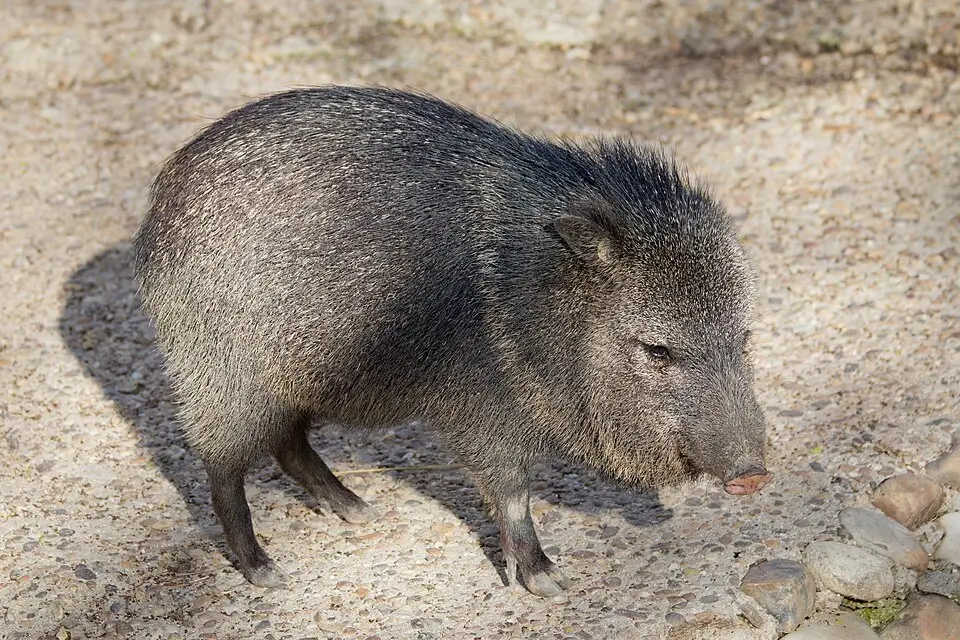
In terms of physical appearance, the collared peccary is a medium-sized, stout-bodied mammal. Adults typically weigh between 35 and 60 pounds, though individual size can vary depending on geography and available food resources. The body is covered in coarse, grizzled gray-black hair with a distinctive pale or whitish band of fur that encircles the neck and shoulders — giving the species its common name, the "collared" peccary. This collar is one of the easiest field identification marks, making it straightforward to distinguish from feral hogs, which lack this feature.
The head of the collared peccary is large and somewhat wedge-shaped, tapering to a mobile, cartilaginous snout used for rooting and foraging. The canine teeth, which are enlarged into short, sharp tusks, are perhaps the most iconic feature of the animal. Unlike the curved, upward-sweeping tusks of wild boars, the javelina's tusks are relatively straight and interlock in a way that allows for a powerful, shearing bite. These tusks are used both in defense and in competition with other individuals within social groups.
One of the most notable anatomical features of the collared peccary is a large scent gland located on the lower back, just above the tail. This gland produces a musky secretion that peccaries use for communication, group recognition, and territorial marking. Social groups routinely rub their faces and necks against one another and against the dorsal gland as a form of bonding. This behavior — along with the strong musk odor the gland can emit when the animal is alarmed or excited — has contributed to the animal's colorful reputation in folklore and hunting culture.
Collared peccaries are highly social animals, typically living in groups called herds or squadrons that can range from just a handful of individuals to over twenty animals. These groups provide safety in numbers, helping individuals watch for predators such as mountain lions, coyotes, bobcats, and large raptors. Communication within the herd is complex, involving vocalizations — including barks, coughs, and tooth-chattering — as well as scent marking and body posturing.
The diet of the collared peccary is broadly omnivorous, though plant material forms the bulk of their intake. In the arid regions of Texas and the Southwest, they rely heavily on prickly pear cactus (genus Opuntia), which provides both moisture and nutrition in desert environments. They also consume roots, tubers, seeds, fruits, grasses, and occasionally invertebrates. Their ability to eat prickly pear — spines and all — is a testament to their toughness and adaptability.
Reproduction in the collared peccary occurs year-round, with peaks in certain seasons depending on local conditions. Females typically give birth to litters of one to four young, though twins are most common. The young are precocial — meaning they are relatively well-developed at birth and can follow the herd within days. Both parents and other herd members may play roles in the socialization and protection of young animals.
Habitat & Range
The collared peccary has one of the broadest ranges of any large mammal in the Americas. Its territory stretches from the deserts of Arizona, New Mexico, and Texas in the United States, through Mexico, Central America, and across the majority of South America, reaching as far south as northern Argentina. This impressive range reflects the animal's extraordinary adaptability to a wide variety of ecosystems.
In the United States, Texas represents the heartland of collared peccary country. The species is found across much of the western and southern portions of the state, particularly thriving in the Chihuahuan Desert of the Trans-Pecos region, the thornscrub and mesquite brushlands of the South Texas Plains, and the Edwards Plateau in the Hill Country. These landscapes — characterized by rocky terrain, sparse but diverse vegetation, and seasonal water availability — provide the ideal conditions for javelina populations to flourish.
Across their broader range, collared peccaries inhabit tropical and subtropical forests, dry scrublands, grasslands, and montane environments. They are generally associated with areas that offer dense cover for shelter and escape, reliable access to water or moisture-rich food sources, and diverse plant communities that support their varied diet.
Hunting Information
In Texas, the collared peccary — known to nearly every hunter in the state as the javelina — is a legal and popular game animal. The Texas Parks and Wildlife Department (TPWD) manages javelina as a game species, and hunters pursuing these animals in Texas should consult TPWD's current regulations for the most up-to-date information on season dates, license requirements, and any applicable reporting requirements.
As of the most recent available information from TPWD, javelina hunting is a recognized and valued part of the Texas outdoor tradition. Hunters are encouraged to check the TPWD website for the latest season frameworks, as regulations can vary by county and management zone. The TPWD also administers mandatory harvest reporting for certain species in specific counties, and hunters should always verify whether reporting is required for javelina in their hunting area.
Javelina hunting in Texas offers a challenging and rewarding experience. These animals have keen senses of smell — their primary defense mechanism — and hunting them successfully requires careful attention to wind direction and scent control. Their eyesight is generally considered moderate, but their hearing and social alarm systems make a herd of spooked peccaries a memorable experience in the field. Many hunters pursue javelina with rifle, muzzleloader, or archery equipment, and the animals are often hunted in conjunction with deer, quail, and other species during the winter months.
For visiting hunters from out of state, Texas is an exceptional destination for javelina hunting. The combination of accessible public and private land, cooperative outfitters and guides, and the sheer abundance of animals in key regions makes the Lone Star State the premier location in the U.S. for pursuing this species. Guided hunts on private ranches in the South Texas brush country and the Trans-Pecos are particularly renowned.
Conservation
The collared peccary is currently listed as a species of Least Concern by the International Union for Conservation of Nature (IUCN), reflecting the animal's widespread distribution and generally stable populations across its range. While localized pressures such as habitat loss, drought, and hunting pressure can affect regional populations, the species as a whole remains abundant and resilient.
In Texas, TPWD actively manages javelina populations through regulated hunting, population monitoring, and habitat stewardship programs. The managed harvest of javelina contributes to wildlife conservation funding through the purchase of hunting licenses and associated fees — a cornerstone of the North American Model of Wildlife Conservation. Landowners and managers in javelina habitat who maintain native brush, water sources, and diverse plant communities play a vital role in sustaining healthy populations of this iconic animal.
Collared peccaries also serve important ecological roles in their native habitats. As consumers of large quantities of plant material, they influence vegetation structure and seed dispersal patterns. Their rooting activity can turn over soil in ways that benefit certain plant species, and as prey animals, they support populations of large predators throughout their range.