Overview
Few birds in North America command the same level of awe and admiration as the wood duck. Known scientifically as Aix sponsa — a Latin phrase often translated to mean "waterfowl in bridal dress" or "betrothed duck" — this remarkable species has captivated naturalists, hunters, birdwatchers, and outdoor enthusiasts for centuries. With its jewel-like plumage, acrobatic flight through forested corridors, and fascinating nesting habits, the wood duck stands apart from virtually every other waterfowl species on the continent. It is a bird that seems almost too beautiful to be real, yet it thrives across a wide range of North American wetlands, river bottoms, and wooded swamps.
The wood duck's story is also one of remarkable resilience. At one point in American history, this species faced serious population pressures due to habitat loss and unregulated hunting. Through dedicated conservation efforts, protective legislation, and a nationwide commitment to wetland preservation, the wood duck has rebounded spectacularly and today represents one of wildlife management's great success stories. For hunters and non-hunters alike, encountering a wood duck — whether on a misty autumn pond or gliding silently through a canopy of hardwoods — is a genuinely memorable experience.
In South Dakota, the wood duck occupies a special niche within the state's rich and varied wildlife tapestry. While South Dakota is perhaps most famous for its world-class pheasant hunting, the state also offers exceptional waterfowl opportunities across its diverse landscapes, including forests, river bottoms, grasslands, and sprawling wetlands along the Missouri River system. The wood duck is very much a part of that story.
Biological Traits
The wood duck (Aix sponsa) belongs to the family Anatidae and is one of only a handful of North American duck species that regularly nests in tree cavities. This unique habit sets it apart from most dabbling and diving ducks, which typically nest on or near the ground. The wood duck is classified in the perching duck group, and its feet feature sharp claws well-suited for gripping bark and branches — an adaptation that allows it to navigate the wooded environments it calls home.
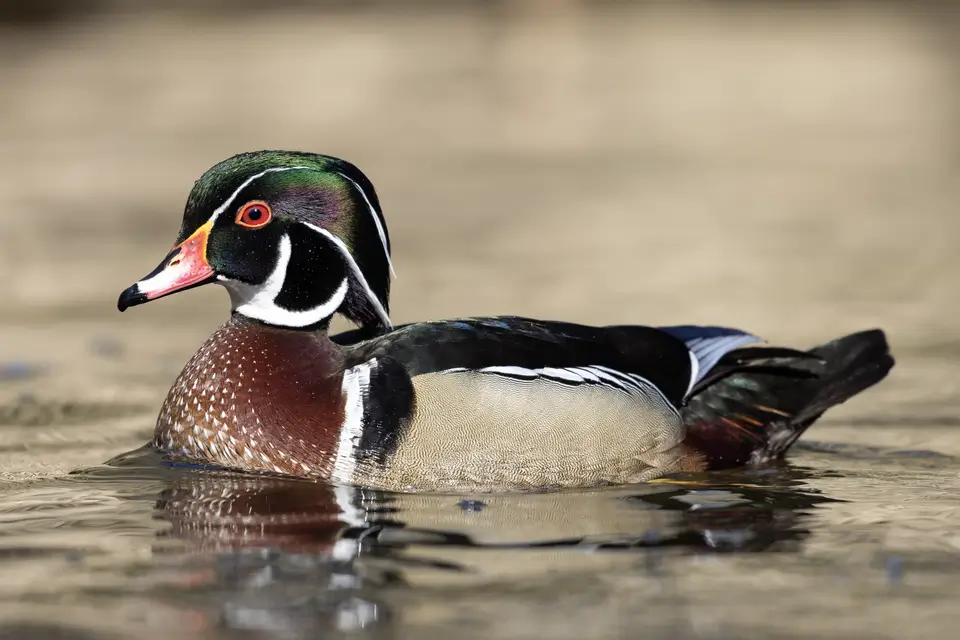
The male wood duck is widely regarded as one of the most visually spectacular birds in the world. His breeding plumage is a breathtaking mosaic of iridescent greens, purples, chestnuts, whites, and blacks, with a distinctive swept-back crest and vivid red eyes. The intricate patterning seems almost hand-painted, with precise white lines delineating the face and throat. The female, by contrast, wears the more subdued earth tones typical of many female ducks, featuring a grayish-brown body accented by a distinctive white teardrop-shaped eye ring and a subtle crest. While less flamboyant than the male, the female wood duck has her own quiet elegance and is easily identifiable in the field.
Wood ducks are medium-sized ducks, generally measuring between 18 and 21 inches in length with a wingspan that typically ranges from 26 to 29 inches. They are agile, fast fliers capable of navigating through dense woodland at impressive speed, a skill that makes them particularly challenging — and thrilling — targets for waterfowl hunters.
One of the most remarkable aspects of wood duck biology is their nesting behavior. Females lay clutches of eggs — often ranging from 9 to 14 eggs — inside natural tree cavities or nest boxes, sometimes at considerable height above the ground or water. Shortly after hatching, the downy ducklings must make a dramatic leap from the nest cavity, sometimes falling 50 feet or more to the forest floor or water below. The chicks are remarkably resilient and bounce or tumble to safety with little apparent injury. This extraordinary beginning to life in the wild is one of nature's more astonishing spectacles.
Wood ducks are omnivores, feeding on a diverse diet that includes acorns, seeds, fruits, aquatic plants, insects, and other invertebrates. Their fondness for acorns in particular ties them closely to mature bottomland hardwood forests. During the fall, wood ducks will congregate near stands of oak trees to feast on the seasonal mast crop, a behavior that is well known to experienced hunters and wildlife observers.
Habitat & Range
The wood duck is primarily a bird of the eastern and central United States, though its range extends across much of North America. It thrives in forested wetlands, wooded swamps, beaver ponds, slow-moving streams, and river floodplains where mature trees provide nesting cavities and where water offers both food and shelter. The species shows a strong preference for areas where forest and water intersect — places where overhanging branches shade calm pools and where fallen logs provide roosting and loafing opportunities.
In the western part of its range, including South Dakota, wood ducks are found primarily along forested river corridors and wooded stream edges. The Missouri River and its associated tributaries, oxbows, and backwaters provide important habitat corridors for wood ducks moving through the Great Plains. South Dakota's river bottoms, lined with cottonwoods, willows, and other riparian trees, offer the kind of sheltered, wooded wetland environment that wood ducks require for successful nesting and rearing of young.
Wood ducks are migratory, generally moving south in autumn and returning north in spring, though some populations in milder climates may be partially resident year-round. During migration, they may concentrate in wetlands, flooded timber, and managed impoundments, making them accessible to hunters across a wide geographic area. South Dakota, situated in the Central Flyway, serves as an important corridor for migratory waterfowl of many species, including wood ducks filtering through on their seasonal journeys.
The widespread installation of nest boxes throughout the 20th century has been a significant factor in expanding and stabilizing wood duck populations. These artificial cavities have helped compensate for the loss of old-growth timber that once provided abundant natural nesting sites, and wood ducks have adopted them enthusiastically across much of their range.
Hunting Information
For waterfowl hunters, the wood duck represents one of the most prized and exciting quarry species available. Their spectacular beauty, their preference for intimate, wooded settings, and their swift, agile flight combine to make them a uniquely challenging and rewarding bird to pursue. Hunting wood ducks typically involves early morning forays into flooded timber, beaver swamps, and wooded creek bottoms — environments that are often as memorable for their atmospheric beauty as for the hunting itself.
South Dakota is a state with a proud and deeply ingrained hunting heritage. The South Dakota Game, Fish and Parks agency oversees a broad range of hunting opportunities across the state's diverse landscapes, which include forests, river bottoms, grasslands, wetlands, and the vast Missouri River reservoir system. Waterfowl hunting is an important part of that tradition, and wood ducks can be encountered by hunters working the timbered river bottoms and wooded wetlands that form critical habitat corridors across the state.
Hunters interested in pursuing wood ducks in South Dakota should consult the South Dakota Game, Fish and Parks for current season dates, bag limits, and licensing requirements, as regulations are updated annually and can vary by zone and season. In general, waterfowl hunters in the United States are required to possess both a state hunting license and a Federal Duck Stamp, and all migratory bird hunters must be registered with the Harvest Information Program (HIP). These requirements help ensure sustainable harvest and support ongoing wildlife management and conservation efforts.
Successful wood duck hunting often involves careful scouting to identify areas where birds are feeding, roosting, or traveling between water bodies. Decoys, particularly small spreads featuring wood duck decoys or a mix of species, can be effective in drawing birds into range. Wood duck calls — featuring the distinctive squealing whistle of the hen — can also be useful in attracting birds, particularly during early season hunting when birds are still grouped and responsive to calling.
Safety, ethical harvest, and respect for private and public land are cornerstones of responsible waterfowl hunting in South Dakota and across the country. Hunters are encouraged to familiarize themselves with all applicable regulations before heading afield.
Conservation
The wood duck's conservation journey is one of the most instructive and inspiring stories in American wildlife management. By the late 19th and early 20th centuries, a combination of unrestricted market hunting and widespread logging of bottomland hardwood forests had drastically reduced wood duck populations across much of their range. There were genuine fears that the species might follow the path of the passenger pigeon toward extinction.
The passage of the Migratory Bird Treaty Act of 1918 provided critical federal protection for wood ducks and other migratory birds, effectively ending the era of unregulated harvest. Combined with the restoration of wetland habitats and the proliferation of nest box programs undertaken by conservation organizations, government agencies, and private landowners throughout the 20th century, wood duck populations recovered remarkably well. Today, the wood duck is considered one of the most abundant waterfowl species in North America, a testament to what thoughtful, science-based management and broad public engagement can achieve.
Ongoing conservation priorities for wood ducks include the protection and restoration of bottomland hardwood forests, the maintenance and expansion of nest box programs, and the preservation of high-quality wetland habitats. In South Dakota and across the Central Flyway, wetland conservation remains a vital concern, as these habitats support not only wood ducks but a vast array of other wildlife species that depend on healthy aquatic ecosystems.
Organizations such as Ducks Unlimited, the U.S. Fish and Wildlife Service, and state wildlife agencies continue to invest in habitat conservation and population monitoring programs that benefit wood ducks and waterfowl broadly. Hunters, through the purchase of licenses, stamps, and donations to conservation organizations, play a meaningful and direct role in funding these efforts and ensuring that future generations will have the opportunity to experience this extraordinary bird in the wild.