Overview
Few animals capture the spirit and grandeur of the American West quite like the American bison (Bison bison). Standing as the largest land mammal in North America, the bison is a symbol of resilience, cultural heritage, and the vast, windswept landscapes that define the heartland of the continent. Once roaming the continent in staggering numbers, the bison's story is one of dramatic decline and remarkable recovery — a conservation tale that has become a cornerstone of wildlife management in the United States.
In states like South Dakota, which lies at the heart of the Great Plains and carries deep ties to the Dakota Sioux people who have long shared the land with these magnificent animals, the bison holds a significance that goes far beyond biology. It is woven into the fabric of history, culture, and the outdoor identity of the region. Whether you encounter one thundering across a prairie landscape or standing stoically in the golden light of a late afternoon sun, the American bison commands respect and admiration like few creatures on earth.
This article explores the biology, habitat, history, hunting traditions, and conservation status of this extraordinary animal — one that came back from the brink to once again roam the grasslands of North America.
Biological Traits
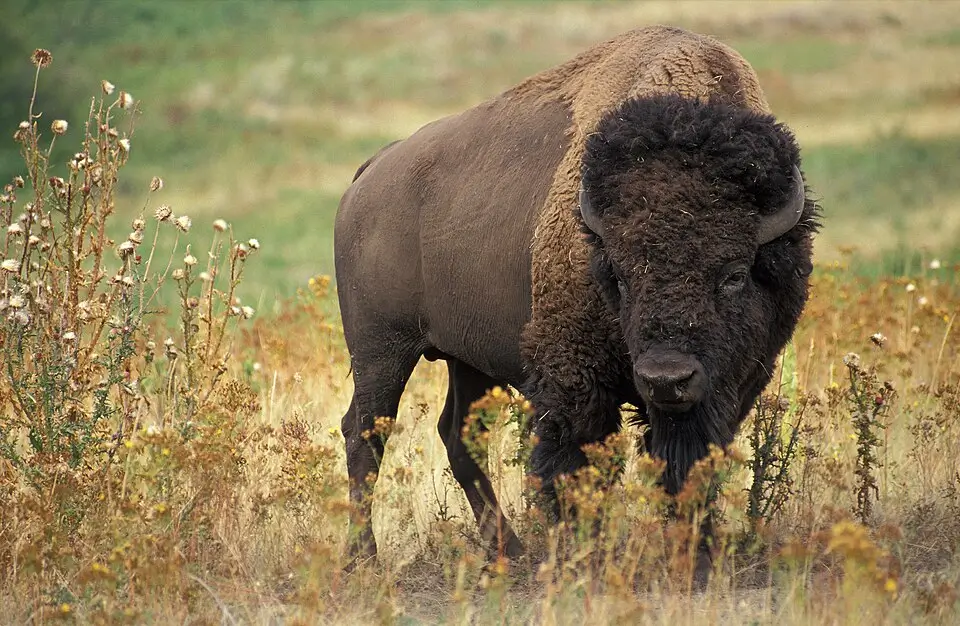
The American bison (Bison bison) belongs to the family Bovidae and is closely related to domestic cattle, sharing the subfamily Bovinae. It is the heaviest land animal in North America. Adult bulls are impressively large, typically weighing between 1,000 and 2,000 pounds, though some exceptional individuals can exceed that range. Cows are considerably smaller, generally ranging from 800 to 1,000 pounds. Despite their immense bulk, bison are surprisingly agile and can run at speeds of up to 35 miles per hour.
Bison are immediately recognizable by their distinctive physical profile: a massive, low-slung head, a pronounced shoulder hump formed by elongated vertebral spines, and a thick, shaggy coat that is especially dense around the head, neck, and forequarters. This heavy frontward mane gives the bison a powerful, almost prehistoric appearance that is unlike any other North American animal. Both males and females possess short, curved horns, though those of the bulls tend to be larger and more robust.
The coat of a bison serves a vital purpose beyond aesthetics. During winter months, the dense fur provides excellent insulation against the brutal cold of the northern plains. In spring and early summer, bison undergo a dramatic molt, shedding large patches of their winter coat, which gives them a somewhat ragged appearance during the transitional season. By late summer, a sleek, darker coat begins to emerge, preparing the animal for the cold months ahead.
Bison are social animals, traditionally living in large herds that were once composed of millions of individuals. Today, herds are considerably smaller, but the animals retain their deeply ingrained social behaviors. Cows and their calves typically form the core of herd structure, while mature bulls tend to live apart in smaller bachelor groups for much of the year, rejoining the main herd during the late summer rut. Calves, often called "red dogs" due to their distinctive orange-red coloration at birth, are born in spring and quickly become active within hours of birth.
The rut occurs primarily in July and August, during which bulls engage in dramatic displays of dominance — bellowing, wallowing in dust, and clashing heads with rival males. These encounters can be intense but rarely result in serious injury, as the thick skull and powerful neck of the bison are well-adapted for such confrontations.
Bison are herbivores and grazers, with a diet consisting primarily of grasses, sedges, and other low-growing vegetation. Their large, powerful digestive systems allow them to extract nutrition from tough, fibrous plant material that other ungulates might not efficiently process. Historically, their grazing patterns played a crucial role in shaping the ecology of the Great Plains, promoting grassland diversity and creating habitat for a wide array of other species.
A bison's lifespan in the wild is generally around 15 to 20 years, with individuals in managed herds sometimes living slightly longer under protected conditions.
Habitat & Range
The American bison is quintessentially a creature of open grasslands and prairies. Historically, the species ranged across an enormous swath of North America, from the eastern seaboard to the Rocky Mountains, and from Canada's boreal forests south into northern Mexico. The heart of bison country, however, was always the Great Plains — a vast inland sea of grass stretching across what is now the central United States and Canada.
South Dakota sits squarely within this historic range. As a landlocked state in the North Central region of the United States and a defining part of the Great Plains, South Dakota represents prime bison country in both geographic and ecological terms. The rolling grasslands, river bottoms, and open landscapes that define much of the state are precisely the habitats that bison have thrived in for millennia.
Bison are well-adapted to the extremes of the Great Plains climate, tolerating both the scorching summers and the bitter winters that characterize the region. Their ability to use their massive heads as snowplows — sweeping snow aside to access the grasses beneath — allows them to survive winters that would challenge less-adapted grazers.
Today, free-ranging and semi-managed bison herds can be found across a number of locations in South Dakota and neighboring states. Custer State Park in the Black Hills of South Dakota is home to one of the largest publicly-owned bison herds in North America, a living testament to the species' enduring connection to the region.
Hunting Information
Bison hunting carries a rich and complex history in North America. For the Dakota Sioux and other Indigenous peoples of the Great Plains, bison were the foundation of life itself — providing food, clothing, tools, and spiritual sustenance. The traditional bison hunt was not merely a subsistence activity but a ceremonial and communal event of deep cultural importance.
Today, bison hunting opportunities in the United States exist primarily through carefully managed programs on private ranches, tribal lands, and select public or state-managed properties. These hunts are typically limited in number to ensure the long-term health and sustainability of bison populations.
In South Dakota, a state renowned for its diverse hunting opportunities across a variety of landscapes — including forests, river bottoms, grasslands, wetlands, and the vast Missouri River reservoir system — bison hunting may be available through specific managed programs. South Dakota Game, Fish, and Parks oversees hunting in the state and manages a wide variety of game animals across the state's diverse ecosystems. Prospective bison hunters in South Dakota are encouraged to contact South Dakota Game, Fish, and Parks directly for the most current and accurate information regarding any available bison hunting licenses, permits, or season dates, as these programs are highly regulated and subject to change.
Due to the bison's size, hunters pursuing these animals should be well-prepared both in terms of equipment and physical readiness. A successful bison hunt requires proper firearms or archery equipment suited for large, thick-skinned game. Processing a bison in the field is a significant undertaking given the animal's enormous size, and hunters should plan accordingly, often with the support of experienced guides or outfitters.
The experience of hunting bison — whether on the open grasslands of South Dakota or elsewhere in their range — is widely considered one of the most meaningful and historically resonant outdoor pursuits available to American hunters today.
Conservation
The conservation history of the American bison is arguably the most dramatic wildlife recovery story in North American history. By the late 19th century, a combination of commercial hunting, habitat loss, and deliberate extermination campaigns had reduced the once-enormous bison population from an estimated 30 to 60 million animals to fewer than 1,000 individuals. The species teetered on the edge of extinction.
The recovery of the bison is a direct result of coordinated conservation efforts that began in the late 1800s and have continued to the present day. Early conservationists, including figures like President Theodore Roosevelt and William Hornaday, recognized the crisis and took action to protect and rebuild bison herds. The establishment of protected reserves and breeding programs proved pivotal in pulling the species back from the brink.
Today, approximately 500,000 bison live in North America, distributed across a combination of conservation herds, private ranches, tribal lands, and public preserves. While this is a fraction of the species' historic numbers, it represents an extraordinary achievement in wildlife management. The American bison was designated the official national mammal of the United States in 2016, a recognition of its profound ecological and cultural significance.
In South Dakota, the bison's presence on the landscape is a source of pride and a tangible connection to the state's deep natural and cultural heritage. The Dakota Sioux people, for whom the bison has always been central to identity and tradition, continue to play an important role in bison conservation and management efforts.
The story of the American bison reminds us that with commitment, vision, and cooperative effort, it is possible to restore what was nearly lost — and to ensure that future generations can witness the power and beauty of these magnificent animals roaming the American plains once more.