Overview
Few animals on Earth command the same level of respect, fascination, and hunting tradition as the wild boar. Known scientifically as Sus scrofa, the wild boar is one of the most widely distributed large mammals on the planet, inhabiting an astonishing range of environments across multiple continents. From the dense forests of Europe and Asia to the open grasslands of North America, this powerful, intelligent animal has proven itself to be a survival specialist of the highest order.
The wild boar carries with it a rich cultural history. It has been depicted in cave paintings, featured in Greek mythology, and hunted by royalty throughout the medieval period. Today, it remains one of the most sought-after game animals for hunters across the globe, prized for its challenging nature, exceptional cunning, and the quality of wild pork it provides. Whether you are a seasoned hunter or a wildlife enthusiast looking to deepen your understanding, the wild boar offers a compelling subject that blends biology, ecology, and outdoor tradition in equal measure.
For those exploring hunting opportunities in the American heartland — including states like South Dakota, with its diverse landscapes of forests, river bottoms, grasslands, and wetlands — understanding the wild boar is an essential part of appreciating the full spectrum of game animals available to modern hunters.
Biological Traits
The wild boar, Sus scrofa, belongs to the family Suidae within the order Artiodactyla, the even-toed ungulates. Despite being a member of the same family as domestic pigs, the wild boar is a dramatically different animal in terms of physique, behavior, and temperament.
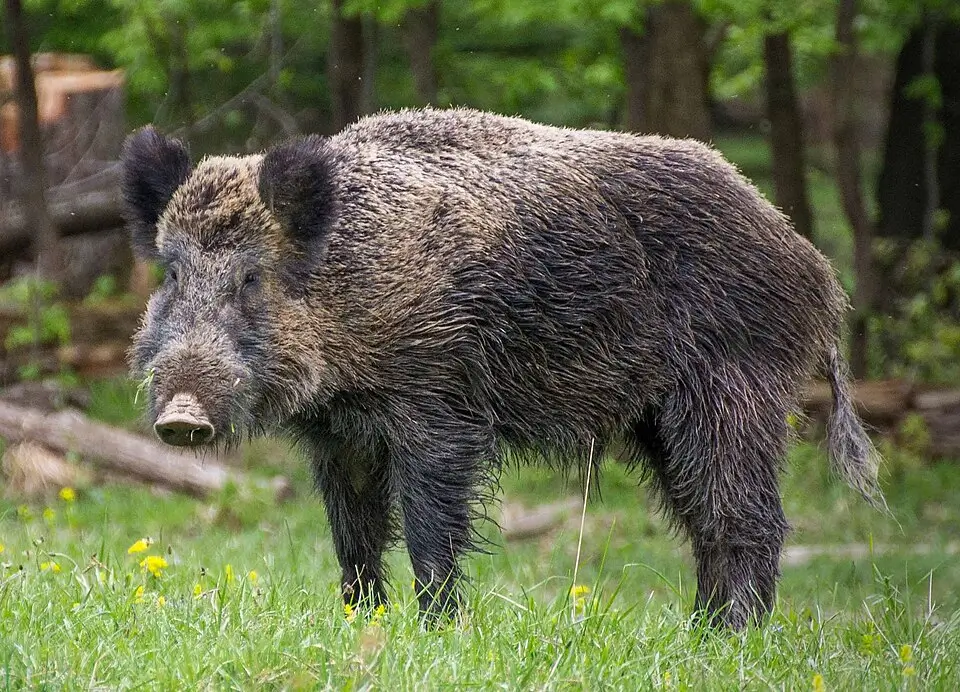
Wild boars are robustly built animals, characterized by a muscular, compact body, a large wedge-shaped head, and a tough hide covered with coarse bristles that can vary in color from dark brown to grayish black, and occasionally reddish or even pale in certain populations. Adults typically display a distinctive mane of longer, stiffer hair running along the ridge of their back, which often stands erect when the animal is alarmed or agitated — a behavior that serves both as a communication signal and a visual intimidation display.
One of the most iconic biological features of the wild boar is its tusks. In males, known as boars, the canine teeth develop into impressive curved tusks that protrude visibly from the mouth. The lower tusks, called cutters, and the upper tusks, called whetters, work together in a scissoring action that keeps both pairs razor-sharp through constant contact. These tusks are not merely aesthetic; they are formidable weapons used in combat with rival males during the breeding season and as a means of defense against predators.
The snout of the wild boar is another remarkable anatomical feature. Reinforced by a specialized disk of cartilage at the tip and supported internally by a small bone called the prenasal bone, the snout is an incredibly powerful digging tool. Wild boars use their snouts to root through soil in search of tubers, bulbs, invertebrates, and other buried food sources, a behavior that leaves distinctive churned patches of earth that are one of the most recognizable signs of boar activity in any habitat.
Wild boars possess an acute sense of smell that is widely regarded as one of the most sensitive in the animal kingdom, far surpassing that of most domesticated dogs. Their hearing is also excellent, though their vision is comparatively weaker. This sensory profile makes them particularly challenging quarry for hunters, as a boar can detect human scent or unusual sounds at considerable distances and will react swiftly.
The reproductive biology of wild boars is one of the key factors behind their remarkable success as a species. Sows, the females, reach sexual maturity within their first year under favorable conditions. Gestation lasts approximately 115 days, and a sow can produce litters of between four and six piglets on average, though larger litters are not uncommon. The piglets, known as striped piglets for the distinctive longitudinal stripes that pattern their coats in early life — a form of camouflage — grow rapidly and wean within three to four months. This high reproductive rate allows wild boar populations to recover quickly from population pressures, a trait that has significant implications for wildlife management.
Wild boars are omnivores with a highly varied diet. They consume plant matter including roots, tubers, fruits, nuts, and grasses, as well as animal matter such as insects, worms, carrion, small mammals, bird eggs, and even amphibians. This dietary flexibility is central to their ability to thrive in diverse environments.
Habitat & Range
The natural range of Sus scrofa is one of the broadest of any large terrestrial mammal. The species is native to much of Europe, Asia, and North Africa, but through both deliberate introduction and natural dispersal, wild boars and their feral domestic pig descendants have established populations across North America, South America, Australia, and numerous island archipelagos.
Wild boars are habitat generalists, meaning they do not require a specific ecosystem to survive. They are found in deciduous and mixed forests, Mediterranean scrublands, tropical rainforests, temperate grasslands, river floodplains, agricultural areas, and semi-arid environments. What they do require is access to water, adequate food resources, and sufficient cover for resting and raising young. Dense thickets, riparian corridors, and forested edges adjacent to open foraging areas represent ideal boar country.
In North America, feral hog populations — descended from escaped domestic pigs and, in some regions, deliberately released wild boar stock — have expanded dramatically over recent decades. These populations now inhabit dozens of states, thriving particularly in the southeastern United States but steadily pushing northward and westward into states across the Great Plains and beyond. The landscape of South Dakota, which encompasses diverse terrain including forested areas, river bottoms, expansive grasslands, and vast Missouri River reservoir systems, represents the kind of varied habitat mosaic where wild and feral pig populations can find purchase when conditions align.
The adaptability of wild boars to cold climates should not be underestimated. Their thick, bristly coats and substantial fat reserves allow them to withstand considerable winter hardship, particularly when food sources such as agricultural crop residues or mast crops remain available beneath snowpack.
Hunting Information
The wild boar is celebrated worldwide as a game animal that demands skill, patience, and respect. Hunters prize wild boar for multiple reasons: the challenge of outsmarting an animal with exceptional senses, the physical thrill of pursuing a powerful and potentially dangerous quarry, and the reward of excellent table fare in the form of wild pork.
Boar hunting methods vary widely by region and tradition. Still hunting and spot-and-stalk approaches are popular where terrain allows. Dogs have been used for centuries to locate and bay boars, a tradition that persists in many parts of the world and parts of the American South. Stand hunting over bait or near food sources such as agricultural fields and mast-bearing trees is another effective technique, particularly during cooler months when boars are most active during daylight hours. In some regions, driven hunts involving groups of beaters pushing game toward waiting hunters remain a celebrated cultural tradition.
Wild boars are notoriously tough animals. Their muscular neck and shoulder region is protected by a thickened layer of cartilaginous material sometimes called a shield, which can deflect or absorb strikes. This biological armor makes precise shot placement critically important, and hunters are encouraged to use adequate calibers and study boar anatomy carefully before heading afield.
In South Dakota, hunters enjoy access to diverse game across a wide variety of landscapes, including forests, river bottoms, grasslands, wetlands, and the Missouri River reservoir system. South Dakota Game, Fish, and Parks manages hunting opportunities across the state. Anyone planning to hunt wild or feral pigs in South Dakota is strongly encouraged to contact South Dakota Game, Fish, and Parks directly to obtain current, accurate information regarding any applicable licenses, permits, seasons, and regulations, as wildlife management rules are subject to change and vary by location.
Wild boar hunting also requires hunters to be aware of field dressing and processing protocols. Feral and wild pigs can carry various diseases and parasites, including trichinella, and proper handling, cooking to recommended internal temperatures, and hygiene during field dressing are all important practices for any boar hunter.
Conservation
The wild boar occupies a complex position in the conservation landscape. As a native species across much of Europe and Asia, Sus scrofa plays an important ecological role. Their rooting behavior turns over soil, creating disturbance patches that benefit certain plant species and provide foraging opportunities for other wildlife. They serve as prey for large predators including wolves, bears, and big cats throughout their native range, forming an important link in food web dynamics.
At the same time, in regions where wild boars or feral hog populations are non-native or have expanded dramatically beyond historical levels, they can have significant impacts on native plant communities, ground-nesting birds, agricultural crops, and soil structure. Wildlife managers in affected regions work to balance the ecological and agricultural realities of large feral pig populations with the interests of hunters, landowners, and conservationists.
Hunters play an active and meaningful role in wild boar management. Through regulated and unregulated hunting pressure, hunters contribute to population management efforts that help reduce crop damage, protect sensitive habitats, and limit the spread of feral pig populations into new areas. This places wild boar hunters in a unique position as both recreational participants and active contributors to wildlife management goals.
Globally, the conservation status of Sus scrofa as assessed by the International Union for Conservation of Nature (IUCN) is Least Concern, reflecting the species' wide range, high population numbers, and remarkable adaptability. The wild boar's story is, in many respects, a testament to the resilience and resourcefulness of nature itself.
Conclusion
The wild boar, Sus scrofa, is an animal that has earned its place in hunting culture and natural history alike. Its combination of raw power, acute senses, impressive intelligence, and extraordinary adaptability makes it one of the most compelling game animals on Earth. For hunters exploring the landscapes of the American heartland, including the forests, river bottoms, and grasslands that define states like South Dakota, the wild boar represents both a challenging pursuit and a meaningful connection to one of nature's great survivors.