Overview
Few sights in the natural world rival the spectacle of thousands of Sandhill cranes gathering in great migratory flocks, their bugling calls echoing across open skies as they trace ancient flyways between their wintering and breeding grounds. The Sandhill crane (Grus canadensis) is one of North America's most iconic and enduring birds — a living link to a prehistoric past that predates human civilization by millions of years. With their tall, stately frames, distinctive red foreheads, and haunting, rattling calls, Sandhill cranes have captivated the imaginations of indigenous peoples, naturalists, hunters, and outdoor enthusiasts for generations.
For hunters, wildlife watchers, and conservationists alike, the Sandhill crane represents something truly special: a bird that has survived ice ages, dramatic habitat shifts, and the pressures of the modern era to remain one of the most abundant large birds on the continent. Across the Great Plains states like South Dakota, where vast grasslands and wetlands provide critical stopover habitat, the Sandhill crane is a regular and celebrated visitor. Understanding this remarkable bird — its biology, behavior, habitat needs, and place in the outdoor heritage of states like South Dakota — is a rewarding endeavor for anyone who spends time in the natural world.
Biological Traits
The Sandhill crane is a large, long-legged wading bird belonging to the family Gruidae, the true cranes. It is one of only two crane species native to North America, the other being the critically endangered Whooping crane. The Sandhill crane's scientific name, Grus canadensis, reflects its broad range across Canada and the North American continent.
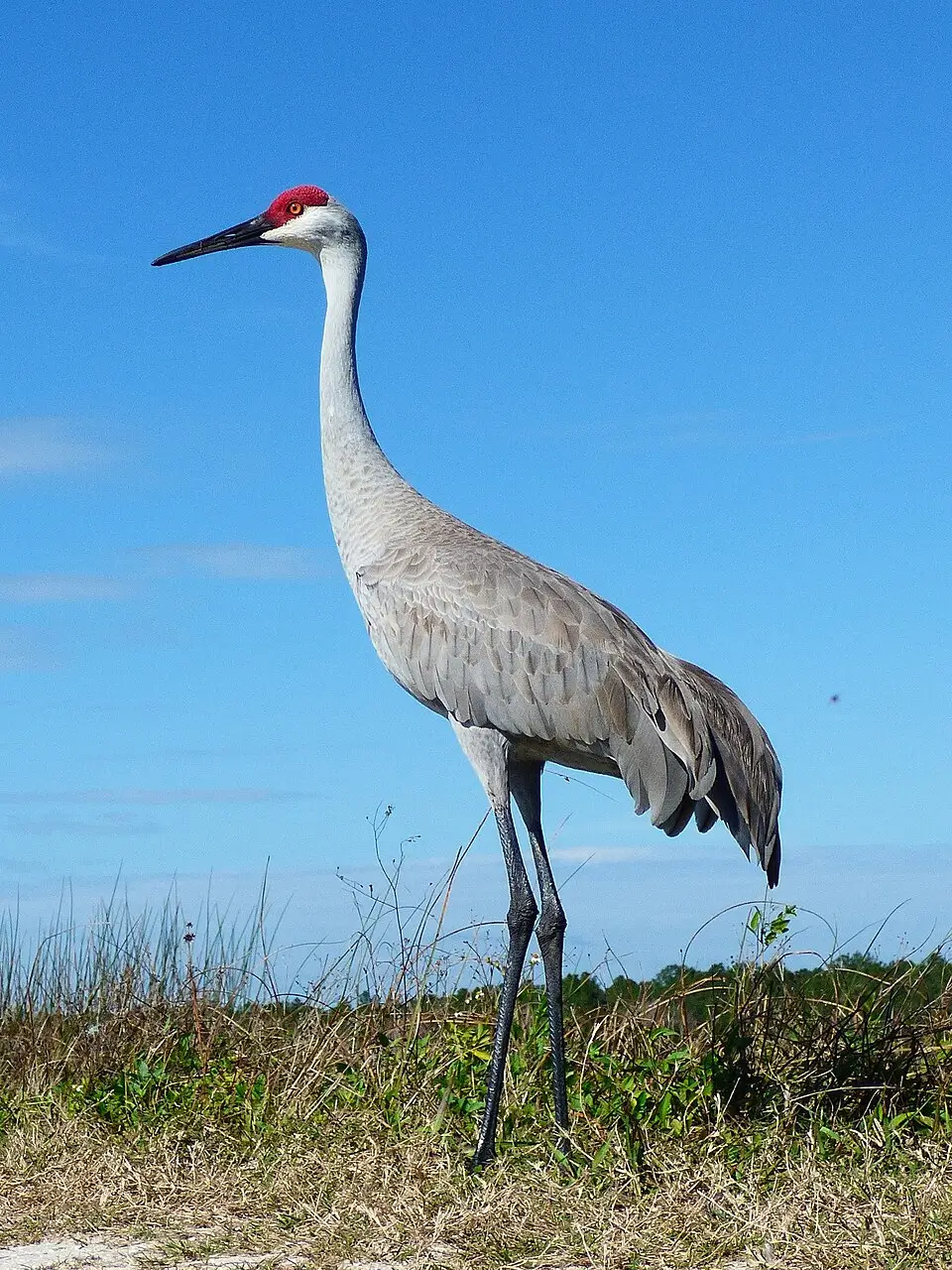
Adult Sandhill cranes are impressive birds by any measure. They typically stand between three and four feet tall, with wingspans that can reach six to seven feet across. Their plumage is largely gray, though wild birds often take on rusty-brown tones due to a unique behavior in which they preen iron-rich mud into their feathers — a form of natural camouflage that helps them blend into their surrounding environment during nesting season. Perhaps the most distinctive feature of the adult Sandhill crane is the bright red patch of bare skin on the forehead and crown, which deepens in color during courtship and displays of excitement.
One of the most endearing behaviors of Sandhill cranes is their elaborate dancing displays. Both males and females participate in these dances, which involve leaping, bowing, wing spreading, and tossing objects into the air. These displays serve multiple purposes throughout the year, including pair bonding, courtship, and the expression of excitement or alarm. Sandhill cranes are known to be monogamous and often mate for life, with pairs returning together to the same nesting areas year after year.
The voice of the Sandhill crane is as distinctive as its appearance. Their calls are loud, resonant, and far-carrying — a rolling, bugling sound produced by an unusually long, coiled trachea that amplifies the call and gives it its characteristic rattling quality. The sound of a flock of cranes in flight can be heard from considerable distances, making them an unmistakable presence in the landscapes they inhabit.
There are several recognized subspecies of Sandhill crane, ranging from smaller migratory populations to larger, non-migratory races found in specific regions. The Lesser Sandhill crane and the Greater Sandhill crane are among the most commonly discussed in the context of the Central and Pacific flyways of North America.
Sandhill cranes are omnivorous foragers, feeding on a wide variety of plant and animal matter. Their diet includes seeds, grains, berries, insects, small rodents, frogs, snakes, and aquatic invertebrates, making them highly adaptable to the different environments they encounter throughout the year. During migration and on wintering grounds, cranes often congregate in agricultural fields to feed on waste grain — a behavior that has contributed to their recovery in the modern era.
The lifespan of Sandhill cranes is notably long for a bird. In the wild, individuals can live for 20 years or more, and captive cranes have been recorded living even longer. This longevity, combined with their relatively late age of sexual maturity and low annual reproductive rate — typically producing only one to two chicks per nesting attempt — makes population management an important consideration for wildlife managers.
The fossil record of Sandhill cranes is extraordinary. Crane fossils attributed to this lineage have been discovered that date back approximately 2.5 million years, and some researchers believe that crane ancestors in North America are far older still. This makes the Sandhill crane one of the oldest known bird species on Earth, a true living fossil that has witnessed geological and climatic changes that would be unimaginable on a human timescale.
Habitat & Range
Sandhill cranes are birds of open landscapes. They favor wetlands, marshes, bogs, wet meadows, prairies, and agricultural fields across an enormous geographic range. During the breeding season, they occupy habitats from the Arctic tundra of Alaska and Canada southward through the Great Plains and into parts of the southeastern United States and Cuba. Migratory populations undertake remarkable journeys twice each year, traveling thousands of miles between their northern breeding grounds and their southern wintering areas in states like Texas, New Mexico, and Florida, as well as parts of Mexico.
Perhaps no location in North America better illustrates the grandeur of Sandhill crane migration than the Central Flyway — the great north-south corridor of the interior continent. Each spring and fall, hundreds of thousands of cranes pass through the Great Plains, staging at key stopover sites to rest and refuel. South Dakota, with its sweeping prairie landscapes, river systems, and abundant wetlands, sits directly within this flyway and serves as important transitional habitat for migrating flocks.
The Missouri River corridor and the numerous lakes and wetland complexes across South Dakota provide resting and foraging habitat that cranes depend upon during their long migrations. The state's diverse landscape — encompassing the vast Missouri River reservoir system, the grasslands of the west, and the wetland-studded plains of the east — offers a mosaic of habitats attractive to cranes and a wide array of other migratory birds.
Hunting Information
The Sandhill crane occupies a unique and growing place in the North American hunting tradition. Sometimes called the "ribeye of the sky" by hunters who appreciate their table qualities, Sandhill cranes have been pursued as upland and migratory game birds in various states and Canadian provinces for decades. Their large size, wariness, and challenging flight characteristics make them a prized quarry for waterfowl and migratory bird hunters.
South Dakota is widely celebrated as a premier destination for hunters across a broad spectrum of game species. As noted by South Dakota Game, Fish, and Parks, the state is "renowned world-wide for its pheasant hunting," with average annual pheasant harvests reaching approximately 1.2 million roosters over the past decade. Beyond pheasants, South Dakota offers hunting across diverse landscapes including forests, river bottoms, grasslands, wetlands, and the vast Missouri River reservoir system — environments that also support migratory birds like the Sandhill crane.
For hunters interested in pursuing Sandhill cranes in South Dakota, it is important to consult the most current regulations published by South Dakota Game, Fish, and Parks, as season dates, bag limits, licensing requirements, and zone-specific regulations can change from year to year and are managed in coordination with the U.S. Fish and Wildlife Service's framework for migratory bird hunting. Because Sandhill cranes are migratory birds, they are managed under federal oversight in addition to state regulations, and hunters must comply with all applicable state and federal requirements, including the possession of a valid hunting license and any required federal duck stamp or migratory bird permits.
Hunting Sandhill cranes requires patience, preparation, and skill. Their keen eyesight and wariness demand effective concealment and realistic decoys. Many hunters use calls to attract cranes within range, mimicking the bugling vocalizations that cranes use to communicate with one another. Field hunting over harvested grain fields and wetland areas are common strategies along the migration routes where cranes concentrate during their fall movements through states like South Dakota.
Conservation
The conservation story of the Sandhill crane is one of the great success narratives in North American wildlife management. While some subspecies and regional populations faced significant pressure in the early twentieth century due to habitat loss and unregulated hunting, sustained conservation efforts, habitat protection, and well-managed hunting programs have allowed the overall Sandhill crane population to recover remarkably. Today, the species is listed as a species of least concern by major conservation organizations, a testament to the resilience of the bird and the effectiveness of science-based wildlife management.
The relationship between healthy waterfowl and migratory bird populations and the conservation of wetland and grassland habitats is well established. Sandhill cranes serve as ambassadors for these critical ecosystems, drawing attention to the importance of preserving the wetlands, river corridors, and prairie habitats upon which they and countless other species depend. In South Dakota, where wetlands and grasslands define the character of the landscape and support an extraordinarily diverse wildlife community, the presence of migrating Sandhill cranes each spring and fall is both a natural spectacle and a reminder of the value of conservation stewardship.
Hunters, wildlife managers, conservation organizations, and private landowners all play roles in maintaining the landscapes that support Sandhill crane populations. The funding generated through the purchase of hunting licenses, federal duck stamps, and the excise taxes on hunting equipment — distributed through programs like the Federal Aid in Wildlife Restoration Act (Pittman-Robertson Act) — has been instrumental in protecting and restoring habitat across the Central Flyway and throughout South Dakota and neighboring states.