A Complete Guide to Bonasa umbellus
Few birds in North America command the respect and admiration of hunters and wildlife enthusiasts quite like the ruffed grouse (Bonasa umbellus). Known by many names — drummer, partridge, woods grouse, or simply "ruff" — this compact, brilliantly camouflaged bird has earned a devoted following among upland bird hunters who pursue it through the thick tangles and forest corridors of North America. Its explosive flush, heart-stopping wingbeats, and remarkable ability to vanish into the timber have made it a legendary quarry, one that tests even the most seasoned wingshooter.
The ruffed grouse is widely considered the king of upland game birds by those who pursue it with serious devotion. Unlike the open-field pheasant or the prairie-dwelling sharptail, the ruffed grouse lives in a world of dense cover, demanding that hunters step away from easy shooting lanes and push deep into brushy alder runs, regenerating clear-cuts, and mixed hardwood forests. It is a bird that rewards persistence, woodsmanship, and a well-trained pointing or flushing dog. Whether you are a lifelong grouse hunter or someone just learning about this remarkable species, there is no shortage of fascinating biology, behavior, and hunting tradition to explore.
Biological Traits
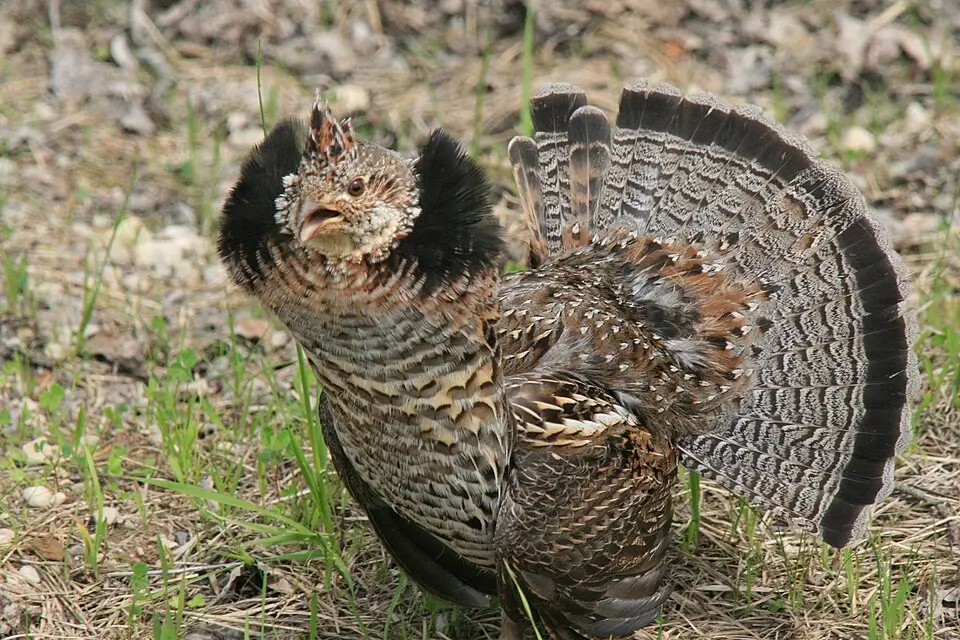
The ruffed grouse (Bonasa umbellus) belongs to the family Phasianidae, which also includes turkeys, quail, and pheasants. It is a medium-sized bird, generally weighing between 16 and 26 ounces in adulthood, with a body length typically ranging from 16 to 19 inches. The species displays subtle sexual dimorphism — males tend to be slightly larger than females — but both sexes share the same general plumage pattern: a beautifully cryptic mix of brown, gray, black, and buff tones that renders them nearly invisible against a forest floor carpeted in fallen leaves.
One of the most iconic features of the ruffed grouse is the distinctive ruff of dark, iridescent feathers located on the sides of its neck. In males, these feathers are fanned outward during courtship displays and territorial interactions, creating a striking collar that gives the bird its common name. The tail is broad and fan-shaped, typically banded with alternating light and dark bars and featuring a prominent dark subterminal band near the tip — a field mark that can help distinguish the species.
Perhaps the most famous behavior of the ruffed grouse is the phenomenon known as "drumming." Male grouse establish territories in late winter and spring and perform a distinctive display in which they stand on a raised log or stump and beat their wings rapidly in an accelerating series of thumps. This sound, which travels surprisingly far through dense timber, is produced entirely by the rapid compression of air beneath the wings — not by the wings striking the log, as is sometimes assumed. Drumming serves both to attract females and to warn competing males away from a territory.
Ruffed grouse are largely non-migratory birds that rely on a home range throughout the year. During winter, they have a remarkable adaptation: small, comb-like projections called pectinations grow from the sides of their toes, effectively acting as snowshoes and allowing the birds to walk atop crusted snow. In especially cold weather, ruffed grouse will dive beneath soft snow to form insulating burrows that protect them from extreme cold and predators alike.
The diet of the ruffed grouse shifts seasonally. In warmer months, the birds consume a wide variety of insects, berries, green leaves, and soft plant material. As autumn deepens and winter approaches, they transition heavily to buds and catkins of aspen, birch, alder, and other woody plants. Aspen, in particular, is one of the most critical food resources for ruffed grouse through the winter months, and the presence of mature and regenerating aspen stands is often a reliable predictor of strong grouse populations in a given area.
Ruffed grouse populations are well-documented to follow a cyclic pattern roughly every eight to ten years, a phenomenon particularly pronounced in northern portions of their range. These population cycles are believed to be driven by complex interactions between the birds, their food sources, and predator-prey dynamics. During peak years, hunters may encounter birds at nearly every turn in suitable habitat; during low points in the cycle, the same woods can feel remarkably empty.
Habitat & Range
The ruffed grouse is a bird of the forest, and its range closely follows the distribution of mixed deciduous and coniferous woodlands across North America. The species is found from Alaska and northern Canada south through the Appalachian Mountains, across the Great Lakes region, New England, and into portions of the upper Midwest and the mountain West. The core of its range coincides with the great northern hardwood and boreal forest belt that stretches across the continent.
Within this broad range, the ruffed grouse shows a clear preference for young, regenerating forest — the brushy, dense growth that springs up in the years following logging, fire, or other disturbance. This early-successional habitat provides the thick cover the birds need for security, abundant browse, and the structural complexity that supports successful nesting. Alder thickets, young aspen stands, brushy stream corridors, and edges between mature forest and regenerating growth are classic grouse haunts.
In terms of South Dakota, it is worth noting that the state's vast prairies, river systems, wetlands, and Black Hills forests offer a rich and diverse hunting landscape. South Dakota Game, Fish, and Parks highlights that the state's hunting opportunities span across forests, river bottoms, grasslands, wetlands, and the expansive Missouri River reservoir system — environments that collectively support a variety of upland game species. The Black Hills region of western South Dakota, with its mixed coniferous and deciduous forest cover, represents the type of terrain most conducive to ruffed grouse habitat within the state.
Hunting Information
The ruffed grouse holds a special place in the traditions of North American upland hunting. Hunting this bird requires patience, physical fitness, and a willingness to work through cover that most hunters would rather walk around. Success demands intimate knowledge of the land — knowing which logging roads hold birds in October, which alder runs funnel grouse during cold snaps, and which hillsides with a southern exposure warm up first and attract feeding birds on crisp autumn mornings.
Dogs are a beloved part of the grouse hunting experience. Both pointing breeds — such as English setters, Brittanys, and German shorthairs — and flushing dogs like Labrador retrievers and English springer spaniels have devoted followings among grouse hunters. A well-trained pointing dog that can navigate dense cover and hold a point long enough for a hunter to get into shooting position is one of the great pleasures of the sport. That said, plenty of grouse are taken by skilled hunters walking alone through known cover.
Shotguns in the improved cylinder or modified choke range are most commonly recommended for ruffed grouse, as shots are typically close and quick in dense timber. Smaller shot sizes — No. 7½ or No. 8 — are commonly used, though preferences vary by region and individual hunter. The compact, explosive nature of the flush demands a gun that can be brought up quickly and swung smoothly.
Hunters interested in pursuing ruffed grouse in South Dakota should consult current regulations directly from South Dakota Game, Fish, and Parks, as season dates, bag limits, and license requirements can change from year to year. The GFP manages hunting opportunities across the state's diverse landscapes, including the forested regions of the Black Hills where grouse habitat is most likely to be found. Always verify the most current regulations before heading afield.
Conservation
The conservation of ruffed grouse is closely tied to the management of forest ecosystems, and particularly to the maintenance of young, early-successional forest habitat. As forests across much of the eastern United States and Canada have matured over the past several decades — partly as a result of fire suppression and reduced timber harvesting — the amount of early-successional habitat available to grouse and other forest wildlife has declined in some areas. Conservation organizations, state wildlife agencies, and private landowners have worked collaboratively to address this challenge through targeted habitat management practices including timber harvesting, prescribed burning, and the creation of forest openings.
The ruffed grouse remains a healthy and widely distributed species across its core range, and it continues to be one of the most popular upland game birds in North America. Thoughtful, science-based management of both the birds and their habitat will be essential to ensuring that future generations of hunters and wildlife enthusiasts can enjoy this remarkable species.