Overview
Few animals capture the spirit of the American West quite like the mule deer. With its oversized, mule-like ears, distinctive bounding gait, and impressive antler formations, Odocoileus hemionus stands as one of the most recognizable and celebrated big game animals on the continent. Whether spotted silhouetted against a crimson sunset on a high desert ridge or bounding through the ponderosa pine forests of the Black Hills, the mule deer commands attention and respect from wildlife enthusiasts, photographers, and hunters alike.
Mule deer occupy a cherished place in the cultural and ecological fabric of North America. They are not simply targets for hunters or subjects for wildlife photographers — they are keystone figures in the ecosystems they inhabit, playing critical roles in vegetation management, predator-prey dynamics, and the broader health of the landscapes they call home. In a state like South Dakota, where diverse terrain ranges from sweeping Great Plains grasslands to forested river bottoms and rugged badlands formations, the mule deer finds a rich and varied home worth celebrating and protecting.
This article explores the biology, behavior, habitat preferences, and hunting traditions surrounding the mule deer, with a particular focus on its presence in South Dakota — a state known for its remarkable wildlife heritage and diverse hunting opportunities.
Biological Traits
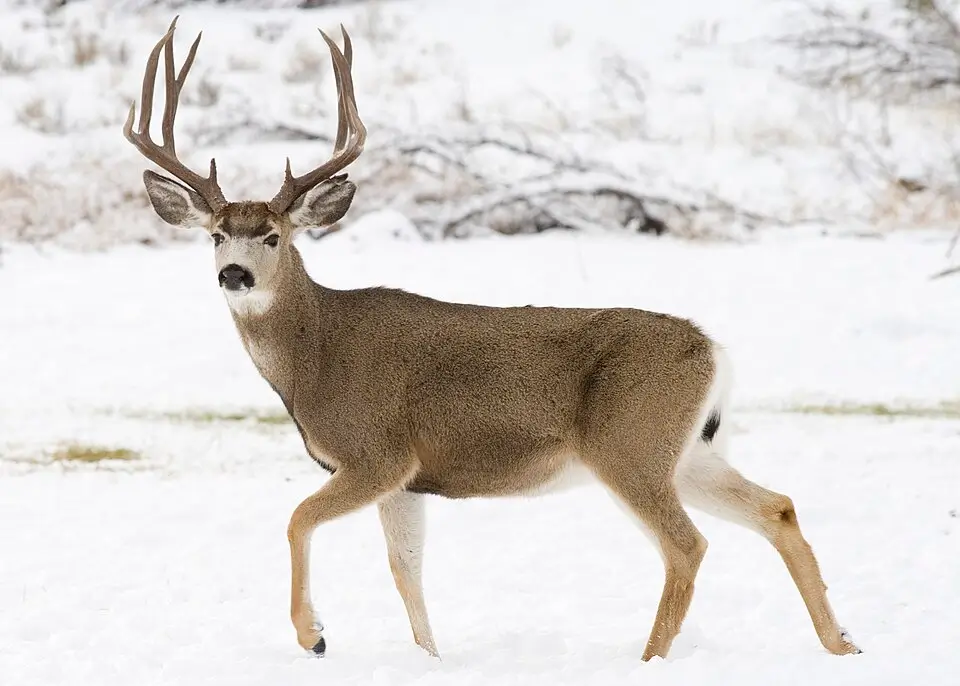
The mule deer (Odocoileus hemionus) belongs to the family Cervidae, the deer family, and is closely related to the white-tailed deer (Odocoileus virginianus). Despite sharing a genus, the two species differ in numerous notable ways. The mule deer's most immediately recognizable feature is, of course, its large ears — proportionally much larger than those of a white-tailed deer — which inspired both its common name and serve as highly effective sensory tools for detecting predators at distance.
Adult mule deer bucks are substantial animals. Mature males typically weigh between 150 and 300 pounds, though particularly large individuals in favorable habitat can exceed those figures. Does are considerably smaller, generally ranging between 95 and 200 pounds. Body size tends to vary across the species' range, with deer in northern and higher-elevation areas often growing larger than their southern counterparts — a well-documented biological phenomenon known as Bergmann's Rule.
One of the most striking features of the mule deer buck is its antler structure. Unlike white-tailed deer, whose antlers typically feature tines projecting from a single main beam, mule deer antlers bifurcate — meaning the main beam forks into two equal branches, each of which may fork again. This gives mature mule deer bucks a distinctive, symmetrical, and often massive antler rack that is prized by hunters and wildlife enthusiasts.
The mule deer's coat changes seasonally. In summer, the coat is a reddish-tan or tawny brown. As autumn arrives and temperatures drop, the coat transitions to a grayish-brown color, providing better camouflage in the dormant vegetation of fall and winter landscapes. A distinctive cream-colored rump patch and a small, rope-like tail tipped in black — in contrast to the white-tailed deer's flag-like tail — help distinguish the species at a glance.
Mule deer are also famous for their unique locomotion style known as "stotting" or "pronking." When alarmed, mule deer often move in a four-footed bounding gait, pushing off with all four legs simultaneously and landing on all four feet. This distinctive movement, also called a "stiff-legged bounce," allows them to navigate rough, rocky, and uneven terrain with remarkable agility and speed, making them well-suited to the rugged western landscapes they favor.
Mule deer are primarily crepuscular, meaning they are most active during the twilight hours of dawn and dusk. During the heat of the day, they tend to bed in shaded areas, conserving energy. They are browsers by nature, preferring shrubs, forbs, grasses, and other vegetation depending on season and availability. In late summer and fall, they dramatically increase their food intake to build fat reserves that will sustain them through the lean winter months.
The rut — the mule deer breeding season — typically occurs from November into December across much of their range. During this period, bucks become highly active, covering large territories in search of receptive does. Bucks may engage in sparring matches, though serious injuries are relatively uncommon. Fawns are typically born the following late spring or early summer, often in pairs, and are spotted at birth — a coloration that fades within their first few months of life.
Habitat & Range
Mule deer are quintessentially western animals. Their range spans a vast swath of western North America, from the coastal ranges of British Columbia and California eastward through the Rocky Mountains, the Great Basin, the Sonoran and Chihuahuan deserts, and out onto the Great Plains. They are found as far north as the Yukon and as far south as Baja California and northern Mexico.
The species demonstrates impressive ecological flexibility. Mule deer inhabit desert scrublands, sagebrush flats, mountain meadows, coniferous forests, riparian corridors, and mixed-grass prairies. What most of their preferred habitats share is a combination of open terrain for visibility and detection of predators, interspersed with cover — whether rocky outcroppings, trees, shrubs, or draws — for bedding and escape.
In South Dakota, mule deer are most commonly found in the western part of the state. The rugged terrain of the Badlands, the grasslands and breaks along the Missouri River, and the forests and meadows of the Black Hills region provide ideal mule deer country. South Dakota's diverse landscapes — spanning forests, river bottoms, grasslands, and wetlands — support a variety of game animals, mule deer prominently among them.
The Missouri River and its tributaries create a natural dividing line of sorts, with mule deer populations concentrated primarily west of the river, while white-tailed deer dominate the eastern half of the state. In areas where the two species' ranges overlap, hybrid individuals are occasionally encountered, though pure representatives of each species remain by far the most common.
Hunting Information
Mule deer hunting is a deeply rooted tradition across the American West, and South Dakota offers hunters a genuine opportunity to pursue this iconic species across some strikingly beautiful country. The state's Game, Fish, and Parks department manages a variety of game animals across its diverse landscapes, including forests, river bottoms, grasslands, wetlands, and the vast Missouri River reservoir system — all of which provide habitat for mule deer.
For hunters planning a mule deer hunt in South Dakota, it is strongly recommended to consult the most current regulations, licensing requirements, and season dates directly from the South Dakota Game, Fish, and Parks (GFP) official website. Regulations, tag availability, and season structures can change from year to year as wildlife managers respond to population data, habitat conditions, and broader conservation goals. Visiting the official GFP website or contacting their offices directly will ensure hunters have the most accurate and up-to-date information available.
Successful mule deer hunting typically requires an understanding of the animal's behavioral patterns. Spot-and-stalk hunting is a favored technique in the open terrain of western South Dakota, where hunters can glass from elevated vantage points, locate animals at distance, and then plan careful approaches using terrain features for cover. The Badlands region offers particularly dramatic and challenging hunting, with deep coulees, rugged ridgelines, and wide-open sagebrush flats that demand both physical conditioning and sharp hunting skills.
Archery hunters will find opportunities to pursue mule deer during bow seasons, while rifle and muzzleloader hunters typically have their own dedicated seasons during the fall. The rut period in November can provide exciting hunting as bucks become more active and less cautious during daylight hours. Regardless of the method, ethical shot placement, proper field dressing, and respect for the animal and landscape are hallmarks of the responsible mule deer hunter.
Conservation
The conservation of mule deer populations across North America is an ongoing and collaborative effort involving state wildlife agencies, federal land managers, tribal nations, hunting organizations, and conservation nonprofits. Mule deer face a range of challenges including habitat fragmentation, development of energy infrastructure, drought cycles, harsh winters, disease pressures, and competition with livestock and other ungulates.
In South Dakota, the Game, Fish, and Parks agency plays a central role in monitoring and managing mule deer populations. Hunting license sales directly fund wildlife management programs, making hunters critical partners in conservation efforts. The North American Model of Wildlife Conservation — which underpins wildlife management across the United States and Canada — relies on this license and tag system to generate funding for science-based population management, habitat restoration, and enforcement of wildlife laws.
Organizations such as the Mule Deer Foundation work alongside state agencies and landowners to restore and enhance mule deer habitat across the West, addressing issues like invasive plant species, degraded riparian areas, and migration corridor protection. Mule deer are known to undertake impressive seasonal migrations, sometimes covering hundreds of miles between summer range and winter range — a behavior that requires intact landscapes and functional wildlife corridors to succeed.
The long-term health of mule deer populations depends on thoughtful stewardship of the western landscapes they inhabit. When hunters, conservationists, land managers, and communities work together in support of science-based wildlife management, the future for this remarkable species remains bright.