Overview
Among the most fascinating and often overlooked members of North America's wildlife community, the gray fox (Urocyon cinereoargenteus) stands as a remarkable testament to nature's ingenuity. Unlike many of its canine relatives, this medium-sized fox has carved out a unique ecological niche that sets it apart from virtually every other member of the dog family. Whether you are a wildlife enthusiast, a hunter, or simply someone who appreciates the diversity of North American fauna, the gray fox offers a compelling story of adaptability, survival, and quiet elegance.
Found across a sweeping range that extends from southern Canada all the way down through Central America, the gray fox is one of the most widely distributed foxes on the continent. Yet despite its broad presence, it remains a creature that many people have never seen in the wild — preferring the cover of dense brush and woodland edges where it can slip through the shadows like a ghost. In states like South Dakota, where dramatic landscapes shift from the rolling grasslands of the Great Plains to the forested river bottoms and rugged terrain of the Black Hills region, the gray fox finds pockets of suitable habitat that make it a resident worth knowing.
This article explores the biology, behavior, habitat preferences, hunting traditions, and conservation status of the gray fox — a species that richly rewards the time taken to understand it.
Biological Traits
The gray fox (Urocyon cinereoargenteus) belongs to the family Canidae and represents one of the oldest living members of the dog family in the Western Hemisphere. Its genus name, Urocyon, comes from the Greek words for "tailed dog," while cinereoargenteus is Latin for "ashy silver," a direct reference to its distinctive coat coloration.
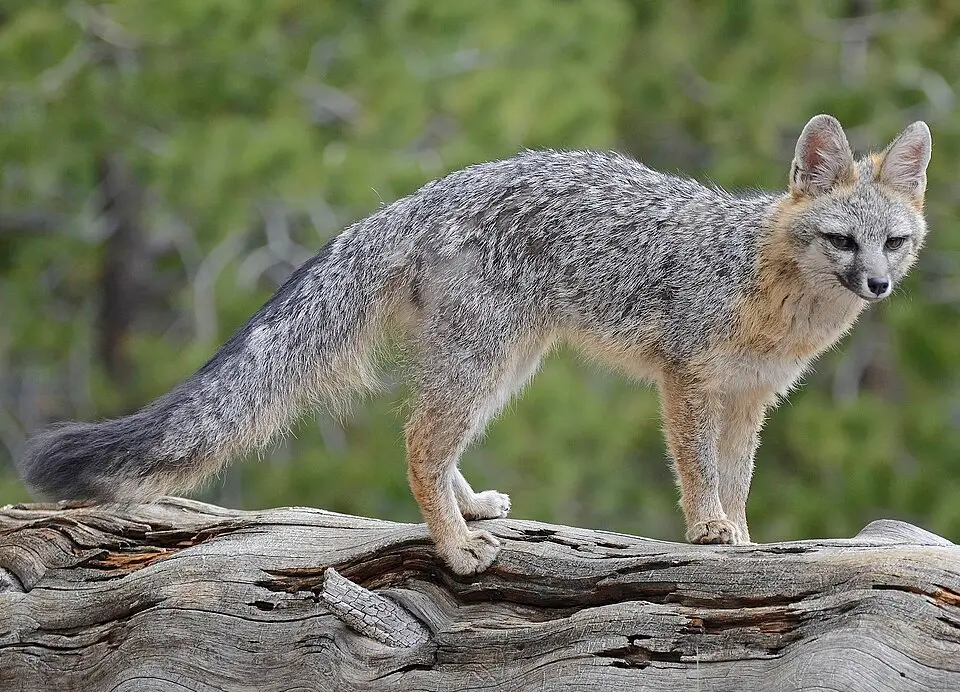
The gray fox is perhaps best recognized by its salt-and-pepper, grizzled gray upperparts, which give the animal a somewhat rugged, textured appearance compared to the more uniformly colored red fox. However, a closer look reveals a surprisingly rich palette. The sides of the neck, flanks, and undersides carry warm tones of rusty orange and buff, while the belly is a creamy white. A bold, dark stripe runs along the top of the tail from the base to the tip, where a distinctive black tip can be found — a useful field mark for distinguishing the gray fox from its red-furred cousin.
Adults typically weigh between 7 and 13 pounds, with body lengths ranging from roughly 31 to 44 inches from nose to the base of the tail. The tail itself is relatively long and bushy, and like much of the animal's anatomy, it is built for function as much as form. The ears are large and upright, well-suited for detecting the faint rustle of prey in dense underbrush. The muzzle is moderately long and pointed, typical of a generalist predator that pursues a wide variety of food items.
One of the most extraordinary biological traits of the gray fox is its climbing ability. Unlike the red fox, the great horned owl, or even the coyote, the gray fox is capable of ascending trees with a squirrel-like agility that surprises most observers who encounter it for the first time. This skill is made possible by strong, hooked claws that are semi-retractile — a feature almost unheard of among canids. Gray foxes will climb trees to escape predators, to access fruit and bird nests, and occasionally to rest in elevated positions that provide both safety and a commanding view of their surroundings.
Gray foxes are omnivores with broad dietary preferences that shift with the seasons. Rabbits, mice, voles, and other small mammals form the backbone of their diet, supplemented liberally by birds, insects, berries, nuts, and fruits. In the autumn months, mast crops such as wild grapes and persimmons can become significant food sources. This dietary flexibility is one of the keys to the species' wide geographic success.
Breeding occurs primarily in late winter, typically between January and March in most parts of their range. After a gestation period of approximately 53 days, the female gives birth to a litter averaging three to five kits, though litters of up to seven have been recorded. Both parents participate actively in raising the young, which remain with the family group through the summer before dispersing in the fall. The family unit, with its division of labor and cooperative pup-rearing, is a behavioral hallmark that gives gray fox pups an exceptional start in life.
Gray foxes are generally solitary outside of the breeding season and are primarily nocturnal and crepuscular in their activity patterns, though sightings during daylight hours are not uncommon in areas with low human disturbance.
Habitat & Range
The gray fox occupies a remarkably diverse range of habitats across its continental distribution. From the mixed deciduous forests of the eastern United States to the scrubby chaparral of the Southwest, and from the tropical lowlands of Mexico and Central America to the brushy river corridors of the Great Plains, this adaptable canid finds ways to thrive wherever sufficient cover and prey are available.
The gray fox shows a strong preference for brushy, broken terrain with a mix of woodland and open areas. Dense shrub cover, rocky outcroppings, and forested creek drainages are particularly favored, as they provide both escape cover and den sites. Unlike the red fox, which tolerates and often thrives in open agricultural settings, the gray fox is more closely tied to wooded and brushy landscapes — a habitat specialist of sorts within its generalist lifestyle.
In South Dakota, the gray fox occupies the edges of the state's geographic range. South Dakota's diverse landscapes — encompassing the expansive grasslands of the Great Plains, the cottonwood-lined river bottoms of the Missouri River system, and the forested slopes and draws of the Black Hills — offer a mosaic of habitats where gray foxes can find suitable conditions, particularly in the more wooded and brushy southwestern portions of the state. The state's forests, river bottoms, and varied terrain provide the kind of structural diversity that gray foxes seek out and exploit effectively.
Hunting Information
The gray fox has a long history as a quarry species in North American hunting traditions. It has been pursued with hounds, called in with predator calls, and harvested by trappers and fur hunters for generations. Its pelt, with its distinctive grizzled coloring and warm tonal accents, has value in the fur trade, and its status as a small predator makes it a natural target for hunters engaged in predator management activities.
Hunting the gray fox typically rewards patience, fieldcraft, and a working knowledge of the animal's habits. Because gray foxes are most active at dawn, dusk, and during the night, hunters who adapt their schedules to match the fox's natural rhythms will enjoy the greatest success. Electronic and mouth-blown predator calls mimicking the sounds of wounded rabbits or distressed rodents are highly effective for drawing gray foxes within range, as the species responds with a bold and often direct approach to calls — sometimes quite fearlessly.
Hunters pursuing gray foxes in South Dakota should consult the South Dakota Game, Fish, and Parks (GFP) for the most current regulations regarding seasons, licensing requirements, and any applicable bag limits or restrictions. South Dakota is well known for its rich and varied hunting opportunities, and the state's diverse landscapes — from river bottom forests to mixed grassland edges — provide excellent habitat for predator hunters seeking gray fox encounters. As with all hunting in South Dakota, compliance with current state regulations is the first and most important step for any hunter planning a gray fox outing.
Gray fox hunting pairs naturally with other predator hunting pursuits and fits comfortably into a broader outdoor experience that might include pheasant hunting, deer hunting, or coyote calling on South Dakota's spectacular and varied public and private lands.
Conservation
The gray fox is currently listed as a species of Least Concern by the International Union for Conservation of Nature (IUCN), reflecting its broad distribution, stable populations across much of its range, and general adaptability to a wide variety of environmental conditions. While the species faces pressure in some parts of its range from habitat loss, fragmentation, and competition with coyotes, it has demonstrated a resilience and flexibility that bodes well for its long-term prospects.
Responsible hunting and trapping, conducted within regulated frameworks like those managed by South Dakota Game, Fish, and Parks, plays an important role in supporting the conservation infrastructure that benefits all wildlife species. License fees and excise taxes generated through hunting fund habitat acquisition, wildlife research, and population monitoring programs that ultimately benefit foxes, pheasants, deer, and the full spectrum of South Dakota's extraordinary wildlife heritage.
The gray fox's preference for dense, brushy habitat also means that conservation efforts directed at maintaining healthy riparian corridors, forested creek bottoms, and shrubland edges will naturally benefit gray fox populations alongside a host of other species. Hunters, landowners, and wildlife managers who work together to preserve and enhance these habitat types are making a tangible positive contribution to the future of this unique and rewarding species.