Overview
Few animals are as instantly recognizable across the North American landscape as the Eastern gray squirrel (Sciurus carolinensis). Whether darting across a city park, spiraling up the trunk of a hardwood tree in a dense forest, or dashing along a fence line in a suburban backyard, this energetic and resourceful creature has woven itself into the fabric of daily life for millions of Americans. Its bushy tail, nimble movements, and seemingly boundless curiosity have made it one of the most observed — and most hunted — small game animals on the continent.
For hunters, naturalists, wildlife enthusiasts, and outdoor educators alike, the Eastern gray squirrel represents something genuinely special: a species that bridges the gap between wild nature and human civilization, thriving in environments ranging from ancient old-growth forests to the manicured green spaces of major metropolitan areas. Understanding this animal — its biology, its behavior, its habitat preferences, and its role in the broader ecosystem — offers a window into the complex and endlessly fascinating world of North American wildlife.
This guide takes an in-depth look at Sciurus carolinensis, exploring everything from its biological traits and ecological role to the hunting traditions it has inspired and its conservation status across its range. Whether you are a seasoned small game hunter looking to sharpen your knowledge or a curious naturalist hoping to learn more about the squirrel you spotted in your backyard oak tree, this article has something for you.
Biological Traits
The Eastern gray squirrel belongs to the family Sciuridae, the large and diverse family of rodents that includes ground squirrels, chipmunks, marmots, prairie dogs, and flying squirrels. Within this family, Sciurus carolinensis is one of the most widely studied and well-known members in the world.
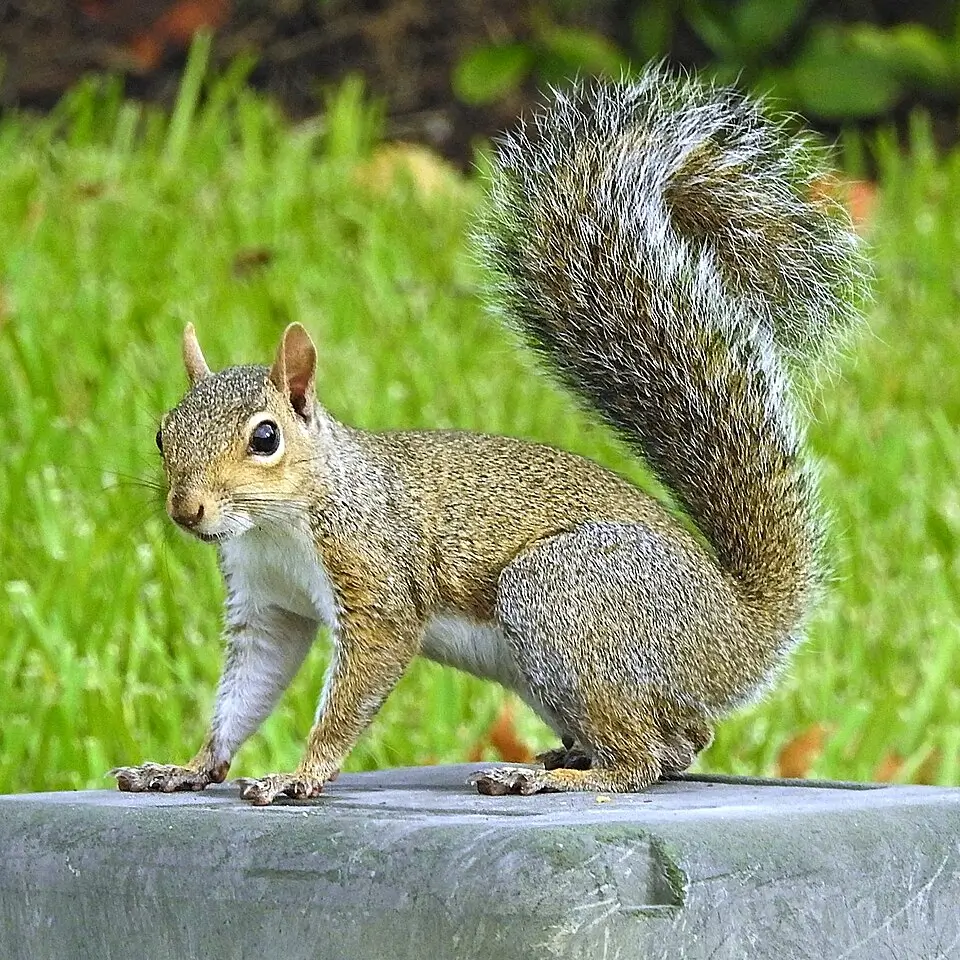
As its common name suggests, the Eastern gray squirrel is predominantly gray in coloration, with lighter gray or whitish underparts. The fur on the back often features subtle brownish or yellowish tones, particularly along the flanks and around the face, which gives the animal a slightly warmer appearance than a pure steel gray. The tail — that iconic, full, and wonderfully expressive appendage — is edged with white-tipped guard hairs that give it a frosted appearance, especially noticeable when the animal is at rest or foraging on the forest floor.
Interestingly, color variation is well-documented in this species. Black (melanistic) individuals are not uncommon in certain populations, and in some regions these darker morphs can make up a notable portion of the local squirrel community. Albino individuals, while rare, have also been recorded.
In terms of size, the Eastern gray squirrel is a medium-sized tree squirrel. Adults typically weigh between 14 and 21 ounces, though individuals can sometimes fall outside this range depending on season, age, and food availability. Body length, not including the tail, generally ranges from about 9 to 12 inches. The tail itself can add another 7 to 10 inches, and it serves a multitude of purposes — from helping the animal balance as it navigates branches and leaps between trees, to acting as a communication device and even a rudimentary parachute during falls.
One of the most celebrated behavioral traits of the Eastern gray squirrel is its relationship with nuts and seeds. This species is a scatter-hoarder, meaning it buries individual food items — particularly acorns, hickory nuts, beechnuts, and other mast — in scattered locations across its territory. This caching behavior is a critical survival strategy, allowing squirrels to access stored food during the lean winter months when fresh food is scarce. Remarkably, Eastern gray squirrels rely on spatial memory to relocate their caches, though they do not always recover every buried item. The seeds that are left behind frequently germinate, making the squirrel an important and often underappreciated agent of forest regeneration and seed dispersal. In this way, Sciurus carolinensis plays a meaningful ecological role in the health and regeneration of hardwood forest ecosystems.
Eastern gray squirrels are diurnal animals, meaning they are most active during daylight hours. Activity tends to peak in the early morning and late afternoon, particularly during autumn when foraging and caching activity intensifies ahead of winter. During cold weather, squirrels may remain in their nests — called dreys — for extended periods but do not truly hibernate the way groundhogs or certain ground squirrels do. They remain physiologically active year-round, relying on their cached food stores and continued foraging to meet their energy needs.
Nests, or dreys, are typically constructed in the forks and branches of trees using leaves, twigs, bark, and other soft materials. Squirrels also readily use tree cavities, particularly in older forests with mature trees that have developed natural hollows. Cavity dens are especially prized during cold winters and during the breeding season, as they offer superior insulation and protection from predators.
The reproductive biology of the Eastern gray squirrel is well adapted to its environment. This species can breed twice per year, with litters typically produced in late winter or early spring and again in midsummer. Litter sizes generally range from two to four young, known as kittens or pups. The young are born hairless and blind, and they depend entirely on their mother for nourishment and warmth during the first weeks of life. By around 10 to 12 weeks of age, juvenile squirrels begin to venture out of the nest and explore their environment. Most young squirrels reach sexual maturity within their first year of life.
Habitat and Range
The Eastern gray squirrel is native to the eastern and midwestern United States and Canada, with its natural range extending from the Atlantic Coast westward through the Great Plains states. It is one of the most adaptable mammals in North America, occupying a remarkably broad range of habitats as long as certain key requirements — primarily the presence of trees that produce mast crops — are met.
At its ecological core, Sciurus carolinensis is a creature of hardwood and mixed hardwood-conifer forests. Mature oak, hickory, beech, walnut, and maple forests represent ideal habitat, providing both the food resources and the structural complexity (canopy cover, tree cavities, branch platforms) that squirrels need to thrive. However, this species has demonstrated an impressive capacity to adapt to fragmented, edge, and even heavily human-modified landscapes. Urban parks, suburban neighborhoods with mature shade trees, farmstead woodlots, and riparian corridors all provide suitable habitat for healthy squirrel populations.
In South Dakota, the Eastern gray squirrel occupies a narrower ecological niche than it does in the forested eastern states, primarily because much of South Dakota's landscape is characterized by open grasslands, agricultural land, and the rolling terrain of the Great Plains — habitat that does not inherently favor a tree-dependent species. Nevertheless, the state's river bottom woodlands, shelterbelts, Black Hills forests, and riparian corridors provide pockets of quality squirrel habitat. The Missouri River corridor and the wooded drainages of eastern South Dakota, in particular, can support notable squirrel populations where mature hardwood trees are present.
South Dakota itself is a state of remarkable ecological diversity. As a landlocked state in the North Central region of the United States and part of the Great Plains, it encompasses an extraordinary variety of landscapes — from the iconic rolling grasslands and wetlands of the east to the dramatic badlands and pine forests of the west. This diversity supports a wide range of wildlife, including numerous game species. The Eastern gray squirrel, while perhaps not the first animal that comes to mind when one thinks of South Dakota's hunting heritage, is nonetheless a part of the state's wildlife tapestry, particularly in the wooded habitats found in river valleys and the eastern part of the state.
Hunting Information
Squirrel hunting holds a cherished place in the broader tradition of American small game hunting. For many hunters across the eastern and midwestern United States, a morning in the timber chasing squirrels represents some of the most pure and satisfying hunting available — requiring patience, woodsmanship, sharp eyes, and an intimate understanding of the forest and its rhythms. It is often the first hunting experience for young hunters and remains a beloved pastime for experienced sportsmen throughout their lives.
The Eastern gray squirrel is widely regarded as one of the premier small game animals on the continent, offering excellent hunting challenge and outstanding table fare. Squirrel meat is flavorful, lean, and versatile — prized by hunters and culinary enthusiasts alike, featured in traditional recipes ranging from squirrel stew and Brunswick stew to fried squirrel that rivals the finest fried chicken.
Hunting techniques for Eastern gray squirrels vary, but several approaches are particularly effective. Still-hunting — sitting quietly at the base of a large mast-producing tree and waiting for squirrels to reveal themselves through movement, barking, or the sound of falling nut hulls — is perhaps the most classic method. Early morning hunts during the autumn, when squirrels are intensively feeding and caching in advance of winter, tend to produce the most activity. Spot-and-stalk hunting through hardwood timber is another productive approach, requiring hunters to move slowly and methodically while scanning the canopy and forest floor for movement.
Both shotguns and rimfire rifles are popular choices for squirrel hunting. A .22 LR rifle is a classic and highly accurate tool for targeting squirrels in the treetops, while a 20-gauge or 12-gauge shotgun loaded with light field loads provides a wider margin for moving or partially obscured targets. Many hunters also enjoy squirrel hunting with dogs — particularly squirrel dogs of breeds like the Mountain Cur or Feist — which tree squirrels and allow hunters to work through large areas of timber efficiently.
In South Dakota, hunters interested in pursuing small game including squirrel should consult the South Dakota Game, Fish and Parks (GFF&P) for current regulations, season dates, and licensing requirements. South Dakota is celebrated internationally for its hunting opportunities, offering diverse game across a range of landscapes including forests, river bottoms, grasslands, wetlands, and the vast Missouri River reservoir system. While pheasant hunting is the state's most famous hunting tradition — with an average annual harvest of 1.2 million roosters over the past decade — the state's varied landscapes support a full menu of hunting experiences. Hunters seeking squirrels in South Dakota would do well to focus their efforts on the wooded river bottoms and hardwood corridors where these animals are most likely to be found. Always check current regulations with the South Dakota Game, Fish and Parks before heading afield, as seasons and licensing requirements are subject to change.
Conservation
The Eastern gray squirrel is currently listed as a species of Least Concern by the International Union for Conservation of Nature (IUCN), reflecting its large and stable population across its native range. In much of North America, populations of Sciurus carolinensis are healthy and robust, supported by the species' remarkable adaptability and its ability to thrive in a wide variety of habitats, including human-modified landscapes.
While the Eastern gray squirrel itself is not in conservation need, its ecological role as a seed disperser and forest regeneration agent underscores the importance of maintaining healthy, mature hardwood forests across its range. The mast-producing hardwood trees that squirrels depend upon — oaks, hickories, beeches, and walnuts — are themselves important conservation assets, providing food and habitat for dozens of other wildlife species. Conservation efforts that protect and restore hardwood forest ecosystems benefit not only the Eastern gray squirrel but the entire community of forest-dependent wildlife.
It is also worth noting that in some parts of the world outside its native range — particularly in the United Kingdom, Ireland, and parts of continental Europe — the Eastern gray squirrel has been introduced and has become an invasive species, where it competes with native red squirrel populations. This situation highlights the importance of thoughtful wildlife management and the complex ecological dynamics that arise when species are moved outside their native ranges. In North America, however, the Eastern gray squirrel remains a native, ecologically integral member of the forest community.
Sustainable hunting, supported by science-based wildlife management programs administered by state agencies like South Dakota Game, Fish and Parks, plays an important role in keeping small game populations — including squirrels — healthy and in balance with their habitats. Hunters who pursue Eastern gray squirrels are participating in a wildlife management tradition that helps fund conservation programs through license fees and excise taxes on sporting equipment, contributing directly to the preservation of wild habitats and wildlife populations for future generations.