Overview
Few birds in the hunting world carry as much mystique and folklore as the common snipe. The very word "sniper" — now deeply embedded in military and cultural vocabulary — traces its origins directly to hunters skilled enough to bag this notoriously difficult-to-hit bird. To be called a sniper in the early 19th century was to receive one of the highest compliments a marksman could earn. That historical legacy alone speaks volumes about the challenge and prestige associated with pursuing Gallinago gallinago, the common snipe.
Yet despite its storied place in hunting culture, the common snipe remains surprisingly misunderstood and underappreciated by modern hunters. Many sportsmen and women are familiar with the old camping prank — the infamous "snipe hunt" — without ever realizing that snipe are, in fact, very real birds and highly prized game. For those who do pursue them seriously, snipe hunting is a deeply rewarding discipline that demands sharp reflexes, keen fieldcraft, and an intimate knowledge of wetland environments.
South Dakota, a state celebrated across the world for its extraordinary pheasant hunting and its diverse landscapes of forests, river bottoms, grasslands, wetlands, and the vast Missouri River reservoir system, also provides quality habitat for common snipe. The state's rich wetland complexes and prairie potholes offer some of the most productive snipe grounds in the central United States, making South Dakota a worthwhile destination for hunters willing to pursue this overlooked and underrated game bird.
This guide explores everything you need to know about the common snipe — its biology, behavior, habitat, and its place in the hunting traditions of states like South Dakota.
Biological Traits
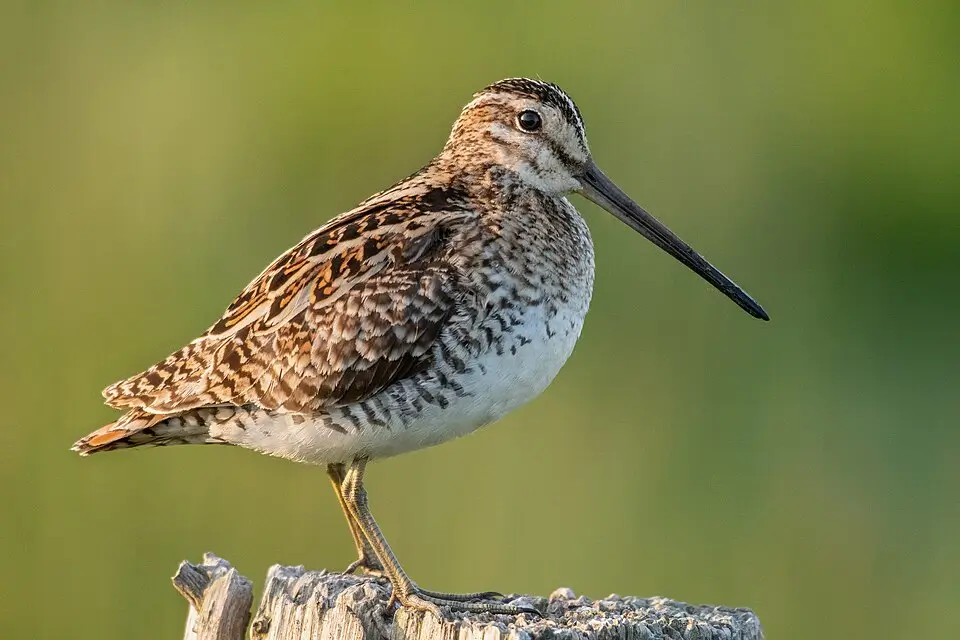
The common snipe (Gallinago gallinago) is a medium-sized wading bird belonging to the family Scolopacidae, which also includes woodcocks, sandpipers, and other shorebirds. It is a compact, well-camouflaged bird, typically measuring between 25 and 27 centimeters in length with a wingspan ranging from approximately 44 to 47 centimeters. Adults generally weigh between 80 and 140 grams, making them a relatively small but satisfying game bird.
Perhaps the snipe's most immediately recognizable feature is its extraordinarily long, straight bill, which can measure up to 7 centimeters. This specialized bill is a masterpiece of evolutionary engineering. The tip of the bill contains dense nerve endings and is capable of a unique motion called "rhynchokinesis" — the ability to flex the upper bill tip independently while the bill is inserted into soft mud. This allows the snipe to detect and grasp invertebrates, earthworms, and insect larvae deep within the substrate without having to withdraw the bill first. It is a feeding adaptation perfectly suited to life in soft, wet soils.
The snipe's plumage is a stunning mosaic of brown, black, buff, and white streaks and spots that provide near-perfect camouflage among dead grasses, reeds, and muddy vegetation. The head is distinctly patterned with bold longitudinal stripes of dark brown and pale buff, which run from the bill over the crown and down the nape. The back features long, pale "tramlines" — streaks of buff that run along the scapular feathers — giving the bird a distinctive appearance when seen up close.
The common snipe is also known for its extraordinary aerial agility. When flushed, it bursts from cover in an erratic, zigzagging flight that has confounded hunters and predators alike for centuries. This evasive flight pattern — characterized by rapid twists, turns, and changes of direction — is precisely what made snipe shooting so demanding and what elevated skilled snipe shooters to legendary status in the days of early sport shooting.
Outside of the breeding season, common snipe are largely crepuscular and nocturnal feeders, being most active during dawn and dusk hours. During the day, they tend to crouch motionless in dense vegetation, relying entirely on their camouflage for protection. Their cryptic nature makes them exceptionally difficult to spot until they are literally underfoot.
During the breeding season, males perform one of the most spectacular and distinctive displays in the avian world — the so-called "drumming" or "winnowing" display. Flying in wide circles high above their territory, males dive at steep angles while spreading their outer tail feathers. Air rushing through these specialized stiff feathers produces a haunting, pulsating sound often described as a trembling or bleating noise, audible from considerable distances. This display, performed most intensively at dawn and dusk, is one of the most evocative sounds of wild wetland landscapes.
Common snipe are primarily solitary outside of the breeding season, though they can sometimes be found in loose congregations — known historically as a "wisp" or "walk" of snipe — in particularly productive feeding areas.
Habitat & Range
The common snipe enjoys one of the broadest distributions of any wading bird in the world. Its breeding range extends across a vast swath of the Palearctic, from Iceland and the British Isles in the west all the way through Europe, Russia, and Siberia to the far eastern reaches of Asia. In North America, the closely related Wilson's snipe (Gallinago delicata) was long considered the same species as the common snipe and shares nearly identical habitat preferences and behaviors.
Snipe are intimately associated with wetland environments. They favor areas with soft, moist, or waterlogged soils where their long bills can probe effectively for food. Prime snipe habitat includes freshwater marshes, bogs, fens, wet meadows, the vegetated margins of ponds and lakes, irrigated fields, flooded agricultural land, and the soft edges of slow-moving streams and rivers. They are particularly partial to areas with a combination of open ground for feeding and nearby dense vegetation for cover and roosting.
The prairie pothole region of the central United States and Canada represents some of the finest snipe habitat on the continent. South Dakota sits squarely within this important wetland region. The state's wetlands — shaped by glacial activity thousands of years ago — create a mosaic of shallow lakes, ponds, marshy depressions, and wet grasslands that support a remarkable diversity of wildlife, including common snipe. The wetland complexes along the Missouri River system, as well as the numerous natural and managed wetlands scattered across the eastern and central portions of the state, all provide important feeding and staging habitat for snipe during migration and, in some areas, through the warmer months.
During migration, snipe can appear almost anywhere there is suitable wet ground, sometimes turning up in surprisingly small patches of saturated soil far from obvious wetland complexes. Their wide-ranging movements make them a somewhat unpredictable quarry, here one morning and gone by afternoon.
Hunting Information
Snipe hunting is one of the most traditional and storied forms of wing shooting, with roots stretching back centuries in both Europe and North America. The pursuit of common snipe demands a very particular set of skills. Unlike pheasant or quail hunting, where flushed birds often present relatively straightforward shots, snipe require hunters who can react almost instantaneously and track a bird through erratic, unpredictable flight. The snipe's habit of holding tight until nearly stepped upon, followed by an explosive flush and a zigzagging escape, has broken the confidence of many an otherwise capable wing shooter.
Hunting snipe typically requires little more than a good pair of waterproof boots, appropriate wet-weather clothing, and a shotgun — usually an open-choked gun to maximize pattern spread at the relatively close distances at which snipe are typically flushed. A good bird dog, particularly a close-working flushing breed or a well-trained pointing dog, can be enormously helpful in locating and holding snipe in cover.
The best strategy for hunting snipe involves slowly and methodically working through productive wetland margins during the early morning or late afternoon hours when snipe are most actively feeding. Patience and an eye for subtle signs of snipe presence — probe holes in soft mud, droppings, and delicate footprints — can help hunters identify productive areas.
South Dakota offers hunters a rich and varied hunting landscape. The state is renowned worldwide for its exceptional pheasant hunting — with an average annual harvest of 1.2 million roosters over the past decade — but its wetlands, grasslands, river bottoms, and the expansive Missouri River reservoir system provide outstanding opportunities for a wide variety of game birds and animals. Hunters pursuing snipe in South Dakota should consult the South Dakota Game, Fish, and Parks for current season dates, licensing requirements, and any applicable regulations before heading afield, as regulations are subject to change annually.
The diversity of South Dakota's hunting landscape means that a snipe hunting excursion can often be combined productively with pursuits of other wetland and upland species, making the state an attractive multi-species destination for dedicated wing shooters.
Conservation
The common snipe, across much of its range, is currently considered a species of least concern by international conservation organizations. Its broad distribution and relatively large global population provide a reasonable buffer against immediate population-level threats. However, like many wetland-dependent species, snipe are not immune to the pressures affecting wetland ecosystems worldwide.
Habitat loss through wetland drainage, agricultural intensification, and changes in land management practices has affected snipe populations in parts of Europe in particular. The conversion of wet grasslands and bogs to more intensively farmed land reduces the availability of the soft, moist soils that snipe depend upon for feeding and nesting. Conservation efforts focused on wetland protection, restoration, and sympathetic land management are therefore important for the long-term wellbeing of snipe populations.
In North America, wetland conservation programs — including federal and state initiatives focused on the prairie pothole region — benefit snipe along with a host of other wetland-dependent species. South Dakota's diverse and well-managed landscapes, supported by agencies like the South Dakota Game, Fish, and Parks, contribute positively to maintaining the wetland habitats upon which snipe and many other species rely.
Responsible hunting, adherence to established seasons and bag limits, and continued investment in wetland habitat conservation all play important roles in ensuring that future generations of hunters and wildlife enthusiasts will be able to experience the thrill of a snipe flushing wild from a frost-rimmed prairie marsh at first light.