Overview
Few birds in North America capture the imagination of wildlife enthusiasts and upland hunters quite like the American woodcock (Scolopax minor). This compact, secretive shorebird-turned-forest-dweller occupies a unique ecological niche, spending its life among the leaf litter of moist woodlands rather than the sandy beaches and coastal mudflats we typically associate with its shorebird relatives. With its rotund body, extraordinarily long bill, and famously elaborate courtship displays, the American woodcock is truly one of nature's most distinctive characters.
Known by a colorful roster of colloquial names — including timberdoodle, bogsucker, night partridge, and Labrador twister — the woodcock has earned a devoted following among hunters and birdwatchers alike. Its cryptic plumage, unpredictable flush behavior, and preference for dense early-successional forest habitat make it both a challenging quarry and a delight to observe in the wild. Whether you are an experienced grouse hunter looking to diversify your upland game pursuits or a wildlife enthusiast hoping to witness the woodcock's legendary sky dance, this species offers experiences unlike any other in North American wildlife.
This article explores the biology, habitat, hunting traditions, and conservation status of the American woodcock, with a look at opportunities to encounter this remarkable bird across the central United States, including the diverse landscapes of South Dakota.
Biological Traits
The American woodcock (Scolopax minor) belongs to the family Scolopacidae, the large and diverse group of shorebirds that includes sandpipers, snipe, and curlews. Despite its family associations, the woodcock has evolved dramatically away from the open coastal and wetland environments favored by most of its relatives, adapting instead to the forested interior of eastern North America.
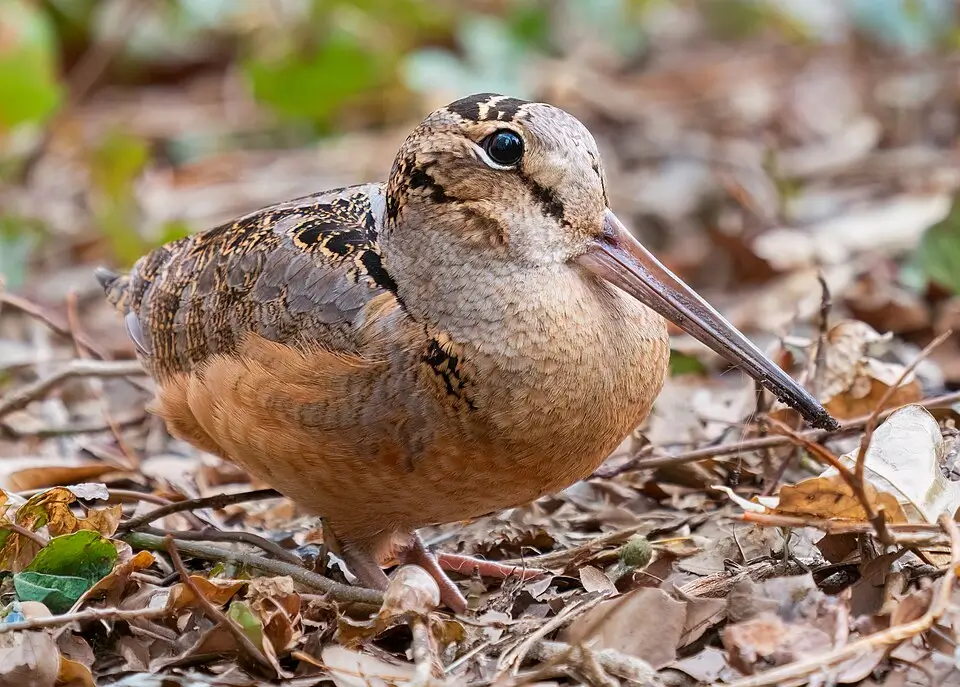
Physically, the woodcock is a stout, short-legged bird with one of the most recognizable silhouettes in the bird world. Its bill is extraordinarily long relative to its body — measuring roughly 2.5 to 2.75 inches — and is uniquely adapted for probing soft earth in search of earthworms, which form the cornerstone of its diet. The tip of the upper mandible is flexible and prehensile, allowing the bird to grasp prey underground without opening its bill at the surface. This remarkable adaptation makes the woodcock one of the most specialized foragers among North American birds.
The woodcock's large, dark eyes are positioned high and toward the back of its skull, providing a nearly 360-degree field of vision — an essential adaptation for detecting aerial predators while the bird's head is buried in the soil. Its brain is also oriented differently from most birds, with the cerebellum and brainstem rotated toward the underside of the skull, a direct consequence of this unusual eye placement.
Plumage in the American woodcock is a masterwork of natural camouflage. The bird's back and upper parts are a rich mixture of russet, chestnut, gray, and black, mimicking the complex texture of dead leaves on a forest floor. The underparts are a warm buff or orange-tan. Both sexes are similarly colored, though females tend to be slightly larger than males — an uncommon trait among birds in general.
One of the most celebrated behaviors of the American woodcock is the male's elaborate springtime courtship display, commonly referred to as the "sky dance." At dawn and dusk, males gather in small open clearings — called singing grounds — where they begin with a distinctive nasal "peent" call repeated at regular intervals from the ground. The male then launches into a spiraling aerial flight that can carry him hundreds of feet into the air. As he ascends, his wings produce a twittering sound caused by the specially modified outer primary feathers. He then descends in a liquid, tumbling pattern while producing a series of liquid chirping vocalizations, landing near the spot from which he departed. This display is repeated many times in succession and represents one of the most awe-inspiring wildlife spectacles available to anyone willing to stand quietly at the edge of a young forest at twilight.
Woodcocks are migratory birds, generally moving north into their breeding grounds in spring and retreating south to wintering areas in the Gulf Coast states as cold weather sets in. Migration tends to occur at night, and woodcocks are known to move in loose aggregations during favorable weather conditions, making certain areas hotspots for hunters and observers during peak migration windows.
Habitat & Range
The American woodcock's breeding range extends across much of the eastern half of North America, from the Gulf Coast states northward through New England and into southern Canada. The species favors young, moist forests and shrubby areas — particularly alder thickets, aspen stands, and areas with abundant ground-level cover near moist soil — where earthworms are plentiful and accessible.
Ideal woodcock habitat typically features a mosaic of different forest ages and structures. Young forest with dense shrub layers provides excellent cover during the day, while more open areas such as old fields, forest clearings, and brushy edges serve as singing grounds during the breeding season. Proximity to water — streams, seeps, beaver ponds, and wet meadows — tends to concentrate woodcock, as moist soils are far more productive for earthworm foraging.
In South Dakota, the woodcock's presence is somewhat peripheral compared to its stronghold in the Great Lakes states and New England. South Dakota is a landlocked state situated in the North Central region of the United States and is characterized by diverse landscapes including forests, river bottoms, grasslands, wetlands, and the vast Missouri River reservoir system. The state's river bottom forests and moist lowland areas in the eastern portions of the state can attract migrating woodcock, particularly during the fall migration period as birds move southward from their northern breeding grounds. Hunters and wildlife observers in eastern South Dakota who pay attention to suitable cover along forested drainages and brushy stream corridors may encounter woodcock, especially during active migration periods in autumn.
Hunting Information
The American woodcock has a long and storied tradition as an upland game bird in North America. Hunters prize the woodcock for its explosive, unpredictable flush from dense cover, its challenging flight through tangled woodland understory, and its reputation as outstanding table fare. Woodcock hunting is traditionally conducted with pointing or flushing dogs, as the birds hold remarkably tight to cover and can be nearly impossible to locate without a well-trained canine nose.
A woodcock hunt typically begins by identifying suitable habitat — young alder runs, aspen regeneration areas, and moist brushy draws near water. During the early season, hunters work these covers in search of resident birds. As the season progresses and temperatures drop, migrating birds funnel through in waves, and savvy hunters learn to time their outings to coincide with these flights.
Because the woodcock is a migratory bird, hunting seasons and regulations in the United States are set at the federal level by the U.S. Fish and Wildlife Service, with states establishing specific season frameworks within those guidelines. Hunters interested in pursuing woodcock in South Dakota or any other state should consult the South Dakota Game, Fish and Parks (GFP) for the most current and specific season dates, bag limits, and licensing requirements applicable to their planned hunting location and year. South Dakota GFP manages hunting opportunities across the state's varied landscapes, and hunters will find a wealth of resources available through the department's official channels.
It is also worth noting that a valid hunting license is required to pursue migratory game birds in South Dakota, and hunters 16 years of age and older are additionally required to purchase a Federal Migratory Bird Hunting and Conservation Stamp (commonly known as the Duck Stamp). Woodcock hunters should always verify current regulations before heading afield, as migratory bird seasons can change from year to year based on population assessments and management goals.
Conservation
The long-term conservation of the American woodcock is closely tied to the management of young forest habitat across eastern North America. Over recent decades, the decline of young forest — often called "early successional habitat" — has been identified as a primary driver of declining woodcock populations in many parts of the species' range. As forests mature and shrubby young growth gives way to closed-canopy woodland, the habitat mosaic that woodcock depend upon becomes increasingly fragmented and scarce.
Conservation efforts for the American woodcock are coordinated at the continental scale through initiatives such as the American Woodcock Conservation Plan, which brings together federal and state wildlife agencies, conservation organizations, and private landowners to protect, restore, and manage young forest habitat. Habitat management practices such as timber harvesting, prescribed fire, and brush clearing can all be used to create and maintain the early successional conditions that woodcock need to thrive.
Hunters play an important role in woodcock conservation. The Federal Duck Stamp, required for migratory bird hunters, generates critical funding for wetland and upland habitat conservation across North America. Hunting organizations and conservation groups also contribute significantly to habitat work through fundraising, volunteer labor, and advocacy. In this sense, the hunting community represents one of the woodcock's most consistent and committed conservation constituencies.
Citizen science efforts, including the annual Breeding Bird Survey and the U.S. Fish and Wildlife Service's American Woodcock Singing Ground Survey, help biologists track population trends and habitat use over time. Birdwatchers, hunters, and outdoor enthusiasts who report woodcock sightings and participate in monitoring efforts contribute meaningfully to the science that guides management decisions.
The American woodcock serves as an important indicator species for the health of young forest ecosystems in North America. Protecting this remarkable bird means protecting the moist woodlands, brushy thickets, and forested stream corridors that support an incredible diversity of other wildlife. It is a cause that resonates deeply with anyone who has ever stood at the edge of an alder thicket at dusk, listening for that unmistakable "peent" call before a timberdoodle rockets skyward into the fading light.