Overview
Few birds in North America command the kind of immediate admiration that the wood duck inspires at first glance. Known scientifically as Aix sponsa — a Latin phrase that translates loosely to "waterfowl in bridal dress" — the wood duck is widely regarded as one of the most visually stunning waterfowl species on the continent. Whether glimpsed gliding silently through a wooded swamp at dawn, perched improbably high in the crook of an old oak tree, or splashing into a quiet backwater creek, this bird never fails to leave an impression on those lucky enough to encounter it.
The wood duck holds a special place not only in the hearts of birdwatchers and wildlife enthusiasts but also among hunters, conservationists, and outdoor professionals who have long recognized its ecological importance and sporting appeal. It is a bird deeply intertwined with the forested wetlands of North America, and its story is one of both biological wonder and remarkable conservation achievement. For hunters and naturalists alike in states like Oklahoma — where wooded river bottoms, oxbow lakes, and flooded timber provide ideal habitat — the wood duck represents one of the most prized waterfowl encounters of the season.
This article explores the wood duck's remarkable biological traits, its preferred habitats and broad range across North America, its significance to hunters and wildlife managers, and the conservation legacy that helped bring this iconic species back from the brink of disappearance over a century ago.
Biological Traits
The wood duck (Aix sponsa) belongs to the family Anatidae, which encompasses all ducks, geese, and swans. Within that family, it is placed in the genus Aix, alongside only one other species — the mandarin duck of Asia — reflecting the uniqueness of its evolutionary lineage. This pairing makes perfect sense to anyone who has seen both birds: they are among the most ornate and colorful ducks in the world.
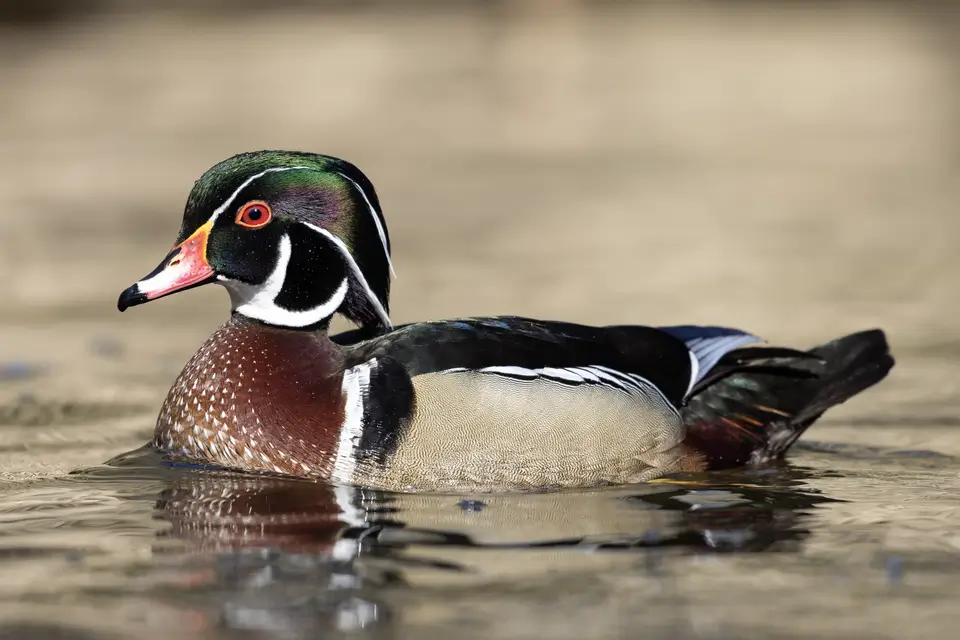
The adult male wood duck in breeding plumage is genuinely breathtaking. His head is adorned with an iridescent green and purple crested helmet, accented with crisp white lines that trace the face and throat. His chest is a rich chestnut brown, spotted with white, transitioning to golden flanks and a stark black-and-white pattern along the back and wings. Bright red eyes and a multi-colored red, white, and yellow bill complete the portrait of a bird that seems almost too vivid to be real.
The female, by contrast, is far more subtly colored — as is common in many duck species where camouflage serves a critical survival function during nesting. She wears a warm gray-brown plumage with a distinctive white teardrop eye ring that gives her a dignified, elegant appearance of her own. Though she lacks the male's dramatic finery, she is no less beautiful on close inspection.
One of the wood duck's most distinctive biological characteristics is its habit of nesting in tree cavities — a trait highly unusual among waterfowl. While most ducks nest on or near the ground, the wood duck seeks out hollow trees, often at considerable heights above the forest floor or even above standing water. Natural cavities formed by the work of large woodpeckers, such as the pileated woodpecker, or simply by decay and weathering, serve as ideal nest sites. The female will line the cavity with down feathers plucked from her own breast, creating a soft, insulated cup for her eggs.
Clutch sizes are typically large, often ranging from 10 to 15 eggs, with incubation lasting approximately 30 days. One of the most extraordinary moments in the wood duck's life cycle occurs just one day after hatching, when the tiny ducklings — not yet able to fly — must leap from the nest cavity, sometimes from heights of 50 feet or more, to follow their mother to water below. Their lightweight bodies and sharp claws allow them to make this dramatic plunge with remarkable success. Once on the water, the hen leads her brood to sheltered, vegetation-rich areas where food and cover are abundant.
Wood ducks are omnivorous, feeding on a wide variety of plant and animal matter. Acorns, seeds, berries, aquatic vegetation, insects, and small invertebrates all form part of their diet depending on the season. The consumption of acorns in particular makes wooded bottomlands with mature oak trees especially important habitat for this species during fall and winter.
The wood duck is also one of the few North American duck species capable of raising two broods in a single breeding season, particularly in the warmer southern portions of its range. This reproductive capacity has been an important factor in the species' recovery and sustained population health.
Habitat & Range
The wood duck is found across a broad swath of North America, with populations distributed through much of the eastern United States, parts of the Pacific Coast, and into southern Canada. It is a species intimately tied to forested wetlands — river bottomlands, wooded swamps, beaver ponds, oxbow lakes, and flooded timber all represent prime wood duck territory.
Unlike many waterfowl species that favor open water and vast marshes, the wood duck thrives in intimate, sheltered aquatic environments surrounded by mature trees. The presence of large, cavity-bearing trees is essential, not only for nesting but also for roosting. Dense shrubby vegetation along water edges provides crucial cover for hens and broods.
In Oklahoma, the wood duck finds ideal conditions across much of the eastern and central portions of the state. The Arkansas River basin, the Ouachita Mountains, and the forested river bottoms that characterize eastern Oklahoma provide the wooded wetland habitat this species depends upon. Oklahoma's network of lakes, reservoirs, and slow-moving streams lined with bottomland hardwoods — including the oaks, pecans, and tupelo gums that produce the mast crops wood ducks love — makes the state an important part of the Mississippi Flyway for migrating and wintering wood ducks, as well as supporting local breeding populations.
Wood ducks are generally considered partially migratory. Northern populations move southward in autumn as temperatures drop and water bodies begin to freeze, while more southerly populations may be year-round residents. Oklahoma sits in a favorable position along the flyway, receiving an influx of birds from the north during autumn migration while also supporting resident breeding pairs.
Hunting Information
The wood duck is a highly sought-after gamebird among waterfowl hunters throughout its range, prized for its beauty, its challenging nature as a target, and its excellent table quality. Wood duck hunting is often conducted in intimate, wooded settings — flooded timber, beaver swamps, and creek bottoms — rather than the wide-open marsh environments associated with many other duck species. This makes it a uniquely atmospheric hunting experience, often involving decoys set in shadowed pools beneath overhanging trees at the break of dawn.
In Oklahoma, waterfowl hunting is regulated by the Oklahoma Department of Wildlife Conservation (ODWC) in coordination with federal guidelines established by the U.S. Fish and Wildlife Service. Hunters pursuing wood ducks in Oklahoma are encouraged to consult the most current ODWC Hunting Regulations for up-to-date season dates, bag limits, and licensing requirements, as these details are reviewed and updated annually. The ODWC provides comprehensive resources for waterfowl hunters through its official website, including information on public hunting lands, the Oklahoma Land Access Program, and controlled hunt opportunities.
Wood duck hunting typically occurs during the early portion of the waterfowl season when birds are still local or newly arrived from the north. Early morning flights into flooded timber are a hallmark of the experience. Hunters typically use small decoy spreads, calls, and careful concealment in natural vegetation or layout boats suited to wooded wetland terrain. Steel shot and other non-toxic shot types are required by federal law for all migratory waterfowl hunting in the United States.
The wood duck's wariness and quick, agile flight through wooded corridors make it a genuinely challenging quarry. It is not uncommon for birds to appear suddenly through the trees at high speed, offering only brief shooting opportunities. This combination of spectacular appearance and demanding sport makes the wood duck one of the most memorable gamebirds a hunter can pursue.
Conservation
The wood duck's conservation story is one of the most compelling in North American wildlife management history. By the late 19th and early 20th centuries, the species had been dramatically reduced across much of its range due to a combination of unregulated market hunting and the widespread loss of old-growth forested wetlands through logging and land clearing. There were genuine fears among naturalists of the era that the wood duck could face extinction.
The passage of the Migratory Bird Treaty Act of 1918 was a watershed moment, providing federal legal protection to the wood duck and other migratory birds and ending the era of commercial market hunting. Combined with growing conservation awareness and the eventual regulation of sport hunting through science-based management, this protection allowed wood duck populations to begin recovering.
Another significant contribution to the wood duck's remarkable recovery has been the widespread adoption of artificial nest boxes. Because wood duck populations are strongly limited by the availability of suitable nesting cavities — a resource that had declined sharply with the logging of old-growth forests — providing man-made nest boxes proved to be a highly effective management tool. Wildlife agencies, conservation organizations, and individual landowners and sportsmen have installed countless nest box programs across the species' range, dramatically increasing nesting success and population numbers.
Today, the wood duck is considered a conservation success story and is one of the most abundant duck species in the eastern United States. Its populations are actively monitored through the annual Waterfowl Breeding Population and Habitat Survey conducted by the U.S. Fish and Wildlife Service and Canadian Wildlife Service. Hunters, through license fees and excise taxes on sporting equipment collected under the Federal Aid in Wildlife Restoration Act (Pittman-Robertson Act), continue to play a vital role in funding the habitat conservation and management programs that keep wood duck populations healthy.
In Oklahoma, conservation-minded sportsmen and the Oklahoma Department of Wildlife Conservation continue this legacy through habitat management, nest box programs, and the careful science-based regulation of harvest. The wood duck stands as enduring proof that wildlife conservation and hunting can work hand in hand to preserve remarkable species for future generations.