Overview
Few animals capture the spirit of the American wilderness quite like the wild turkey. Bold, intelligent, and strikingly beautiful, the wild turkey (Meleagris gallopavo) is one of North America's most iconic game birds — and one of its greatest conservation success stories. Whether you encounter one strutting across a sun-dappled forest clearing in the Ozark hills, calling from a ridgeline at dawn, or feeding quietly in an open Oklahoma meadow, the wild turkey commands attention and respect.
Long before it became a symbol of the Thanksgiving table, the wild turkey held a place of deep cultural significance for Indigenous peoples across the continent. Today, it remains a centerpiece of American hunting tradition, drawing millions of hunters into the field each spring and fall. Its combination of sharp senses, elusive behavior, and sheer magnificence make it one of the most challenging and rewarding quarries a hunter can pursue.
This article explores the biology, habits, range, and hunting significance of this remarkable bird, with a special focus on opportunities available to hunters and wildlife enthusiasts in the state of Oklahoma.
Biological Traits
The wild turkey is the largest member of the order Galliformes found in North America, a group that also includes pheasants, grouse, and quail. The species name Meleagris gallopavo is derived from Latin and Greek roots referencing its resemblance to guineafowl and its domestic counterpart. There are six recognized subspecies of wild turkey in North America, each adapted to slightly different environments, with the Eastern wild turkey (M. g. silvestris) and the Rio Grande wild turkey (M. g. intermedia) being the two subspecies most commonly found in Oklahoma.
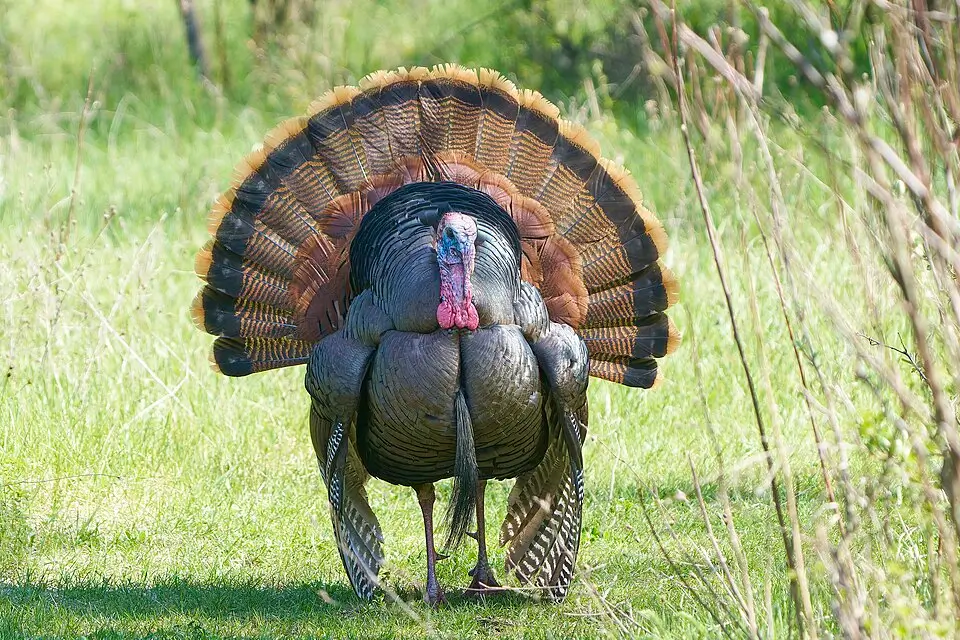
Wild turkeys are sexually dimorphic, meaning males and females differ significantly in appearance. Adult males, known as toms or gobblers, are among the most visually dramatic birds on the continent. They are covered in iridescent feathers that shimmer with hues of bronze, copper, green, and red depending on the angle of light. Toms feature a distinctive fleshy growth called a "snood" that hangs over the bill, a bare, colorful head that can flush red, white, or blue depending on the bird's mood, and a prominent "beard" — a tuft of coarse, hair-like feathers projecting from the chest. Some exceptional toms may grow multiple beards. Their legs are equipped with sharp, curved spurs that grow longer with age and are often used as indicators of a bird's maturity.
Adult toms are substantial birds, typically weighing between 16 and 24 pounds, though exceptionally large individuals can exceed this range. Their wingspans can reach approximately 4 to 5 feet, and their body length from bill to tail can approach 4 feet. The dramatic fan-shaped tail display is one of the most recognizable behaviors in the animal kingdom, performed by strutting toms during the spring breeding season to attract hens.
Female turkeys, called hens, are considerably smaller and more cryptically colored, sporting muted brown and buff tones that provide excellent camouflage in the underbrush. This natural disguise is crucial during the nesting period, when hens incubate clutches of typically 10 to 14 eggs in shallow ground nests for approximately 28 days.
Wild turkeys are omnivores with a highly varied diet. They consume acorns, seeds, berries, insects, small reptiles, and agricultural grains depending on seasonal availability. Their keen eyesight — widely regarded as among the sharpest of any North American game bird — is a primary defense mechanism. They can detect movement at remarkable distances and are capable of seeing in color, giving them a significant advantage over hunters who fail to remain perfectly still.
The turkey's vocalizations are equally remarkable. The legendary "gobble" of a tom can carry more than a mile in ideal conditions and is used to locate hens and announce dominance. Hens communicate with a variety of calls including the classic "yelp," "cluck," "purr," and "cackle," all of which have become essential knowledge for turkey hunters who use calls to lure birds within range.
Habitat & Range
The wild turkey is a highly adaptable species with one of the broadest ranges of any North American game bird. Historically, turkeys ranged across much of the continental United States, parts of Canada, and into Mexico. Following sharp population declines through the 19th and early 20th centuries due to overhunting and habitat loss, successful restoration programs have allowed the species to reclaim and even expand beyond its original range.
Today, wild turkeys can be found in 49 of the 50 U.S. states, as well as portions of Canada and Mexico. They thrive in a mosaic of habitats — ideally a mix of mature hardwood or mixed forests interspersed with open meadows, agricultural fields, and water sources. The forest provides roosting sites in tall trees (wild turkeys roost off the ground nightly to avoid predators), as well as mast crops like acorns and hickory nuts. Open areas offer foraging opportunities and strutting grounds during the breeding season.
In Oklahoma, the landscape provides exceptional turkey habitat. The eastern portion of the state, characterized by dense hardwood forests, river bottoms, and rolling hills, supports healthy populations of Eastern wild turkeys. The more open prairies, mesquite grasslands, and river corridors of western and central Oklahoma are home to the Rio Grande wild turkey, a subspecies well-suited to drier, more open terrain. This geographic diversity means Oklahoma hunters have the rare opportunity to pursue both subspecies, often in dramatically different landscape settings.
Oklahoma's rivers — including the Arkansas, Canadian, Red, and Cimarron — create critical riparian corridors that support turkey populations year-round, offering food, water, and travel routes through otherwise challenging terrain.
Hunting Information
The wild turkey is one of the most celebrated game birds in North America, and turkey hunting is a deeply rooted tradition in Oklahoma and across the country. The Oklahoma Department of Wildlife Conservation (ODWC) oversees wild turkey hunting regulations and management in the state, working to ensure sustainable populations for future generations of hunters and wildlife enthusiasts alike.
Oklahoma's varied geography and dual subspecies presence make it a premier turkey hunting destination in the south-central United States. Spring turkey season is widely considered the premier hunting event for this species. During this time, toms are actively gobbling, strutting, and searching for hens, making them more responsive to calls and decoys. The classic spring turkey hunt involves arriving before dawn, setting up near a known roosting area, and using hen calls to coax a gobbling tom into shooting range — a pursuit that demands patience, woodsmanship, and skill.
Fall turkey seasons are also available in many parts of the country, including Oklahoma, offering a different but equally rewarding experience. Fall hunting often involves locating and scattering flocks, then using assembly calls to bring the birds back together within range.
Hunters pursuing wild turkeys in Oklahoma are encouraged to check the most current regulations published by the Oklahoma Department of Wildlife Conservation, as season dates, bag limits, and licensing requirements can change from year to year. The ODWC website provides comprehensive, up-to-date hunting information, controlled hunt opportunities, and public land access resources through the Oklahoma Land Access Program.
Turkey hunting is typically conducted with shotguns loaded with turkey-specific loads, or increasingly with archery equipment, adding an additional layer of challenge to an already demanding pursuit. Successful turkey hunters invest significant time learning to read turkey sign — tracks, scratchings, droppings, and feathers — as well as mastering a variety of calls on box calls, slate calls, and mouth diaphragm calls.
Conservation
The wild turkey's story is one of the most inspiring conservation narratives in American wildlife history. By the early 20th century, unregulated hunting and widespread habitat destruction had reduced wild turkey populations to dangerously low levels — estimated at fewer than 30,000 birds across the entire country at the population's nadir.
The turnaround began in earnest in the mid-20th century, driven by the combined efforts of state wildlife agencies, the National Wild Turkey Federation (NWTF), and a dedicated community of hunters and conservationists. Through regulated hunting, habitat restoration, and large-scale trap-and-transfer programs that relocated wild-caught birds to suitable but unpopulated habitats, turkey populations rebounded dramatically. Today, an estimated 6 to 7 million wild turkeys roam North America — a testament to what science-based wildlife management and hunter-led conservation can achieve.
In Oklahoma, the ODWC has been an active participant in turkey management and conservation, monitoring populations and adapting regulations to ensure the long-term health of both Eastern and Rio Grande turkey populations. The North American Model of Wildlife Conservation — funded in large part through hunting license fees and excise taxes on sporting equipment under the Federal Aid in Wildlife Restoration Act (Pittman-Robertson Act) — continues to underpin these efforts.
Wild turkeys also serve important ecological roles. As omnivores that consume large quantities of insects and seeds, they contribute to pest control and seed dispersal. Their presence is often an indicator of healthy, diverse forest and grassland ecosystems.
For hunters, wildlife watchers, photographers, and conservationists alike, the wild turkey represents something profound: proof that dedicated, science-driven stewardship can restore a species from the brink and return it to its rightful place in the American landscape. In Oklahoma and across the nation, this magnificent bird continues to inspire awe, challenge hunters, and enrich the natural world.