Overview
Few sights in the natural world capture the imagination quite like a flock of Sandhill cranes moving across an open sky. These towering, gray-plumed birds — with their distinctive bugling calls echoing across wetlands and prairies — represent one of North America's most iconic wildlife spectacles. The Sandhill crane (Grus canadensis) is a species steeped in deep evolutionary history, behavioral complexity, and ecological significance. For hunters, naturalists, and casual observers alike, encountering these birds in the wild is a genuinely memorable experience.
As one of the most recognizable migratory birds on the continent, Sandhill cranes pass through states like Oklahoma each year in impressive numbers, drawing wildlife enthusiasts and hunters from across the region. Whether you are watching their graceful V-formations drift overhead on a crisp autumn morning or listening to their unmistakable rolling calls at dusk, the Sandhill crane commands attention and respect. This article explores the biology, behavior, habitat, hunting traditions, and conservation status of this remarkable species.
Biological Traits
The Sandhill crane is one of the oldest known bird species on Earth. Fossil records indicate that cranes remarkably similar to the modern Sandhill crane existed well over two million years ago, making this bird a true living relic of prehistoric North America. It belongs to the family Gruidae, the crane family, and is classified under the genus Grus.
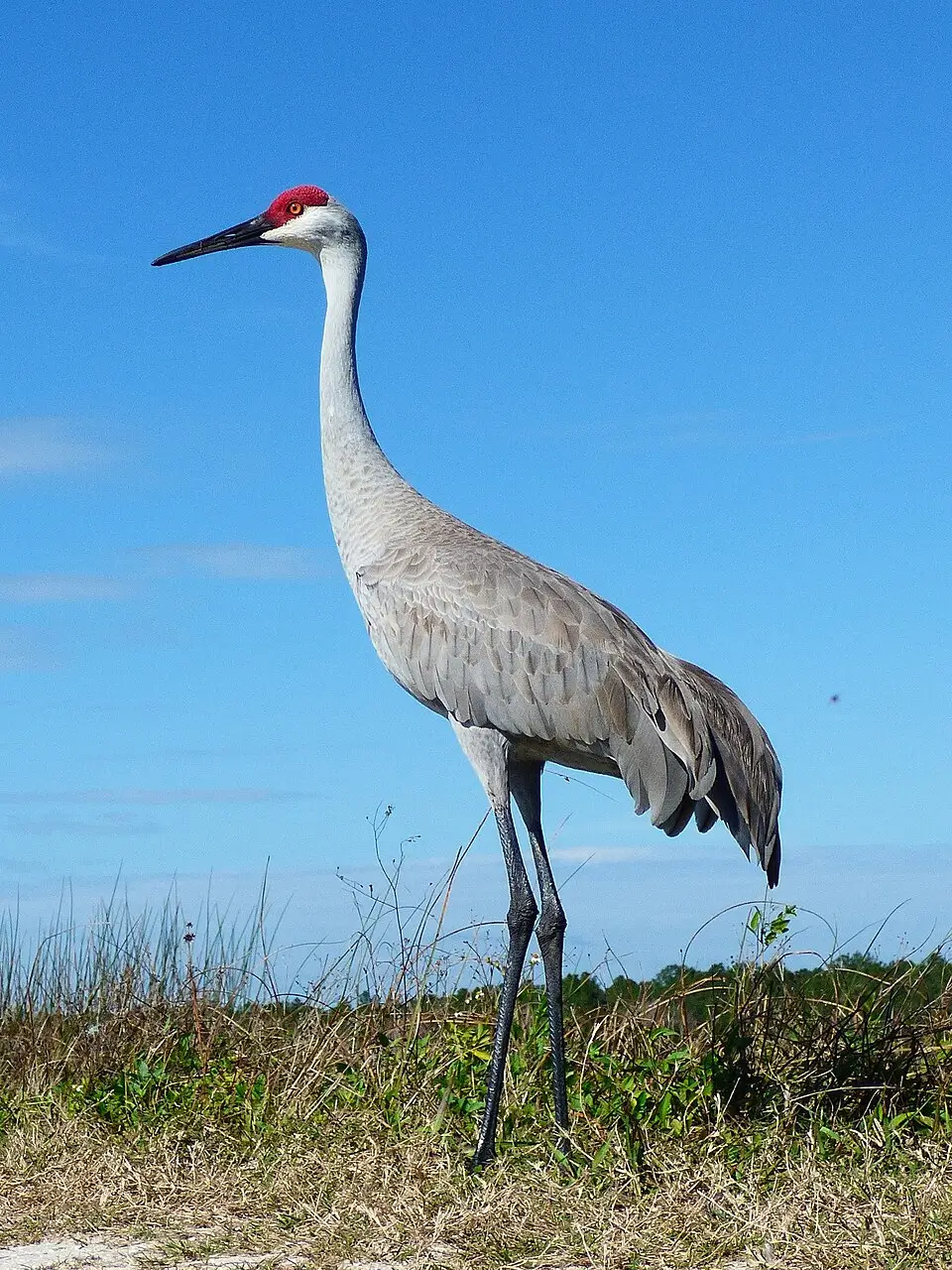
Adult Sandhill cranes are large, long-legged wading birds that stand approximately three to four feet tall and boast a wingspan that can stretch from five to nearly seven feet. Their plumage is predominantly gray, though wild birds often appear rusty or brownish in coloration due to a behavior unique among birds: they preen iron-rich mud into their feathers, staining them a warm reddish-brown during the breeding season. This self-applied "camouflage" is thought to help conceal nesting birds in their wetland and meadow environments.
One of the most iconic physical features of the Sandhill crane is the vivid red patch of bare skin that crowns the forehead and extends slightly down toward the eyes. This bright caruncle is more prominent in adults and plays a role in display behaviors during courtship and territorial interactions. Both males and females share this characteristic, though males tend to be slightly larger in body size.
Sandhill cranes are renowned for their elaborate and energetic courtship dances. These displays involve bowing, jumping, wing-spreading, and tossing of objects such as grass or sticks into the air. Pairs often perform these dances together, reinforcing the pair bond. Sandhill cranes are monogamous birds and typically mate for life, with pairs returning to the same nesting territories year after year.
Their vocalizations are equally distinctive. The Sandhill crane produces a deep, resonant, bugling call that can carry for several miles across open landscape. This call is produced with the help of an elongated trachea that coils within the sternum, acting like a natural amplifier and giving the call its characteristic rolling, trumpet-like quality. Flocks in migration can be heard long before they are seen, a feature that makes them particularly exciting for hunters and wildlife watchers positioned in the field.
Sandhill cranes are omnivorous, feeding on a wide variety of foods depending on the season and habitat. Their diet includes plant matter such as seeds, tubers, berries, and grain, as well as animal prey including insects, small rodents, snakes, frogs, and aquatic invertebrates. During migration, cranes often take advantage of agricultural fields, feeding heavily on leftover grain from corn and wheat harvests — a behavior that helps them accumulate the energy reserves needed for long-distance travel.
The species is divided into several subspecies, including the Greater Sandhill crane, Lesser Sandhill crane, Canadian Sandhill crane, Mississippi Sandhill crane, Florida Sandhill crane, and Cuban Sandhill crane. Some subspecies are migratory, while others — such as the Florida and Mississippi Sandhill cranes — are non-migratory resident populations.
Habitat & Range
The Sandhill crane occupies a remarkably broad range of habitats across North America. Breeding populations are found across Canada, Alaska, and portions of the northern and central United States, as well as in isolated pockets of the southeastern United States, Cuba, and even parts of Siberia. During migration and winter, the species spreads across a wide swath of the continent, funneling through the Central Flyway and other major migratory corridors.
Preferred habitats during the breeding season include freshwater marshes, wet meadows, bogs, and the edges of shallow lakes and rivers. These environments provide both nesting cover — cranes construct large mound nests made of aquatic vegetation in shallow water or on elevated ground near water — and the foraging resources necessary for raising young.
During migration, Sandhill cranes gather in extraordinary concentrations at key stopover sites. The Platte River valley in Nebraska is perhaps the most famous of these, hosting hundreds of thousands of cranes each spring as birds rest and refuel before continuing north to their breeding grounds. Other important staging areas exist throughout the central United States.
In winter, Sandhill cranes congregate in warm southern states including Texas, New Mexico, Arizona, California, and parts of Mexico. Oklahoma, situated along the Central Flyway, serves as both a migration corridor and, for some birds, a wintering destination. The state's mix of wetlands, prairie landscapes, agricultural fields, and river bottomlands makes it highly attractive to migrating cranes, and impressive flocks can be observed moving through Oklahoma during both the fall and spring migration periods.
Hunting Information
Sandhill crane hunting has grown considerably in popularity across the United States over the past several decades. Often called the "Ribeye of the Sky" by hunters who have sampled the table fare, the Sandhill crane offers a unique and rewarding wing-shooting experience. The meat of the Sandhill crane is notably dark and rich, with a flavor profile that many hunters compare to beef or pork rather than typical waterfowl, making it highly sought after as a culinary prize.
Hunting Sandhill cranes requires skill, patience, and a deep understanding of crane behavior. Hunters typically employ large full-body decoys or silhouette spreads to attract passing flocks, combined with electronic or mouth calls that mimic the birds' distinctive bugling vocalizations. Hunting often takes place in agricultural fields where cranes gather to feed, with hunters concealed in blinds or layout positions within the decoy spread.
Because Sandhill cranes are large birds with exceptional eyesight and an innate wariness developed over their long evolutionary history, hunters must pay careful attention to concealment and decoy placement. Patience is essential, as the birds may circle for extended periods before committing to a landing approach.
In Oklahoma, the Oklahoma Department of Wildlife Conservation (ODWC) oversees hunting regulations for migratory birds, including Sandhill cranes. Hunters interested in pursuing Sandhill cranes in Oklahoma are encouraged to consult the current Oklahoma Hunting Regulations provided by the ODWC, as season dates, bag limits, and licensing requirements are subject to annual review and may change from year to year. The ODWC also offers information about controlled hunts and public lands that may be accessible for crane hunting opportunities. Always verify the most current regulations directly through the Oklahoma Department of Wildlife Conservation before heading afield.
Conservation
The Sandhill crane is a conservation success story that speaks to the effectiveness of science-based wildlife management. Historically, populations of Sandhill cranes — like many North American bird species — declined significantly due to habitat loss and unregulated hunting in the 19th and early 20th centuries. Protective legislation, habitat restoration efforts, and carefully managed harvest programs have allowed most populations to recover to healthy and sustainable levels.
Today, the overall population of Sandhill cranes is considered stable and robust, with the migratory subspecies in particular doing well across their range. The species is not currently listed as threatened or endangered at the federal level in the United States, though some resident subspecies — particularly the Mississippi Sandhill crane and the Florida Sandhill crane — remain the focus of dedicated conservation efforts due to their restricted ranges and smaller populations.
Wetland conservation is central to the long-term health of Sandhill crane populations. Organizations, government agencies, and private landowners across North America have worked collaboratively to protect and restore the wetland and grassland habitats on which cranes depend. The health of key migration stopover sites, such as the Platte River in Nebraska, is considered especially critical to the species' continued success.
Hunters play an important role in crane conservation. Funds generated through hunting licenses, stamps, and the Federal Excise Tax on sporting goods — as administered through the Pittman-Robertson Act — contribute significantly to wildlife management programs that benefit Sandhill cranes and countless other species. The hunting community's investment in conservation infrastructure has been instrumental in sustaining the healthy crane populations that both hunters and wildlife watchers enjoy today.
The Sandhill crane stands as a symbol of resilience — a species that has endured for millions of years and continues to thrive across the North American landscape. For those fortunate enough to witness a great flock rising from a wetland at dawn or spiraling down into a harvested corn field on an autumn afternoon, it is clear that this ancient bird still has a vital place in the wild heart of the continent.