Overview
When most people think of fast animals, their minds might drift to the cheetah blazing across African savannas, but right here in North America, an equally remarkable sprinter has roamed the open grasslands for millions of years. The pronghorn (Antilocapra americana) is one of the continent's most iconic and biologically fascinating large mammals — a creature so uniquely adapted to its environment that it stands alone in the animal kingdom without a single close living relative. Often called the "American antelope," the pronghorn is not a true antelope at all, but rather the sole surviving member of the family Antilocapridae, a lineage that once included dozens of species during the Pleistocene epoch.
For hunters, naturalists, and wildlife enthusiasts across the American West and Southwest, the pronghorn represents both a thrilling quarry and a conservation success story of remarkable proportions. Lean, alert, and almost supernaturally fast, the pronghorn embodies the wild spirit of the open range. Understanding this animal — its biology, its behavior, its habitat requirements, and its place in the hunting tradition — is the first step toward appreciating just how special this creature truly is.
Biological Traits
The pronghorn is a study in evolutionary specialization. Its scientific name, Antilocapra americana, translates roughly to "American antelope-goat," a nod to its superficial resemblance to Old World antelopes and goats, despite being entirely unrelated to either. It is, in fact, the last living representative of a uniquely North American family of mammals — a genuine biological treasure.
One of the most immediately striking features of the pronghorn is its speed. Widely recognized as the fastest land animal in the Western Hemisphere, the pronghorn is capable of reaching speeds of up to 55 miles per hour and can sustain speeds of around 35 to 40 miles per hour over considerable distances. This extraordinary velocity is thought to be an evolutionary legacy from a time when North America was home to large, fast-running predators such as the American cheetah and various extinct hyenas. Even though those predators are long gone, the pronghorn has retained its breathtaking speed, making it one of the most athletic animals alive today.
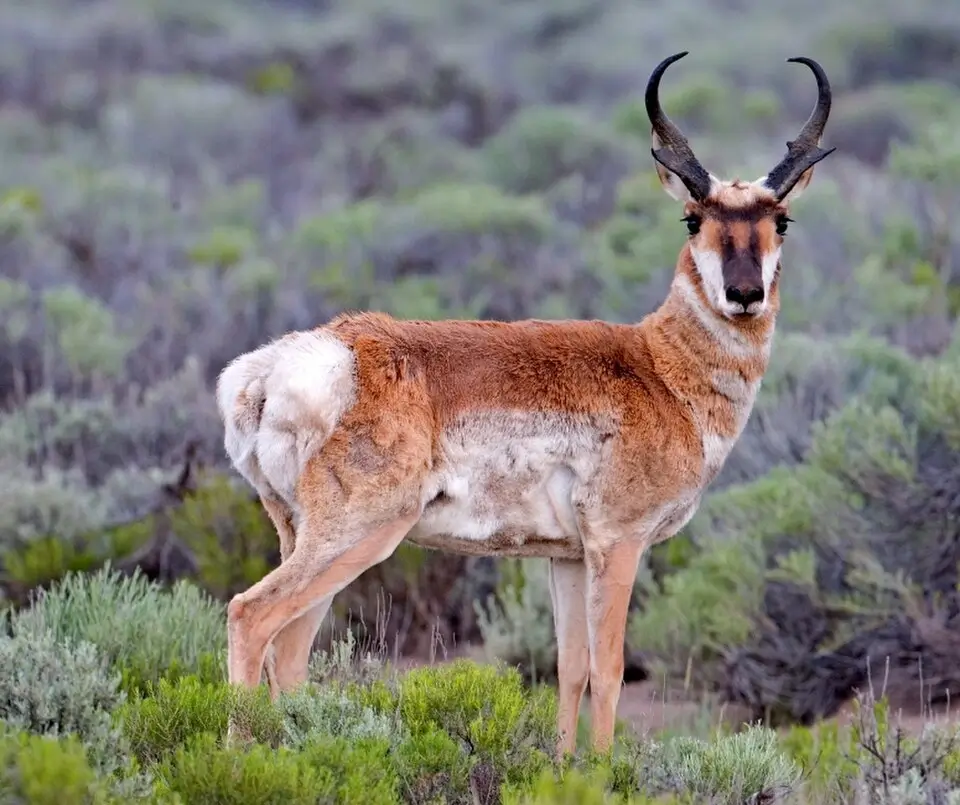
The name "pronghorn" comes from the distinctive shape of the animal's horns — and here, the pronghorn offers yet another biological curiosity. Unlike deer, which grow and shed antlers made of bone, or true antelope, whose horns are permanent bone sheaths, the pronghorn grows true horns with a bony core but sheds the outer keratinous sheath annually. This makes the pronghorn unique among all horned animals in the world. Both males and females typically bear horns, though the male's are considerably larger, often sweeping back and then forward in the characteristic "pronged" or forked shape that gives the animal its common name.
Pronghorns have an exceptionally large windpipe, heart, and lungs relative to their body size — physiological adaptations that fuel their remarkable speed and endurance. Their eyes are positioned on the sides of their head and are notably large for a mammal of their size, giving them a wide field of vision to detect approaching predators across the open terrain they favor. A pronghorn's eyesight is often compared to that of an 8-power binocular, capable of detecting movement at extraordinary distances. This acute vision, combined with their speed, makes them one of the most challenging animals in North America to approach on foot.
Males, called bucks, are noticeably larger than females, which are called does. Adult bucks typically weigh between 100 and 140 pounds, while does are somewhat lighter. The coat is a rich tan-to-brown on the upper body, with white patches on the sides, belly, and rump. The rump patch is particularly notable — when alarmed, a pronghorn can erect the long white hairs of the rump patch, creating a highly visible flash that serves as a warning signal to other members of the herd.
Habitat and Range
The pronghorn is quintessentially an animal of open spaces. It thrives in short-grass and mixed-grass prairies, sagebrush flats, and semi-arid shrublands — landscapes where its extraordinary eyesight and speed offer maximum advantage. Pronghorns are found primarily across the western United States, ranging from Montana and Wyoming southward through the Great Plains and into the desert Southwest and northern Mexico. Smaller populations also exist in parts of Canada.
The pronghorn's preference for wide, open terrain is not merely a matter of aesthetics — it is a survival strategy. Dense forests and heavy brush negate the animal's two greatest defenses: its ability to see threats from a great distance and its ability to outrun virtually anything that pursues it. Pronghorns are not jumpers by nature; in fact, they tend to crawl under fences rather than leap over them, a behavioral trait that has made fencing a significant management consideration in the western states.
In Oklahoma, pronghorn historically roamed the western portions of the state, particularly in the Panhandle region — the narrow strip of land in the far northwest of the state that extends westward between Kansas and Texas. This area, with its flat to gently rolling terrain, short-grass prairie, and open rangeland, represents classic pronghorn habitat. Oklahoma's Panhandle connects geographically and ecologically with the broader pronghorn range that extends through the Texas Panhandle and into New Mexico and Colorado to the west.
Hunting Information
The pronghorn has a long and storied history as a game animal in North America. For indigenous peoples, it was an important food source and a subject of cultural significance. In the modern era, pronghorn hunting has become a beloved tradition across the western states, prized for the unique challenge the animal presents, the quality of its meat, and the spectacular landscapes in which the hunt takes place.
Hunting pronghorn is widely regarded as one of the most exciting and demanding experiences in North American big game hunting. The combination of the animal's phenomenal eyesight, its preference for open terrain with minimal cover, and its almost paranoid wariness creates a hunt that demands skill, patience, and careful planning. Spot-and-stalk hunting is perhaps the most common method, requiring hunters to glass extensively from vantage points, identify animals at long range, and then carefully plan an approach that uses every available contour of the land for concealment.
In Oklahoma, pronghorn are found primarily in the Panhandle counties. Hunters interested in pursuing pronghorn in Oklahoma should consult the Oklahoma Department of Wildlife Conservation (ODWC) for the most current licensing requirements, season dates, and any applicable controlled hunt regulations. Like many western states, Oklahoma may employ a controlled hunt or lottery system for pronghorn to ensure populations are managed sustainably. Prospective hunters are strongly encouraged to visit the ODWC's official website and review the most up-to-date hunting regulations before planning a pronghorn hunt in the state.
Regardless of the specific regulations in any given season, hunters pursuing pronghorn should be well-prepared for the unique demands of this quarry. Long-range shooting skills are an asset, as pronghorn in open terrain often do not allow a close approach. Optics — both binoculars and a quality spotting scope — are essential tools. Early mornings and late afternoons tend to be the most productive times to locate animals, as pronghorn are most active during cooler parts of the day.
The meat of the pronghorn is widely celebrated among hunters for its mild, fine-grained quality. When field-dressed promptly and properly cared for in the field, pronghorn venison is considered by many to be among the finest-tasting game meats in North America.
Conservation
The pronghorn's conservation story is one of the most remarkable wildlife recoveries in American history. At the turn of the twentieth century, unregulated market hunting and habitat loss had reduced the pronghorn population from an estimated 30 to 40 million animals — a number that rivaled the great bison herds — to fewer than 15,000 individuals. The species teetered on the edge of extinction.
Thanks to the implementation of regulated hunting, the establishment of the North American Model of Wildlife Conservation, and the dedicated efforts of wildlife managers and sportsmen's organizations, pronghorn numbers rebounded dramatically over the course of the twentieth century. Today, pronghorn populations across North America number in the hundreds of thousands, representing one of the great wildlife conservation achievements of modern times.
Hunters have played a central and ongoing role in this conservation success. Through license fees and excise taxes on sporting goods — funds directed to wildlife management through mechanisms like the Federal Aid in Wildlife Restoration Act (Pittman-Robertson Act) — hunters have provided substantial financial support for pronghorn research, habitat management, and population monitoring. In states like Oklahoma, where the pronghorn occupies a relatively small portion of its historic range, careful management by agencies like the Oklahoma Department of Wildlife Conservation is essential to maintaining healthy, sustainable populations.
Ongoing conservation challenges for pronghorn include habitat fragmentation, fencing that impedes migration corridors, and land use changes that affect the short-grass and shrubland habitats the species depends upon. Wildlife managers and conservation organizations continue to work on solutions such as fence modifications that allow pronghorn to pass beneath the lowest wire, and the protection and restoration of key migration routes.
The pronghorn stands as a living symbol of both the resilience of North American wildlife and the effectiveness of science-based conservation management. Every time a pronghorn buck erupts into a full sprint across the open plains, it is a reminder of what can be preserved — and what can be recovered — when people commit to the long-term stewardship of the natural world.