A Complete Guide to Zenaida macroura
Few birds are as deeply woven into the fabric of American outdoor culture as the mourning dove. With its soft, mournful cooing drifting across open fields at dawn, this elegant bird has captured the hearts of birdwatchers and hunters alike for generations. Known scientifically as Zenaida macroura, the mourning dove is widely regarded as the most hunted migratory game bird in North America, with tens of millions harvested by hunters each year across the continent. Yet despite this hunting pressure, the species remains remarkably abundant, a testament to its extraordinary reproductive capacity and adaptability.
In Oklahoma, the mourning dove holds a place of special cultural and recreational significance. The state's diverse landscape — ranging from rolling prairies and red dirt plains in the west to verdant river bottoms and wooded hills in the east — provides ideal habitat for this beloved bird. Whether you're a seasoned hunter who has spent decades rising before the sun to set up along a sunflower field, or a curious naturalist trying to identify that soft cooing from the backyard, understanding the mourning dove is a rewarding pursuit. This article takes a comprehensive look at the mourning dove's biology, habitat, behavior, hunting traditions, and conservation status.
Biological Traits
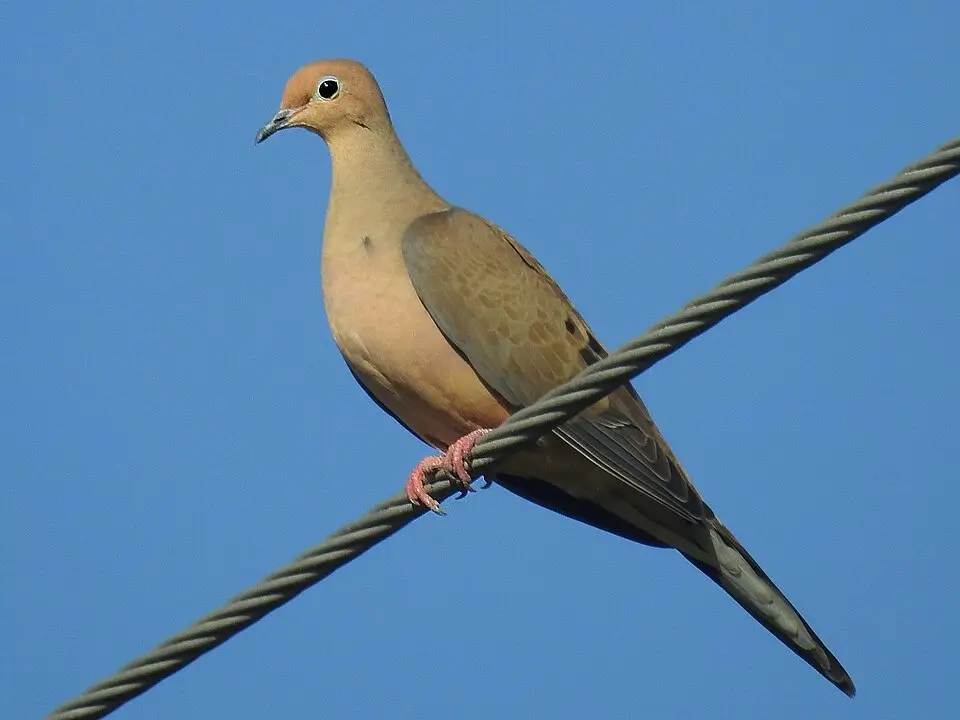
The mourning dove (Zenaida macroura) belongs to the family Columbidae, the large and globally distributed family of pigeons and doves. It is a medium-sized bird, sleek in build, with a small rounded head perched atop a plump, streamlined body that tapers to a long, pointed tail — one of the most distinctive features of the species. This elegant tail sets the mourning dove apart from many of its relatives and is a key field identification marker.
The bird's plumage is a study in subtle beauty. Its upperparts are primarily a soft grayish-brown, often described as tawny or buff, while the underparts are a warm pinkish-tan. The wings are dotted with distinctive black spots, and the face is adorned with a small but striking patch of iridescent pink and green feathers on the neck, visible in good light. The skin around the eye is a vivid blue-gray, giving the bird an almost jeweled appearance up close. Males tend to be slightly more colorful than females, with stronger iridescence on the neck and a more distinctly pinkish breast.
One of the most recognizable aspects of the mourning dove is its vocalization. The bird produces a series of soft, drawn-out coos — often written as "oowoo-woo-woo" — that carry remarkably far across open landscapes. This call, resembling a lament or a gentle grieving, is the origin of the bird's common name. Many people who hear this call for the first time mistake it for the call of an owl, a common and understandable confusion.
The mourning dove is also celebrated for its flight capabilities. When flushed from the ground or a perch, it launches with a distinctive whistling sound produced by its wings — a feature caused by specialized feathers and rapid wingbeats. In sustained flight, mourning doves are fast and agile, capable of reaching speeds estimated at over 55 miles per hour. This speed and unpredictable flight pattern make the species a challenging and exciting target for wing shooters.
Perhaps most remarkable among the mourning dove's biological traits is its reproductive output. Pairs typically raise multiple broods per year — often as many as five or six in warmer climates — with each clutch consisting of just two eggs. Incubation lasts roughly two weeks, and the young, called squabs, fledge in another two weeks or so. Both parents share incubation and brooding duties, and both produce a nutritious secretion called "crop milk" to feed their young during the earliest days of life. This crop milk, rich in protein and fat, is produced in the crop of both male and female doves and is a trait shared with other members of the pigeon family. This prolific breeding strategy allows dove populations to remain robust even under significant hunting pressure.
Mourning doves are primarily granivorous, meaning they subsist almost entirely on seeds. They forage on the ground, often in open areas, consuming seeds from a wide variety of grasses, weeds, and agricultural crops. Sunflower seeds, millet, safflower, and various weed seeds are among their preferred foods. Unlike many birds, doves do not crack open seeds with their bills but swallow them whole, relying on a muscular gizzard and ingested grit to grind their food. This feeding behavior makes them heavily reliant on open ground with accessible seed sources, and it also draws them to agricultural areas where grain crops are grown or harvested.
Habitat & Range
The mourning dove is one of the most widespread birds in North America. Its range extends from southern Canada through the continental United States, Mexico, Central America, and into portions of the Caribbean. In the United States, the species is present year-round across much of the southern half of the country, while northern populations are migratory, moving southward in autumn and returning in spring. This migratory behavior is what classifies the mourning dove as a migratory game bird under federal law, placing it under the jurisdiction of the U.S. Fish and Wildlife Service.
In terms of habitat preference, the mourning dove is a bird of open and semi-open landscapes. It thrives in areas that combine open ground for foraging with scattered trees or shrubs for perching, roosting, and nesting. Farmlands, grasslands, open woodlands, forest edges, roadsides, suburban neighborhoods, and desert scrub all provide suitable habitat. The species shows a particular affinity for agricultural areas, where harvested grain fields offer abundant food resources.
Oklahoma's geography makes it an outstanding state for mourning doves. The western portions of the state, dominated by shortgrass and mixed-grass prairies, agricultural fields, and river corridor woodlands, provide textbook dove habitat. The central regions, including the famous red dirt country of central Oklahoma, are equally productive. Even the more heavily forested eastern counties of the state, with their mix of timber and agricultural clearings, support healthy dove populations. The state sits squarely within the Central Flyway, one of the four major migratory corridors in North America, making Oklahoma a critical staging and wintering area for doves moving through the continent.
Hunting Information
The mourning dove is the most popular game bird in the United States by total harvest, and it holds a similarly exalted place in Oklahoma's hunting culture. Dove hunting is frequently a hunter's first experience with wing shooting, and it remains one of the most accessible and social forms of hunting practiced in the state. Opening day of dove season — typically falling on or around September 1st as established by federal migratory bird regulations — is treated almost as a holiday in many rural Oklahoma communities. Hunters gather in sunflower fields, harvested grain plots, and water sources, often in the company of family and friends, making dove season as much a social tradition as a sporting event.
Effective dove hunting requires relatively modest equipment compared to many other forms of hunting. A shotgun — most commonly a 12 or 20 gauge — loaded with appropriate small shot is the standard tool. Hunters often set up along field edges, near water sources, or along known flight corridors where doves move between roosting and feeding areas. Because doves fly fast and erratically, successfully hitting them consistently is a genuine skill that takes practice to develop, making the pursuit endlessly satisfying.
Hunters and landowners in Oklahoma also frequently manage land specifically to attract doves. Planting sunflowers, milo, or millet, as well as managing weedy areas and maintaining access to water sources, can significantly increase dove numbers on a given property. This type of wildlife management not only benefits dove hunters but also supports a wide range of other wildlife species.
For those interested in hunting mourning doves in Oklahoma, it is important to consult the Oklahoma Department of Wildlife Conservation (ODWC) for current regulations, season dates, bag limits, and licensing requirements. Regulations for migratory birds are set annually through a cooperative process between the U.S. Fish and Wildlife Service and individual state agencies, so hunters should always verify current rules before heading afield.
Conservation
Despite being harvested in enormous numbers each year, the mourning dove is classified as a species of Least Concern by conservation authorities, reflecting its large and widespread population. Its ability to raise multiple broods annually gives the species a remarkable capacity to sustain itself under hunting pressure as well as natural mortality.
Conservation organizations and wildlife agencies monitor dove populations through tools such as the Breeding Bird Survey and the Call Count Survey, a long-running program in which observers count dove coos along established routes to track population trends. These monitoring efforts help ensure that hunting seasons and bag limits remain sustainable over the long term.
Habitat conservation is perhaps the most important factor in the long-term welfare of mourning dove populations. The loss of agricultural diversity, changes in farming practices that reduce weed seed availability, and urban sprawl can all reduce carrying capacity for doves. Conversely, conservation programs that support native grasslands, wildlife food plots, and hedgerows benefit dove populations significantly. Hunters themselves play a major role in this equation, as the excise taxes paid on firearms and ammunition — through the Federal Aid in Wildlife Restoration Act, commonly known as the Pittman-Robertson Act — fund a significant portion of wildlife management and habitat conservation work across the country.
In Oklahoma, the ODWC works actively to manage and conserve dove habitat alongside the broader array of wildlife species that share the state's diverse landscapes. Hunters, conservationists, landowners, and wildlife managers share a common interest in ensuring that the mourning dove continues to thrive for generations to come.