Overview
Few birds capture the spirit of the American Great Plains quite like the Greater prairie-chicken (Tympanuchus cupido). This striking, medium-sized grouse has long been woven into the ecological and cultural fabric of the central United States, serving as both a symbol of wild, open spaces and a barometer for the health of native grassland ecosystems. With its elaborate courtship displays, distinctive vocalizations, and fascinating behavioral adaptations, the Greater prairie-chicken stands as one of North America's most captivating upland game birds.
Oklahoma, with its sweeping tallgrass prairies and mixed-grass plains, represents an important part of the Greater prairie-chicken's remaining range. The state's wide-open landscapes provide a glimpse into what much of the central United States once looked like — vast, unbroken expanses of native grass stretching to the horizon, alive with the booming calls of these remarkable birds. For hunters, wildlife enthusiasts, and conservationists alike, the Greater prairie-chicken holds a special place of reverence and admiration.
Understanding this species — its biology, its needs, its history, and its future — is essential for anyone who values the rich natural heritage of the American grasslands. This article explores the world of the Greater prairie-chicken from multiple perspectives, shedding light on what makes this bird so extraordinary and why its conservation matters deeply to the future of prairie ecosystems.
Biological Traits
The Greater prairie-chicken (Tympanuchus cupido) belongs to the family Phasianidae and the order Galliformes, placing it in the same broad family as turkeys, pheasants, and quail. It is one of three species in the genus Tympanuchus, the others being the Lesser prairie-chicken (Tympanuchus pallidicinctus) and the Sharp-tailed grouse (Tympanuchus phasianellus).
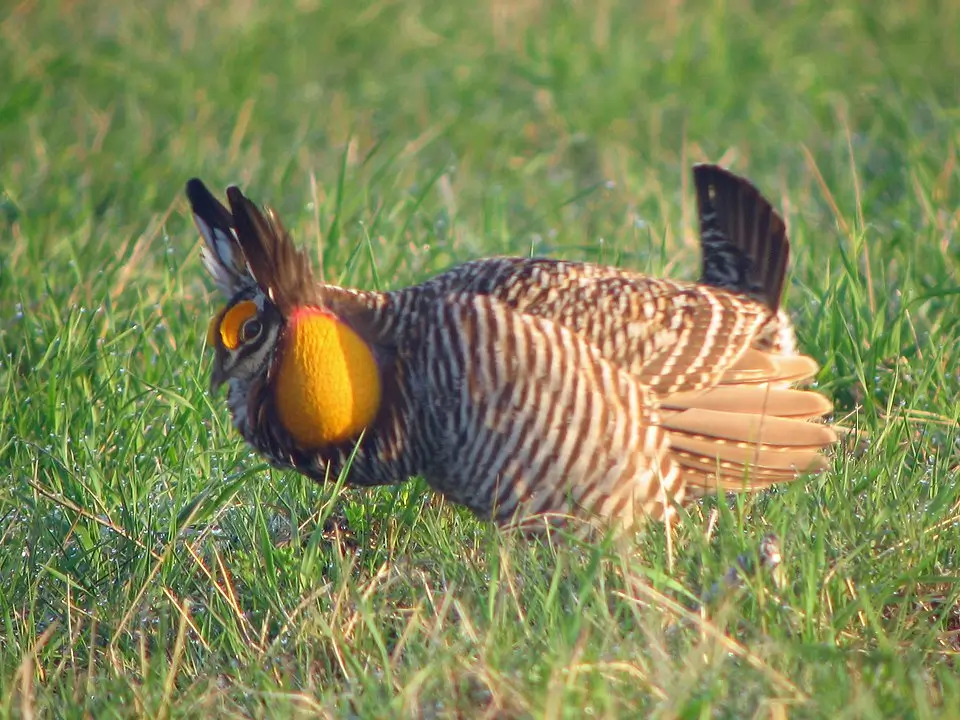
One of the most visually distinctive features of the Greater prairie-chicken is its heavily barred plumage. Both males and females display alternating bands of brown, buff, and white across their body feathers, providing excellent camouflage in grassland environments. Males, however, are adorned with several additional characteristics that set them apart, particularly during the breeding season. They possess elongated feathers on the sides of the neck, known as pinnae or "pinnacles," which can be raised during display. Beneath these feathers lie bright orange-yellow air sacs called tympanic sacs, which males inflate to produce the haunting, resonant "booming" sounds that define the prairie spring.
This booming display is performed on traditional mating grounds known as leks — open, slightly elevated areas of short grass where males gather each spring to compete for the attention of females. Lek activity typically begins in the very early morning, before dawn, and can continue for several hours. Males engage in a full repertoire of behaviors at leks, including stomping their feet rapidly, spreading their tail feathers, inflating their air sacs, raising their pinnae, and rushing toward rival males. The competition can be intense, but it is primarily ritualistic rather than physically harmful. Dominant males that hold central positions on the lek are typically the most successful in attracting mates.
Females visit the lek, select a mate, and then typically move off to nest alone. Nests are simple scrapes in the ground, hidden within dense grass or other low vegetation. Clutch sizes generally range from around 10 to 14 eggs, and the female alone incubates them for approximately 23 to 26 days. Once hatched, the chicks — known as precocial young — are capable of leaving the nest and foraging within hours of hatching, though they remain under the care of the hen for several weeks.
The diet of the Greater prairie-chicken shifts seasonally in response to availability. During warmer months, insects make up a substantial portion of the diet and are especially important for growing chicks, providing the protein needed for rapid development. As the seasons change and insects become scarce, the birds transition to a diet dominated by plant material including seeds, waste grain, leaves, and fruit. In winter, they may travel considerable distances to find adequate food sources, sometimes concentrating in agricultural areas where grain is available.
Greater prairie-chickens are generally not long-distance migrants, but they do make seasonal movements, particularly in response to food availability and weather. Their home ranges can vary considerably depending on habitat quality and seasonal conditions.
Habitat & Range
The Greater prairie-chicken is fundamentally a bird of the grasslands. It evolved alongside the vast tallgrass and mixed-grass prairies that once blanketed much of the central United States, and its survival today is inextricably linked to the persistence of these ecosystems.
Historically, the species ranged across a broad swath of North America, from the Atlantic coast of New England and the Mid-Atlantic states westward through the Great Plains. As European settlement expanded and agricultural practices transformed the landscape, much of this range was dramatically reduced. Today, the species is largely confined to portions of the central Great Plains, with populations present in states such as Kansas, Nebraska, South Dakota, and Oklahoma, among others.
Oklahoma represents a meaningful part of the bird's current range, particularly in the northeastern portion of the state where remnant patches of tallgrass prairie persist. The Osage Hills and the broader Flint Hills ecosystem — which extends from Kansas into northern Oklahoma — provide some of the most intact tallgrass prairie habitat remaining anywhere in the world. These landscapes, characterized by rolling hills covered in big bluestem, little bluestem, Indiangrass, and switchgrass, are precisely the type of environment that Greater prairie-chickens depend upon for nesting, brood-rearing, and survival.
Within their habitat, Greater prairie-chickens require a mosaic of vegetation conditions. Dense, undisturbed grass patches are needed for nesting and escape cover, while more open, shorter grass areas serve as lekking grounds and foraging sites. The presence of shrubs and woody vegetation can be detrimental, as it reduces sight lines and provides cover for predators. This is why grazing and prescribed fire — traditional tools of grassland management — play important roles in maintaining the open, varied structure that prairie-chickens need.
Hunting Information
The Greater prairie-chicken has a long and storied history as an upland game bird in the United States. During the 19th and early 20th centuries, market hunting placed enormous pressure on prairie-chicken populations across their range. Today, regulated hunting continues in states where populations are sufficient to support harvest, and it is conducted under careful scientific management by state wildlife agencies.
In Oklahoma, the Oklahoma Department of Wildlife Conservation (ODWC) oversees all aspects of wildlife management, including any hunting seasons for Greater prairie-chicken. Hunters interested in pursuing Greater prairie-chickens in Oklahoma are strongly encouraged to consult the ODWC's current hunting regulations before the season, as rules regarding season dates, bag limits, licensing requirements, and open zones can change from year to year based on population data and habitat assessments. The ODWC publishes updated hunting regulations annually and provides resources to help hunters understand where and when hunting is permitted.
Hunting Greater prairie-chickens is a traditional pursuit that rewards patience and fieldcraft. These birds are most commonly hunted over pointing dogs, which use their keen sense of smell to locate birds holding in dense grass cover. Hunters work behind the dogs, walking prairies and grasslands in the early morning and late afternoon hours when birds are most active. A well-trained bird dog capable of working in open terrain and handling prairie grasses is an invaluable partner in this type of hunting.
The experience of hunting prairie-chickens is deeply tied to the landscape itself. Walking the rolling grasslands at dawn, with the wide Oklahoma sky overhead and the possibility of a covey flushing underfoot, is a uniquely American hunting experience that connects participants to a tradition stretching back generations. As with all wildlife pursuits in Oklahoma, ethical conduct, respect for the land, and adherence to regulations are the cornerstones of responsible hunting.
Conservation
The conservation story of the Greater prairie-chicken is complex and ongoing. The species has experienced significant range contraction over the past two centuries, driven primarily by the large-scale conversion of native grasslands to row-crop agriculture, urban development, and the encroachment of woody vegetation into open prairie. Populations that once numbered in the millions have been reduced to scattered remnants in a fraction of their former range.
Despite these challenges, conservation efforts on behalf of the Greater prairie-chicken have produced meaningful results in many areas. Federal programs that incentivize the preservation and restoration of native grasslands — such as the Conservation Reserve Program (CRP) — have helped landowners maintain habitat on private lands. State wildlife agencies, conservation organizations, and private landowners have collaborated on efforts to restore and manage grasslands through prescribed burning, targeted grazing, and invasive species control.
In Oklahoma, the state's wildlife agency works to monitor prairie-chicken populations and manage habitat in ways that support the species' long-term persistence. The Tallgrass Prairie Preserve in northeastern Oklahoma, managed by The Nature Conservancy, represents one of the largest protected expanses of tallgrass prairie in the world and provides critical habitat for a range of grassland-dependent species, including the Greater prairie-chicken.
The long-term future of the Greater prairie-chicken depends on the future of the grasslands themselves. Protecting and restoring native prairie is not only an investment in this iconic species but also in the broader suite of plants, insects, mammals, and birds that depend on these ecosystems. For those who hunt, birdwatch, or simply value the wild heritage of the American interior, supporting grassland conservation is one of the most meaningful actions available.