Overview
Few birds in North America have captured the imagination of hunters, birdwatchers, and outdoor enthusiasts quite like the common snipe. Known scientifically as Gallinago gallinago, this remarkable shorebird occupies a unique space in outdoor culture — it is simultaneously one of the most challenging birds to hunt, one of the most fascinating to observe, and, thanks to the long-standing "snipe hunt" prank, one of the most mythologized creatures in the American wilderness. Yet despite its reputation as a novelty, the common snipe is a very real, very worthy quarry that demands respect from any serious wingshooter.
In states like Oklahoma, where diverse wetland habitats, river bottoms, and marshy lowlands provide ideal conditions during migration and winter months, the common snipe offers hunters a genuinely thrilling experience unlike almost any other bird hunt. Its cryptic camouflage, explosive flushing behavior, and unpredictable zigzagging flight have earned it a reputation as one of the most difficult birds to bring to bag. The word "sniper" itself is derived directly from this bird, a testament to just how much skill was historically required to hunt it successfully.
Whether you are a seasoned wingshooter looking to add a new challenge to your season or a curious naturalist eager to learn more about this secretive wader, this guide offers a comprehensive look at the common snipe — its biology, its habitat, its behavior, and what hunters can expect when pursuing it in Oklahoma and beyond.
Biological Traits
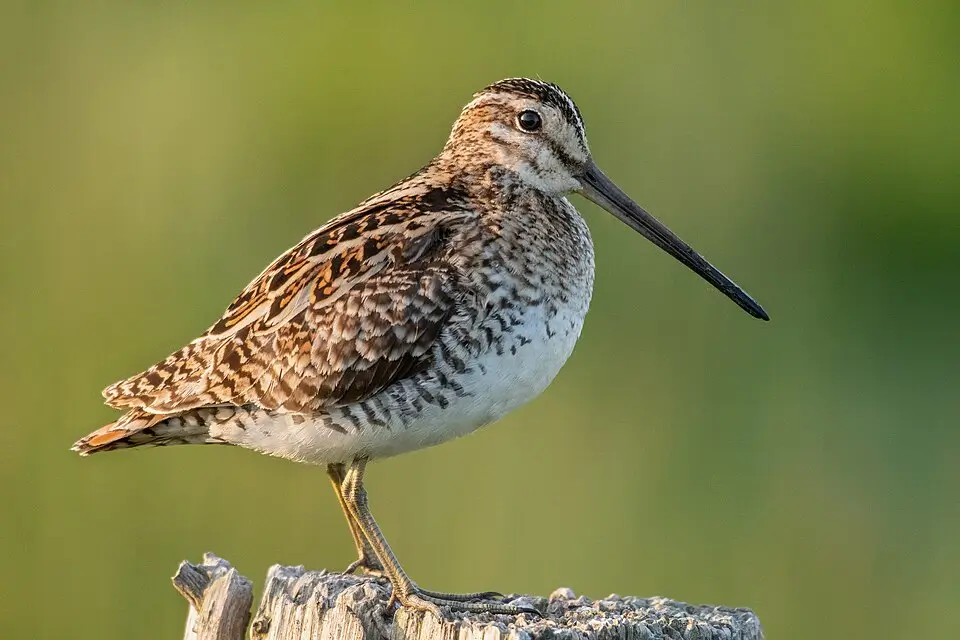
The common snipe (Gallinago gallinago) is a member of the family Scolopacidae, the large and diverse group of shorebirds that includes sandpipers, woodcocks, and their relatives. It is a medium-sized wading bird, typically measuring between 25 and 27 centimeters in length, with a wingspan that can reach up to 47 centimeters. One of its most immediately recognizable features is its extraordinarily long, straight bill, which can measure up to 7 centimeters and is packed with sensitive nerve endings near the flexible tip — an adaptation that allows the bird to detect and seize invertebrates in soft mud without ever seeing them.
The plumage of the common snipe is a masterwork of natural camouflage. The bird's back is richly patterned in stripes of buff, chestnut, black, and white, producing a broken-up visual pattern that makes it nearly invisible against a background of dried grasses, sedges, and leaf litter. The underparts are paler, with streaking on the breast and flanks. This cryptic coloration is not merely decorative — it is the snipe's primary defense mechanism. When approached by a predator or hunter, the bird will often freeze and rely entirely on its camouflage before finally flushing at close range with a startling burst of speed.
That flush is one of the defining experiences of snipe hunting. When a common snipe takes flight, it does so explosively, rising steeply and immediately launching into a rapid, jinking, zigzagging flight pattern that is notoriously difficult to track with a shotgun. This evasive flight is instinctive and has been honed over millennia of predator pressure. Snipe can reach speeds of up to 60 miles per hour, and their erratic course changes make them one of the most challenging aerial targets in the bird hunting world.
Like other shorebirds, common snipe are probers. They use their long, flexible-tipped bills to probe deep into soft mud and soil in search of earthworms, insect larvae, small crustaceans, and other invertebrates. The tip of the bill is uniquely adapted with a rhynchokinetic joint, meaning the bird can open just the tip of its bill while it is buried in mud — a highly specialized feeding adaptation shared by relatively few bird species.
Common snipe are also known for a dramatic and musical display flight called "drumming" or "winnowing," performed primarily during the breeding season. During this display, the male (and sometimes the female) dives steeply through the air while spreading and vibrating the stiff outer tail feathers. The rush of air over these specialized feathers produces a haunting, hollow sound often described as a "bleating" or "drumming" — a sound that has earned the bird numerous folk names in various European cultures, including "heather-bleater" and "sky goat."
Habitat & Range
The common snipe has an impressively broad range, breeding across much of the Palearctic — from Iceland and the British Isles eastward through Europe and northern Asia. In North America, the closely related Wilson's snipe (Gallinago delicosa) was long considered the same species and is the bird most commonly encountered by hunters on the continent. However, true common snipe do occur in North America as rare migrants and occasional visitors, and for many practical purposes — in terms of hunting, identification, and habitat preference — the two species are ecologically nearly identical and share very similar characteristics.
In terms of habitat, common snipe are strongly associated with wetlands and moist, open terrain. They favor marshes, bogs, fens, wet meadows, flooded agricultural fields, river margins, and any area where soft, waterlogged soil provides access to their invertebrate prey. They are ground-dwelling birds that prefer areas with sufficient vegetation cover for concealment but also require open patches of wet or muddy ground for foraging.
During migration and winter, snipe disperse widely across lower latitudes. In the United States, wintering birds can be found across the Gulf Coast states, the Southeast, and anywhere mild temperatures keep the ground unfrozen and accessible. Oklahoma, with its diverse landscape of river bottoms, flooded fields, stock ponds, marshes along major waterways like the Arkansas and Red Rivers, and wetland conservation areas, provides excellent habitat for snipe during the fall and winter months. Birds moving south from northern breeding grounds pass through or winter in Oklahoma in significant numbers, making the state a genuine destination for snipe hunters.
Hunting Information
The common snipe's reputation as a difficult and sporting quarry is well-earned. Historically, snipe shooting was considered one of the highest tests of a wingshooter's skill, and it remains so today. The combination of the bird's cryptic habits, its reluctance to flush until nearly underfoot, and the chaotic nature of its escape flight conspires to humble even experienced shotgunners.
Hunters pursuing snipe in Oklahoma should familiarize themselves with the regulations set by the Oklahoma Department of Wildlife Conservation (ODWC). Because snipe are a migratory bird species, their hunting seasons, bag limits, and licensing requirements are governed by federal frameworks established by the U.S. Fish and Wildlife Service, administered at the state level by agencies like the ODWC. Hunters are strongly encouraged to visit the Oklahoma Department of Wildlife Conservation's official website at odwc.ok.gov or consult the current year's Oklahoma Hunting Regulations for up-to-date, accurate season dates, possession limits, and licensing requirements before heading afield. Regulations can change from year to year, and compliance is the responsibility of every hunter.
In terms of practical hunting technique, snipe are typically pursued on foot by walking likely habitat — wet meadows, flooded rice or grain fields, marshy edges, and muddy stream banks. A pointing dog or flushing dog can be very effective at locating birds that might otherwise be walked past without detection. Many successful snipe hunters prefer an open-choked shotgun loaded with lighter field loads, as the birds, while fast, are not heavily built and do not require heavy shot.
Patience and persistence are key virtues for the snipe hunter. Because of their exceptional camouflage, birds are often incredibly difficult to locate visually before they flush. Walking in a slow, stop-and-start pattern — pausing frequently and changing direction — is a time-honored method thought to unsettle hidden birds and encourage them to flush. When a snipe does flush, giving the bird a moment to straighten out its initial jinking before pulling the trigger is a strategy often recommended by experienced hunters, though this requires considerable composure in the heat of the moment.
Oklahoma's varied landscape and healthy network of public lands, wildlife management areas, and accessible wetlands provide excellent opportunities for hunters willing to put in the effort to locate good snipe habitat.
Conservation
The common snipe and its close relatives are not currently considered globally threatened species, and healthy populations persist across their broad range. However, like virtually all wetland-dependent wildlife, snipe are closely linked to the health of wetland ecosystems, which have faced significant pressures from drainage, agricultural conversion, and land-use change over the past century.
Conservation organizations, state wildlife agencies, and federal programs have worked diligently to protect, restore, and manage wetland habitats across the United States and beyond. In Oklahoma, the ODWC and partners work to maintain and enhance wetland areas that benefit a wide range of species, including migratory shorebirds like the snipe. Programs that support wetland conservation directly benefit snipe populations by preserving the moist-soil and marshy habitats these birds depend on throughout their annual cycle.
Hunters themselves play an important role in conservation through the purchase of licenses and federal Migratory Bird Hunting and Conservation Stamps (the "Duck Stamp"), the proceeds of which fund wetland acquisition and preservation. By participating in regulated hunting and supporting conservation programs, snipe hunters contribute meaningfully to the long-term protection of the habitats and species they love.
The common snipe stands as a reminder that wild places — particularly the soggy, seemingly unremarkable marshes and wet meadows that might be easy to overlook — harbor extraordinary wildlife. Protecting these habitats is not only good for snipe but for the entire web of species that depends on healthy wetlands.