Overview
Few birds capture the imagination of hunters and wildlife enthusiasts quite like the Common pheasant. With its dazzling plumage, explosive flush, and challenging behavior in the field, Phasianus colchicus stands as one of the most recognized and celebrated game birds in the world. Whether you encounter a rooster bursting from a hedgerow in a cloud of color or simply spot one strutting across a rural field, the Common pheasant commands attention and respect. Its story spans continents and centuries, weaving together threads of natural history, cultural tradition, and the enduring appeal of upland bird hunting.
The Common pheasant holds a particularly special place in American hunting culture. Introduced from Asia centuries ago and now firmly established across much of the United States, this bird has become a cornerstone of upland hunting seasons, a star of sporting art, and a culinary prize for those who take to the field each autumn. In states like Oklahoma, where diverse landscapes meet a strong outdoor heritage, the Common pheasant represents both a wildlife management success story and an exciting quarry for hunters young and old.
This article explores the biology, habitat, hunting traditions, and conservation considerations surrounding one of the world's most iconic game birds.
Biological Traits
The Common pheasant, Phasianus colchicus, belongs to the family Phasianidae — the same family that includes turkeys, quail, grouse, and peacocks. The genus name Phasianus derives from the Phasis River in the ancient region of Colchis (modern-day Georgia), where the birds were reportedly abundant in antiquity and from which they were first brought westward. The species epithet colchicus similarly references this Colchic origin, making the scientific name itself a nod to the bird's ancient homeland.
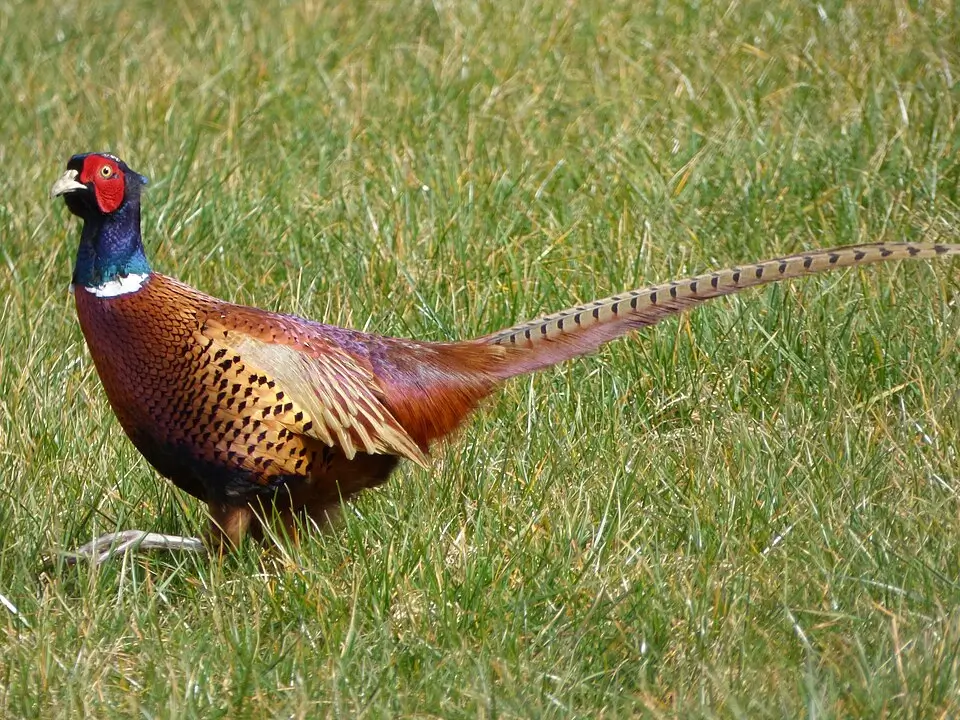
One of the most immediately striking characteristics of the Common pheasant is the dramatic sexual dimorphism between males and females. Male pheasants — commonly called roosters or cocks — are among the most visually spectacular birds found anywhere in the world. Their plumage is a vivid tapestry of iridescent greens, deep reds, rich golds, and burnt oranges, accented with a distinctive white neck ring in many subspecies. Their faces bear bright red wattles and small ear tufts, and their tails are famously long and elegantly barred. In contrast, female pheasants — known as hens — are clothed in mottled brown plumage that provides exceptional camouflage against natural surroundings, an adaptation well-suited to their roles in incubating eggs and brooding chicks.
Pheasants are robust, medium-to-large birds built for life on the ground. They are capable of powerful, direct flight when flushed, launching themselves with a loud, startling cackle that has surprised more than a few hunters over the years. However, they prefer to run from threats when possible, using their strong legs to cover ground quickly through grass and brush. This running behavior is one reason pointing dog breeds have become so beloved in pheasant hunting culture — a well-trained dog can pin a pheasant in place, preventing the bird from simply sprinting away.
Pheasants are omnivorous, feeding on a wide variety of seeds, grains, berries, insects, and small invertebrates. This dietary flexibility is a major reason they have been able to adapt so successfully to agricultural landscapes, where food is abundant and varied throughout the year. During colder months, waste grain from harvested crop fields becomes especially important to pheasant flocks.
Breeding behavior in Common pheasants is polygynous — dominant roosters may mate with multiple hens during the spring breeding season. Hens typically lay large clutches of eggs, often numbering between eight and fifteen, in ground-level nests concealed within dense vegetation. Chicks are precocial, meaning they are mobile and capable of foraging very shortly after hatching, though they remain with their mother for several weeks before becoming fully independent.
Habitat & Range
The Common pheasant is native to Asia, with its original range extending from the Caucasus region through Central Asia and into China, Korea, and parts of Southeast Asia. Over the centuries, however, the bird has been introduced to an extraordinary number of countries around the world, making it one of the most widely distributed game birds on the planet. Europe, North America, Australia, New Zealand, and parts of South America all host established populations of Common pheasants.
In North America, pheasants were introduced in the 19th century and quickly established themselves across suitable agricultural and grassland habitats. The species thrives in landscapes that offer a mosaic of crop fields, grasslands, brushy edges, and wetland margins. Dense grasses and shrub cover provide crucial nesting and roosting habitat, while nearby grain fields supply abundant food. Pheasants are notably adaptable and have proven capable of surviving cold winters, particularly where agricultural food sources remain available.
In Oklahoma, the Common pheasant can be found in portions of the state, particularly in areas where grasslands, wheat fields, and shrubby cover come together. Oklahoma's diverse geography — ranging from the short-grass prairies of the Panhandle region to the rolling agricultural plains of the northwest — provides pockets of suitable pheasant habitat. The western and northwestern portions of Oklahoma, with their expansive grain fields and grassland areas, historically have represented the heart of pheasant range within the state.
Pheasants are not migratory in the traditional sense, though they do move locally in response to weather, food availability, and seasonal changes. During harsh winter conditions, birds tend to congregate near reliable food sources and protective cover. Spring dispersal occurs as breeding season approaches, with roosters establishing territories and hens seeking suitable nesting sites.
Hunting Information
The Common pheasant ranks among the most popular upland game birds in North America, and for good reason. A flushing rooster is one of the most exciting and challenging targets a wing shooter can pursue. The bird's tendency to hold tight before exploding into flight, combined with its speed and aerial agility, makes for demanding and rewarding shooting.
Pheasant hunting traditionally revolves around the use of well-trained dogs. Flushing breeds such as Labrador Retrievers, Springer Spaniels, and Cocker Spaniels are widely used to locate and flush birds from heavy cover. Pointing breeds like English Setters, German Shorthaired Pointers, and Vizslas are also highly popular, as their ability to locate and hold birds allows hunters to approach and position themselves before the flush. A quality hunting dog greatly increases both success rates and the overall experience in the field.
For hunters pursuing pheasants in Oklahoma, consulting the Oklahoma Department of Wildlife Conservation (ODWC) is the essential first step in understanding current season dates, bag limits, license requirements, and legal hunting areas. The ODWC manages hunting regulations across Oklahoma and provides up-to-date information through its official channels and published hunting regulations. Hunters should always ensure they are hunting with appropriate licenses and following all current regulations, which can vary from year to year based on population assessments and wildlife management priorities.
Pheasant hunting typically takes place in the colder months of the year, when birds are gathered in predictable areas near food sources and cover. Early morning and late afternoon hours are traditionally productive times to hunt, as birds move to and from feeding areas. Working field edges, creek drainages, shelterbelts, and CRP (Conservation Reserve Program) grasslands are time-honored strategies for locating birds.
Oklahoma also offers public land hunting opportunities, and the state's Land Access Program and public hunting areas provide options for hunters seeking access to quality pheasant habitat. Checking with ODWC regarding specific locations and access rules is always advisable before heading out.
Pheasant meat is widely regarded as one of the finest table offerings in the upland hunting world. The breast meat is lean, flavorful, and versatile in the kitchen, lending itself well to roasting, braising, grilling, and a wide array of wild game recipes.
Conservation
The long-term health of pheasant populations depends on the availability of quality habitat — particularly the nesting cover and food resources that allow populations to sustain themselves through the breeding season and beyond. Across much of North America, habitat loss driven by changes in agricultural practices, urban expansion, and the reduction of grassland and brushy edge cover has presented challenges for pheasant populations.
Conservation organizations, wildlife agencies, and private landowners play vital roles in maintaining and improving pheasant habitat. Programs that encourage the planting of native grasses, the establishment of shelterbelts, and the maintenance of idle grasslands provide meaningful benefits not only to pheasants but to a wide range of wildlife species. The ODWC, along with national organizations dedicated to upland bird conservation, continues to work toward habitat improvement across Oklahoma and the broader region.
Hunters themselves have long been among the most committed supporters of pheasant conservation. License fees, excise taxes on sporting equipment under the Federal Aid in Wildlife Restoration Act (Pittman-Robertson Act), and voluntary contributions to conservation organizations all fund critical wildlife management and habitat restoration work. In this sense, hunters are not simply participants in pheasant culture — they are active partners in its preservation.
Responsible harvest, habitat stewardship, and support for wildlife agencies and conservation programs all contribute to ensuring that the Common pheasant remains a vibrant part of Oklahoma's wildlife heritage for generations to come.