Overview
Few birds capture the imagination of upland hunters and wildlife enthusiasts quite like the American woodcock (Scolopax minor). Known by a colorful collection of regional nicknames — timberdoodle, bogsucker, mudsnipe, and Labrador twister among them — this rotund, long-billed shorebird has carved out a remarkable ecological niche in the moist woodlands and alder thickets of North America. Beloved by bird dogs and hunters alike, the woodcock is simultaneously one of the most elusive and most charismatic quarry in the upland hunting tradition.
Despite being classified as a shorebird in the taxonomic sense, the American woodcock has long since abandoned the open shores and tidal flats favored by its relatives. Instead, it has made its home in young forests, brushy fields, and dense bottomland thickets — habitats that place it squarely in the path of the grouse hunter and the spaniel aficionado. Its famous "sky dance" courtship display, performed at dusk and dawn in early spring, is one of the most celebrated natural spectacles in North American ornithology and draws enthusiasts out into the twilight for a glimpse of nature's quiet theater.
For hunters and wildlife observers in the South Central United States — including the state of Oklahoma — the American woodcock represents a welcome and somewhat unpredictable visitor. Whether you're a seasoned wingshooter or a curious naturalist, understanding this bird's biology, habits, and conservation needs enriches every encounter. This article explores the American woodcock in depth, covering its biological traits, habitat preferences, range, hunting culture, and conservation status.
Biological Traits
The American woodcock (Scolopax minor) belongs to the family Scolopacidae — the same large family that includes sandpipers, snipes, and dowitchers. However, the woodcock is something of an evolutionary outlier within this group, having adapted comprehensively to a terrestrial and forest-dwelling lifestyle far removed from the coastal and wetland habitats typical of its kin.
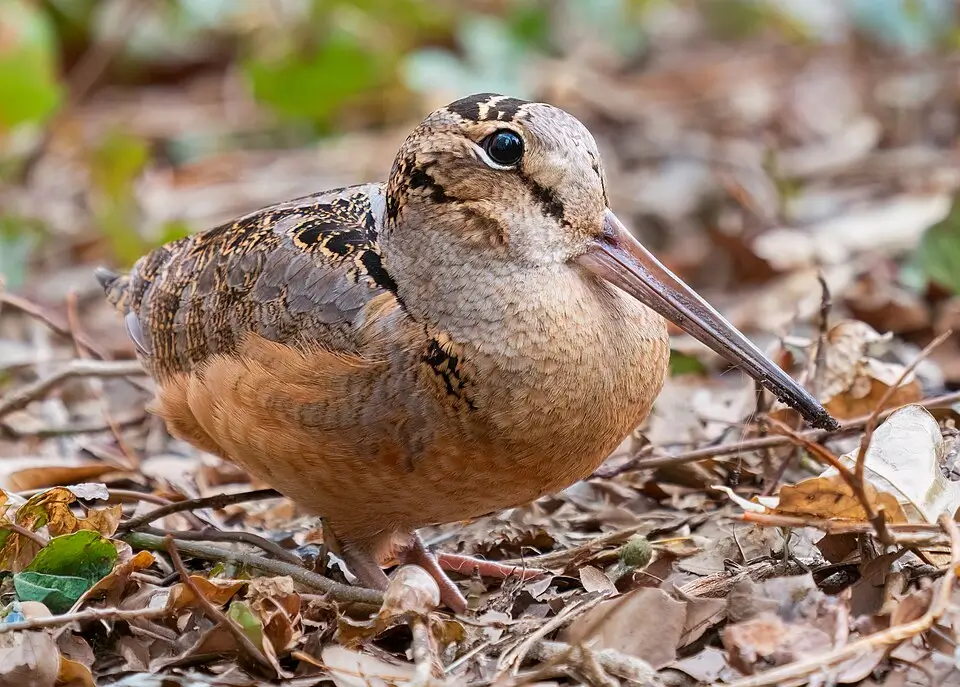
One of the woodcock's most immediately striking features is its extraordinarily long bill, which can measure approximately 2.5 to 2.8 inches in length. This bill is not merely ornamental — it is a sophisticated sensory organ. The tip of the upper mandible is highly flexible and packed with sensory nerve endings (Herbst corpuscles) that allow the bird to detect the movement of earthworms deep in soft soil. Woodcock feed primarily on earthworms, which they extract from the ground with a rapid probing motion. They are known to consume quantities of earthworms roughly equal to their own body weight each day during peak feeding periods.
The woodcock's eyes are positioned high and far back on its skull, providing an almost 360-degree field of vision — a critical adaptation for a bird that spends most of its time in dense cover with predators potentially approaching from any direction. Fascinatingly, this eye placement means the woodcock actually has a wider field of view behind its head than in front of it.
In terms of size, the American woodcock is a compact, chunky bird. Adults typically weigh between 5 and 8 ounces, with females generally being larger than males — a pattern of reversed sexual size dimorphism that is relatively uncommon among birds. The woodcock's plumage is a masterwork of cryptic camouflage: rich tawny, brown, black, and gray tones blend seamlessly with the leaf litter of the forest floor. When motionless, a woodcock can be nearly impossible to detect even at close range.
The bird's flight is distinctive and instantly recognizable to those who have flushed one. When startled, a woodcock rockets upward through the forest canopy in a rapid, twisting, unpredictable burst of speed — a flight pattern that has humbled many an experienced wingshooter. The wings produce a characteristic twittering whistle during flight, caused by the bird's specialized outer primary feathers.
Perhaps the most magical aspect of the American woodcock's life history is its spring courtship display. Beginning in late winter or early spring, male woodcock gather at open singing grounds — often old fields or forest clearings — at dawn and dusk to perform their "sky dance." The male begins by making a nasal, buzzing peent call from the ground, then launches himself into the air in a spiraling, climbing flight that can reach several hundred feet in altitude. At the apex of his flight, he produces a liquid, bubbling chirping sound before tumbling back to earth in a zigzag descent. This display, repeated numerous times each evening and morning, is used to attract females and establish territory.
Habitat & Range
The American woodcock is native to the eastern half of North America. Its breeding range extends from the Atlantic Coast westward through the Great Lakes region and into the central United States and southern Canada. The bird winters primarily in the southeastern United States, from the Gulf Coast states through the Carolinas and into parts of the mid-Atlantic region.
Woodcock favor young, early-successional forests with rich, moist soils capable of supporting healthy earthworm populations. Alder thickets, aspen regeneration areas, moist bottomland forests, and brushy old fields bordering woodland edges are all classic woodcock habitats. Proximity to soft, wet soil is essential, as the bird depends entirely on its ability to probe for worms. Habitat with a mix of dense shrubby cover for roosting and loafing, along with nearby open areas for their courtship displays, represents ideal woodcock country.
In Oklahoma, the American woodcock is primarily known as a migratory visitor rather than a breeding resident. Oklahoma's geographic position as a landlocked state in the South Central region of the United States places it along migration corridors used by woodcock moving between northern breeding grounds and southern wintering areas. The state's bottomland hardwood forests, river corridors, and moist thickets provide suitable stopover habitat during these migratory movements, and the bird can appear in favorable Oklahoma habitats during the hunting season months.
Because woodcock are closely tied to earthworm availability, their movements are heavily influenced by temperature and soil conditions. Cold snaps that freeze the ground can push birds southward quickly, while mild conditions may allow them to linger further north. This sensitivity to weather makes woodcock hunting — even in states like Oklahoma — an exercise in careful scouting and opportunistic timing.
Hunting Information
The American woodcock occupies a cherished place in the traditions of American upland hunting. Woodcock hunting has a long, storied history, particularly in the northeastern and Great Lakes states where breeding populations are strongest. The pursuit of timberdoodles with a well-trained flushing or pointing dog is considered by many hunters to be among the most artful and satisfying forms of wing shooting. The bird's explosive flush, twisting flight through dense cover, and unpredictability make it both a challenging target and an endlessly rewarding quarry.
In Oklahoma, hunters interested in pursuing American woodcock should consult the Oklahoma Department of Wildlife Conservation (ODWC) for current season dates, bag limits, and any applicable licensing requirements. The ODWC manages hunting regulations for migratory birds in accordance with federal frameworks established by the U.S. Fish and Wildlife Service, as woodcock are a federally managed migratory game bird. Regulations can change from year to year, and it is the hunter's responsibility to verify current rules before heading afield. Oklahoma's Department of Wildlife Conservation provides hunting regulations and resources through its official channels.
For hunters new to woodcock, the key to success lies in locating suitable habitat — moist, dense thickets near river bottoms, creek drainages, and lowland forest edges where earthworms are plentiful. A well-trained bird dog, whether a pointer, setter, or flushing spaniel, dramatically improves the odds of locating and flushing birds in dense cover. Open chokes and smaller shot sizes (No. 7½ or No. 8) are standard choices given the close-range flushing nature of woodcock hunting.
Woodcock are considered excellent table fare by many hunters. The meat is dark and richly flavored, and the bird has inspired a tradition of gourmet preparation in both American and European culinary circles.
Conservation
The American woodcock has experienced significant population declines over the past several decades, a trend that has drawn the attention of wildlife managers and conservation organizations across North America. The primary driver of these declines is the loss and degradation of early-successional forest habitat — the young, brushy woodlands that woodcock depend on for nesting, feeding, and raising young. As forests mature and the practice of active forest management has decreased in parts of the bird's range, suitable young-forest habitat has become less available.
Organizations such as the American Woodcock Society and the Ruffed Grouse Society have been active in promoting habitat conservation and restoration efforts on behalf of the woodcock. Active forest management practices — including timber harvesting, prescribed burning, and the creation of brush fields — are recognized as important tools for maintaining the early-successional habitat that woodcock and many other wildlife species require.
The woodcock's status as a migratory game bird means that its management involves cooperation between federal agencies, state wildlife departments, and conservation organizations across an international landscape spanning the United States and Canada. Annual breeding population surveys, known as the Singing Ground Survey, are conducted each spring to monitor woodcock population trends and inform management decisions.
For hunters, participating in voluntary harvest surveys and reporting programs helps wildlife managers better understand woodcock populations and refine conservation strategies. Every piece of data contributes to the larger picture of this species' health and long-term sustainability.