Overview
Few birds capture the spirit of North American wildlife quite like the wild turkey (Meleagris gallopavo). Bold, wary, and unmistakably American, this large game bird has roamed the continent's forests, grasslands, and woodlands for millennia. Once pushed to the brink of local extinction in many regions due to habitat loss and overhunting in the 19th and early 20th centuries, the wild turkey has made one of the most remarkable conservation comebacks in North American wildlife history. Today, the species thrives across a vast range that stretches from the pine forests of Maine to the scrublands of Mexico, and from the Pacific Coast ranges eastward to the Atlantic shoreline.
In New York State — one of the most geographically diverse states in the northeastern United States — the wild turkey has reestablished itself as a robust and celebrated resident. From the hardwood ridges of the Catskills to the rolling farmlands of the Finger Lakes region and the Adirondack foothills, New York's varied landscape offers excellent habitat for this remarkable bird. Hunters, wildlife watchers, and outdoor enthusiasts alike have embraced the return of the wild turkey as a symbol of successful wildlife management and the enduring richness of North America's natural heritage.
This article explores the biology, habitat, behavior, hunting tradition, and conservation story of the wild turkey, with a particular focus on what New York State has to offer those who pursue or simply appreciate this magnificent bird.
Biological Traits
The wild turkey, Meleagris gallopavo, belongs to the family Phasianidae and is one of only two species in the genus Meleagris, the other being the ocellated turkey (Meleagris ocellata) of the Yucatán Peninsula. It is the heaviest member of the order Galliformes found in North America, and it is the direct ancestor of the domesticated turkey familiar to dinner tables across the world.
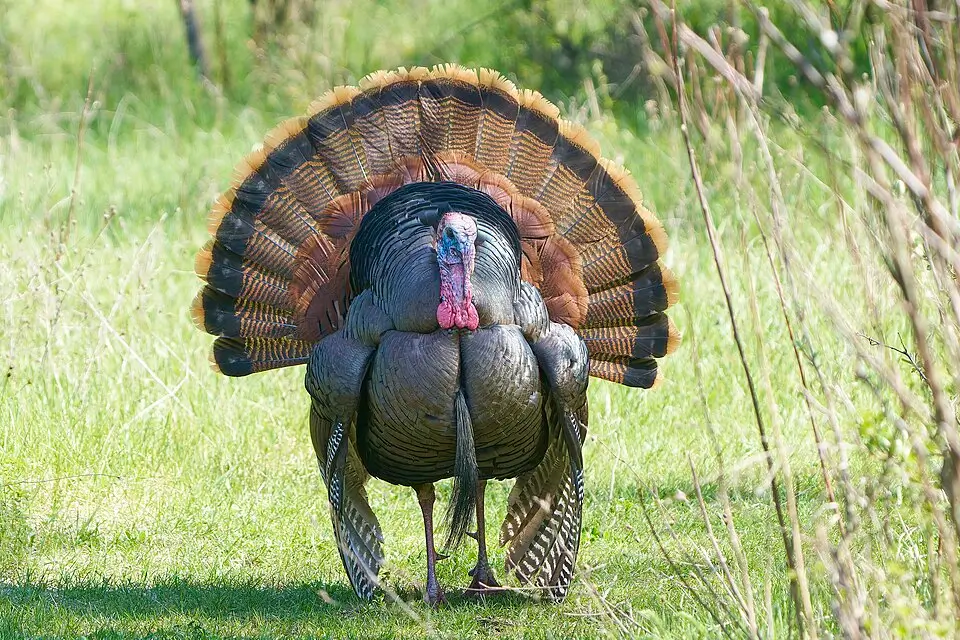
Wild turkeys are immediately recognizable birds. Adult males, known as toms or gobblers, are particularly striking in appearance. They are large, heavily built birds draped in iridescent plumage that shimmers with hues of bronze, copper, green, and gold in the sunlight. A tom's head and neck are largely bare of feathers and display vivid coloration — shades of red, blue, and white — that can intensify dramatically during courtship or moments of excitement. One of the tom's most distinctive features is the "snood," a fleshy protuberance that hangs over the beak, along with pendulous "caruncles" on the neck. Toms also sport a "beard," which is a cluster of modified, hair-like feathers projecting from the center of the breast. These beards can grow to impressive lengths in older birds and are a prized trophy feature among hunters.
Female wild turkeys, known as hens, are considerably smaller and far more subdued in coloration. Their feathers are predominantly brown and buff, providing excellent camouflage in the dappled light of the forest floor. This cryptic coloring is essential for nesting hens, who must remain as inconspicuous as possible while incubating their eggs.
Wild turkeys are capable of surprisingly fast flight over short distances, reaching speeds of up to 55 miles per hour, though they more commonly travel by walking and running. They are equally adept at running, capable of reaching speeds of around 25 miles per hour on the ground. Despite their bulky appearance, wild turkeys roost in trees at night, flying up to elevated branches to avoid predators.
The diet of the wild turkey is broadly omnivorous. These birds forage actively across the landscape, scratching through leaf litter in search of acorns, beechnuts, seeds, berries, insects, salamanders, and other small invertebrates. Mast crops — particularly acorns and beechnuts — are critically important food sources, especially heading into the colder months. A flock of turkeys moving through a hardwood stand in autumn is a spectacular sight, as the birds methodically work through the fallen leaves with powerful legs and feet.
Wild turkeys are polygamous. In spring, dominant toms perform elaborate courtship displays, fanning their tails into broad, magnificent fans, puffing their body feathers outward, and strutting with a low, dragging of their wing tips. All the while, they emit the iconic "gobble" vocalization — a loud, resonant call that can carry more than a mile under the right conditions. This gobbling serves both to attract hens and to challenge rival males. Hens typically nest on the ground in concealed locations, laying clutches of around 10 to 14 eggs. The poults — young turkeys — are precocial, meaning they are mobile and capable of feeding themselves very shortly after hatching, though they remain with the hen for several months.
Wild turkeys are highly social animals outside of the breeding season, typically moving in flocks that may be segregated by sex and age. Their complex vocalizations extend well beyond the famous gobble and include yelps, clucks, purrs, putts, and cackles, each carrying specific social meaning that hunters have spent generations learning to interpret and imitate.
Habitat & Range
The wild turkey is a native North American species with a broad natural range. Historically, the species ranged across most of the eastern United States, parts of the Midwest, and south through Mexico. Over time, through wildlife management and restocking programs, wild turkeys have been successfully introduced and reestablished across much of their former range and beyond, including states in the West where the species was not historically present.
Wild turkeys are highly adaptable and occupy a wide variety of habitat types. They are most closely associated with mixed hardwood and hardwood-conifer forests, where mast-producing trees such as oaks, beeches, and hickories provide essential food resources. However, turkeys also thrive along forest edges, in agricultural landscapes interspersed with woodlots, in open grasslands adjacent to forest cover, and in many types of transitional habitats. They require a combination of open areas for foraging and strutting, dense cover for nesting and roosting, and mature trees tall enough to provide nighttime roosting sites safe from ground-based predators.
In New York State, this combination of habitat types is abundant. New York's landscape encompasses an extraordinary variety of terrain, including the vast Adirondack and Catskill forests, the fertile agricultural valleys of the Hudson, Mohawk, and Genesee rivers, the vineyard-dotted hillsides of the Finger Lakes, and the wooded ridges of the Southern Tier. All of these landscapes, in their various ways, provide the food, cover, and roosting opportunities that wild turkeys need to flourish.
New York is among the northeastern states where wild turkey populations have rebounded strongly following dedicated restocking efforts beginning in the latter half of the 20th century. Today, wild turkeys can be found across much of New York State, making the bird a familiar and cherished part of the state's wildlife community.
Hunting Information
The wild turkey holds a special place in the hearts of North American hunters. Turkey hunting is widely regarded as one of the most challenging and rewarding pursuits in upland game hunting. Unlike deer hunting, which often involves patient waiting from a stationary position, turkey hunting is typically an active and intensely engaging endeavor. The hunter uses calls — either mouth-operated diaphragm calls, box calls, slate calls, or other devices — to imitate the vocalizations of a hen turkey, attempting to coax a gobbler within range. Successfully calling in a wary old tom is considered by many hunters to be among the finest achievements in North American hunting.
New York State has a well-established tradition of turkey hunting, supported by the Department of Environmental Conservation (DEC), which manages the state's wildlife resources. New York offers both a spring turkey season, which typically runs from late April through May, and a fall turkey season. The spring season is particularly popular, as it coincides with the breeding season when toms are actively gobbling and responsive to calling. The fall season offers a different style of hunting, often involving the technique of scattering a flock and then calling them back together.
Hunters pursuing wild turkeys in New York are required to obtain the appropriate hunting license and turkey permit as specified by the New York State DEC. Regulations, season dates, legal shooting hours, and bag limits are subject to change annually, and hunters are strongly encouraged to consult the current New York State Hunting and Trapping Regulations Guide — available through the DEC — before taking to the field. Regulations are carefully designed to ensure sustainable harvest and long-term population health.
The wild turkey is a challenging quarry demanding patience, skill, and intimate knowledge of the bird's behavior. Hunters typically target gobblers in the spring season, listening for distant gobbles at dawn, then moving carefully to set up a calling position within range of an approaching bird. The experience of a spring morning in a New York forest — with the chorus of songbirds, the mist rising off a meadow, and the distant thunder of a gobbling tom — is one that resonates deeply with those fortunate enough to experience it.
Conservation
The story of the wild turkey's recovery is one of the great conservation success stories of the 20th century. By the early 1900s, wild turkey populations had been decimated across much of the eastern United States, including New York, due to a combination of unregulated market hunting and the extensive clearing of forest habitat for agriculture and development.
Recovery efforts began in earnest in the mid-20th century, driven by state wildlife agencies, the National Wild Turkey Federation (NWTF), and dedicated hunters and conservationists. Trapping and transplanting programs, in which wild-trapped turkeys were relocated to suitable but unoccupied habitats, proved remarkably effective. The wild turkey's adaptability, combined with regulated hunting seasons and habitat management, allowed populations to climb steadily and eventually surpass historic levels in many areas.
Today, wild turkey populations in North America are estimated to number in the millions, spread across 49 U.S. states as well as portions of Canada and Mexico. In New York, the species is firmly established and continues to be actively managed by the DEC to ensure healthy, sustainable populations for future generations of wildlife enthusiasts and hunters alike.
The wild turkey stands as enduring proof that thoughtful wildlife management, habitat conservation, and the partnership between hunters and conservation agencies can achieve extraordinary results. The bird that Benjamin Franklin famously (if perhaps apocryphally) admired as a symbol of American character has returned in force to the forests, fields, and ridgelines of New York and the nation.