Overview
Few animals inspire as much fascination — and healthy respect — as the wild boar. Known scientifically as Sus scrofa, the wild boar is one of the most widely distributed and ecologically significant mammals on the planet. From the dense temperate forests of Europe and Asia to the swamps of North America and the scrublands of North Africa, this powerful, intelligent creature has carved out a living across an extraordinary range of environments. Its adaptability, resilience, and sheer tenacity have made it both a beloved game animal and an important subject of ecological study.
For hunters, wildlife observers, and outdoor enthusiasts in New York and across the northeastern United States, the wild boar represents a compelling chapter in the story of American wildlife. Whether you are drawn to this animal out of sporting interest, ecological curiosity, or a desire to understand the natural world more deeply, the wild boar offers something remarkable at every turn. This guide explores the biology, habitat, hunting culture, and conservation considerations surrounding Sus scrofa, with a particular focus on what residents of New York State should know.
Biological Traits
The wild boar, Sus scrofa, belongs to the family Suidae within the order Artiodactyla — the even-toed ungulates. It shares this broad family with domestic pigs, from which it is, in fact, the primary wild ancestor. The relationship between wild boar and the domestic pig (Sus scrofa domesticus) is a fascinating one: over thousands of years of selective breeding, humans transformed the wild boar into the many domesticated breeds we know today. Yet the wild boar itself has remained largely unchanged, a testament to how well its natural form suits its environment.
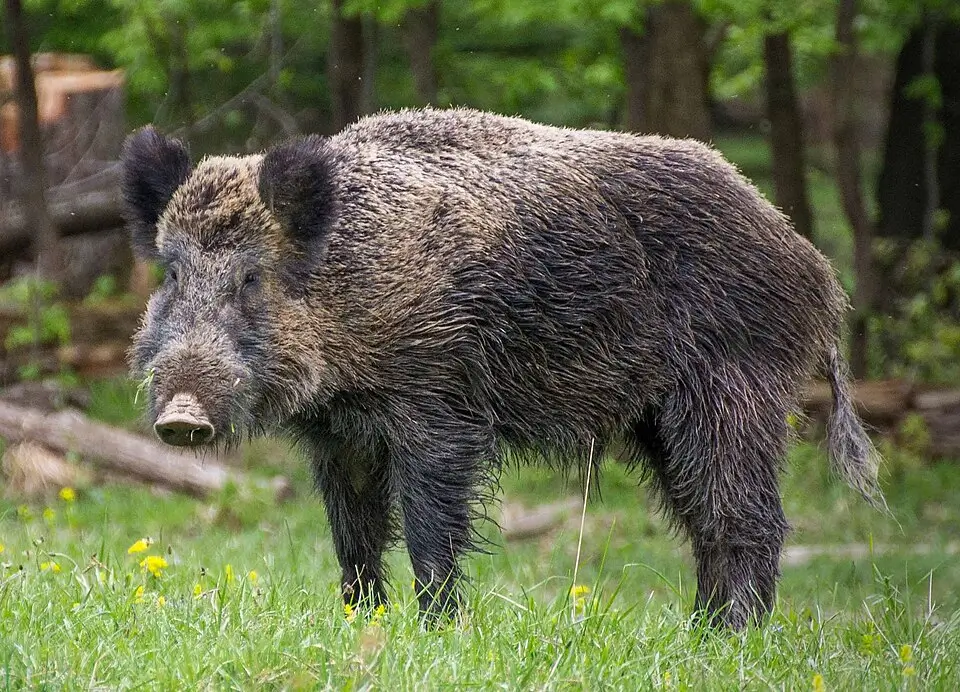
Physically, wild boars are robust, powerfully built animals. They are characterized by a stocky, barrel-shaped body, a large wedge-shaped head, and a long, flexible snout that serves as a highly effective foraging tool. The snout is one of the wild boar's most important anatomical features — reinforced with cartilage and connected to a specialized muscle called the musculus rostralis, it allows the animal to root through soil, leaf litter, and even rocky substrates in search of food.
Male wild boars, known as boars, are typically larger than females, called sows. Males develop prominent tusks — elongated canine teeth — that grow continuously throughout their lives. These tusks serve multiple purposes: they are used in combat with rival males during the breeding season, in defense against predators, and as tools for foraging. The upper tusks, known as "whetters," curve upward and are constantly sharpened by contact with the lower tusks, making them formidable weapons.
The coat of a wild boar typically consists of coarse, bristly outer hairs and a softer undercoat. Coloration varies by region and age, but adults are most commonly dark brown, gray, or black. Piglets, by contrast, are born with distinctive reddish-brown fur marked with pale longitudinal stripes — a camouflage pattern that helps conceal them in dappled forest light during their vulnerable early weeks of life.
Wild boars are highly intelligent animals with complex social structures. Females and their offspring typically live in groups called "sounders," which may consist of several related sows and their young. Adult males tend to be more solitary, joining sounders primarily during the breeding season, or rut. Boars engage in dramatic displays of dominance and direct physical combat during this period, using their tusks and sheer body mass to establish breeding rights.
Omnivorous by nature, wild boars have one of the most varied diets in the mammalian world. They consume roots, tubers, nuts, berries, fungi, insects, worms, small vertebrates, carrion, and agricultural crops. This dietary flexibility is central to their extraordinary success as a species. Their rooting behavior — while ecologically disruptive in some contexts — also plays a role in seed dispersal and soil aeration, highlighting the complex ecological role they inhabit.
Reproduction in wild boars is notably prolific. Sows can produce multiple litters per year under favorable conditions, with litter sizes ranging from a few piglets to well over a dozen. This high reproductive rate is a key factor in the species' ability to maintain and expand its populations even under significant hunting pressure.
Habitat & Range
Sus scrofa has one of the broadest natural ranges of any land mammal. Originally native to much of Europe, Asia, and North Africa, the wild boar has been introduced — intentionally and unintentionally — to the Americas, Australia, and numerous island ecosystems around the world. This global spread is a reflection of both the animal's adaptability and its long association with human civilization.
Wild boars thrive in a wide variety of habitat types. They are most commonly associated with mixed deciduous and coniferous forests, where the combination of dense cover and abundant mast crops — acorns, beechnuts, and chestnuts — provides both shelter and sustenance. However, they are equally at home in Mediterranean scrublands, tropical forests, agricultural landscapes, wetlands, and even semi-arid environments. Their primary requirement is access to adequate food, water, and cover.
In North America, feral swine — populations descended from escaped or released domestic pigs, Eurasian wild boar, or hybrids of the two — have established themselves across much of the continent. These populations are particularly dense in the southeastern United States but have been expanding northward in recent decades. The presence of feral swine in New York State and the broader northeastern region is an evolving wildlife management situation, with animals occasionally appearing in rural and semi-rural landscapes.
New York State, with its diverse geography encompassing the Adirondack Mountains, the Catskills, the Hudson Valley, the Finger Lakes, and the agricultural plains of western New York, provides a mosaic of habitats that could theoretically support wild boar populations. The state's extensive forested areas, combined with its agricultural land, offer the kind of varied landscape in which these animals are known to thrive.
Hunting Information
The wild boar is one of the most prized and challenging game animals in the world. Hunting Sus scrofa has a history stretching back thousands of years, from the royal boar hunts of medieval Europe to the modern sport hunting traditions found across multiple continents. The animal's intelligence, acute senses, physical toughness, and potential for aggressive behavior when cornered make it a genuinely demanding quarry that commands respect from even experienced hunters.
In the United States, wild boar and feral swine hunting is practiced across many states, particularly in the South and West where established feral populations exist. Various hunting methods are employed, including spot-and-stalk hunting, hunting over bait where legal, dog hunting, and hunting from elevated stands or blinds near feeding areas, water sources, or travel corridors.
With regard to New York State specifically, hunters should be aware that official state hunting regulations regarding wild boar are not currently detailed in widely published public guidance in the same manner as more established game species. Prospective hunters interested in pursuing wild boar or feral swine in New York are strongly encouraged to consult directly with the New York State Department of Environmental Conservation (DEC) for the most current and accurate information regarding licenses, seasons, legal hunting areas, and any applicable regulations. Regulations in this area can be subject to change as wildlife management agencies respond to the evolving presence of feral swine in the region.
Private hunting preserves in New York and surrounding states do offer wild boar hunting experiences, and these operations are governed by their own licensing and regulatory frameworks. For those seeking a wild boar hunting experience in the northeastern United States, researching licensed hunting preserves can be a productive avenue.
Regardless of where wild boar are hunted, safety is a paramount consideration. Wounded or cornered boars can be dangerous animals, and hunters should exercise appropriate caution, use adequate firearm calibers or archery equipment suitable for large, tough game, and follow all safe hunting practices.
Conservation
From a global conservation perspective, Sus scrofa is classified by the International Union for Conservation of Nature (IUCN) as a species of Least Concern, reflecting its wide distribution and robust, adaptable populations. In many parts of its native range, wild boar populations are stable or even expanding, aided by agricultural landscapes that provide reliable food sources and by reductions in natural predator populations.
In North America, the management of feral swine — which are largely considered an invasive species in many ecosystems — is an active area of wildlife conservation and management. Feral swine can have significant impacts on native ecosystems, agricultural lands, and native wildlife populations, and wildlife management agencies across the country work to monitor and manage these populations. Hunting is recognized as one important tool in these management efforts.
In their native Eurasian range, wild boars play an important ecological role as seed dispersers, soil engineers through their rooting behavior, and prey species for large carnivores such as wolves, bears, and large felids. Maintaining healthy, well-managed wild boar populations contributes to the overall biodiversity and ecological function of many forest and scrubland ecosystems.
Hunters, wildlife biologists, conservation organizations, and government agencies all play important roles in the sustainable management of wild boar populations worldwide. Ethical hunting practices, adherence to all applicable regulations, and support for sound wildlife management policies contribute meaningfully to long-term conservation outcomes for this remarkable species.