Overview
Few wild animals are as immediately recognizable — or as deeply embedded in North American cultural consciousness — as the striped skunk. With its bold black-and-white coloration and legendary chemical defense, Mephitis mephitis occupies a unique place in the natural world. Equal parts fascinating and formidable, the striped skunk is one of the most widespread and ecologically important mammals on the continent. From the dense hardwood forests of upstate New York to the open prairies of the Midwest, this resilient creature has carved out a thriving existence alongside human civilization, making it one of the most commonly encountered wild mammals in the United States and Canada.
Despite its reputation, the striped skunk is far more than just a source of roadside odor. It is a skilled forager, a vital component of its ecosystem, a fascinating subject for wildlife biologists, and, in many parts of its range, a legal quarry for hunters and trappers. Understanding this animal — its biology, its habits, its ecological role, and its relationship with people — opens a window into the rich, interconnected world of North American wildlife. This article explores all of these dimensions, offering both the naturalist and the outdoor enthusiast a comprehensive look at one of the continent's most iconic mammals.
Biological Traits
The striped skunk, Mephitis mephitis, belongs to the family Mephitidae, a group of mammals that diverged from the weasel family (Mustelidae) and are now recognized as a distinct family in their own right. The genus name Mephitis is derived from Latin, meaning "noxious vapor" — an apt descriptor for an animal whose primary defense mechanism is one of the most potent chemical weapons in the animal kingdom.
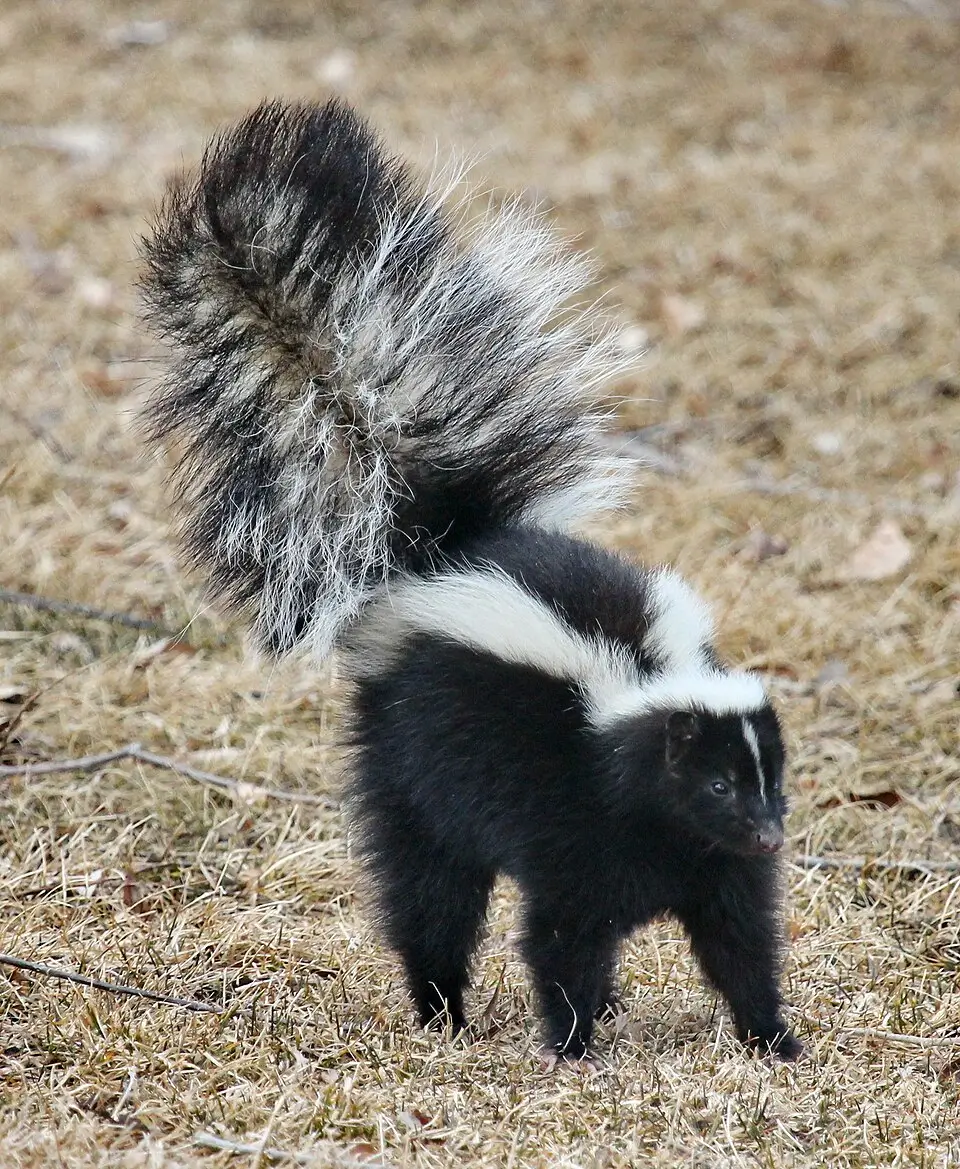
Physically, the striped skunk is a medium-sized mammal, roughly the size of a domestic cat. It features a stout, robust body, a small pointed head, short legs, and a large, bushy tail that it raises as a warning signal before deploying its spray. The iconic coloration — glossy black fur interrupted by a bold white stripe running from the top of the head down the back, often splitting into two stripes along the sides — serves as a vivid warning to potential predators. This type of coloration is known in biology as aposematism: a visual signal that advertises the animal's dangerous or unpleasant qualities to discourage attack.
The skunk's musk glands are two highly developed scent glands located on either side of the anus. These glands produce a sulfur-containing chemical compound known as a thiol — specifically a mixture of compounds including (E)-2-butene-1-thiol, 3-methyl-1-butanethiol, and other related chemicals. When threatened, a skunk can spray this mixture with remarkable accuracy at distances of up to ten feet or more. The spray causes intense irritation to the eyes and mucous membranes and produces a powerful, lingering odor that is extraordinarily difficult to neutralize. Before spraying, skunks typically give ample warning — stomping their front feet, raising their tail, and in the case of the striped skunk, doing a distinctive "handstand" display — offering would-be predators a chance to retreat.
Beyond their chemical defenses, striped skunks are highly capable omnivores. Their diet is impressively varied, shifting with the seasons. In warmer months, insects — particularly ground-nesting bees, beetles, grasshoppers, and grubs — form a major dietary component. Skunks use their long, curved claws and sensitive snouts to excavate soil in search of beetle larvae and earthworms. They also consume small mammals, bird eggs, amphibians, berries, fruits, seeds, and carrion. This dietary flexibility is one of the key reasons for the species' remarkable success across such a wide geographic range.
Striped skunks are largely nocturnal, becoming active after dark and returning to their dens before dawn. They are not true hibernators but do enter periods of torpor during cold winter months, relying on accumulated fat reserves to survive stretches of bitter weather. During mild winter periods, they may emerge briefly to forage. Their dens may be excavated burrows, modified dens of other animals, hollow logs, rock piles, or spaces beneath buildings and porches — the last of which often brings them into close contact with humans.
Reproduction in the striped skunk follows a relatively simple annual cycle. Mating typically occurs in late winter, and females give birth to litters of four to seven young (called kits) in late spring. The kits are born blind and helpless but develop rapidly. By late summer, young skunks are nearly full-grown and capable of producing their own musk — a fact that many curious dogs and unwary humans have discovered to their lasting regret. Females are the primary caregivers; males play no role in raising the young.
One of the most significant biological facts about the striped skunk from a public health perspective is its role as a major wildlife reservoir for rabies. Skunks are among the most commonly reported rabies-positive wild mammals in North America, and a skunk behaving unusually during daylight hours should always be treated with caution and reported to local wildlife authorities.
Habitat & Range
The striped skunk is one of the most broadly distributed mammals in North America. Its range extends from southern Canada through virtually all of the contiguous United States and into northern Mexico. Few habitat types fall outside its reach: it is found in mixed hardwood forests, agricultural fields, grasslands, suburban neighborhoods, wetland edges, riparian corridors, and even the outskirts of major cities.
In New York State — a geographically diverse region encompassing everything from the Adirondack Mountains and Catskill highlands to the Hudson Valley farmlands and the coastal marshes of Long Island — the striped skunk finds a wealth of suitable habitat. The state's mix of forested uplands, agricultural lowlands, and suburban development actually creates ideal conditions for the species. Skunks thrive at the edges between habitat types, where foraging opportunities are diverse and denning sites are plentiful.
New York's four seasons also align well with the striped skunk's biological calendar. The warm, productive summers provide abundant insect prey and plant foods, while the state's milder winters — particularly in the lower Hudson Valley and along the coast — allow skunks to remain intermittently active year-round. The species is a familiar sight (and scent) to homeowners throughout the state's suburban and rural communities.
Hunting Information
The striped skunk has a long history as a furbearer in North American hunting and trapping traditions. For much of the 19th and early 20th centuries, skunk fur was actually considered a commercially valuable commodity in the North American fur trade, marketed under various more appealing names. While the fur trade's peak has long passed, skunks remain a legal furbearer species in many states and provinces, including parts of the northeastern United States.
For hunters and trappers in New York State, official current season dates and licensing requirements for striped skunk are not available in this source. Prospective hunters and trappers in New York should consult the New York State Department of Environmental Conservation (NYSDEC) directly for the most current and accurate information regarding furbearer regulations, season dates, licensing requirements, and any applicable bag limits or reporting requirements.
Trapping is the most traditional and widely used method for taking skunks. Cage traps and foothold traps set near denning areas, trails, and fence lines are commonly employed. Because of the obvious challenges involved in handling a live or dispatched skunk, trappers have developed a range of practical methods for minimizing the likelihood of being sprayed. Approaching a trapped skunk slowly and calmly, keeping a visual barrier between trapper and animal, and dispatching quickly and humanely are all elements of responsible skunk trapping practice.
Those who pursue skunks as furbearers often do so as part of a broader predator or furbearer trapping program that includes species such as raccoon, opossum, and fox. While skunk fur may not command premium prices in today's market, the activity remains a meaningful part of rural outdoor tradition and contributes to local wildlife population management.
Conservation
The striped skunk enjoys a stable and healthy conservation status across its range. It is listed as a species of Least Concern by the International Union for Conservation of Nature (IUCN), reflecting its wide distribution, adaptability, and resilient population numbers. Human landscape modification — including suburban development and agricultural expansion — has in many respects benefited skunks by increasing the availability of food sources and denning habitats in human-dominated landscapes.
However, the striped skunk does face meaningful mortality pressures. Road mortality is significant, as skunks frequently forage near roads and are vulnerable to vehicle strikes, particularly during their nocturnal movements. Rabies epizootics — periodic outbreaks of the disease within skunk populations — can cause localized population declines, though populations typically recover. Predation by great horned owls, one of the few predators seemingly unaffected by skunk musk, also contributes to natural mortality.
From a public health and wildlife management perspective, the striped skunk's role as a rabies vector requires ongoing attention from state wildlife agencies, including those in New York. Oral rabies vaccination programs, in which bait containing rabies vaccines is distributed across the landscape for wildlife to consume, have been used in some regions as a management tool.
Overall, the striped skunk's ecological services — insect control, seed dispersal, and its role as prey for apex predators — make it a genuinely valuable component of healthy ecosystems. Appreciating this animal for what it truly is — a resourceful, ecologically significant, and uniquely adapted North American mammal — is a worthy perspective for any outdoor enthusiast.