Overview
Few sights in the natural world command as much awe and reverence as a flock of Sandhill cranes moving across an open sky. These magnificent birds, known scientifically as Grus canadensis, are among the most captivating large wading birds found across the North American continent. Their prehistoric silhouettes, resonant bugling calls, and graceful aerial displays have made them beloved icons of wild places — from sprawling prairie wetlands to the forests and marshes of the northeastern United States.
The Sandhill crane carries with it a sense of deep time. Fossil records suggest that cranes closely related to the modern Sandhill crane have walked the Earth for millions of years, making them one of the oldest surviving bird species on the planet. To encounter one in the field — whether you are a birder, a wildlife enthusiast, or a hunter — is to come face-to-face with a genuine living relic of the ancient world. In a landscape increasingly shaped by human activity, the persistence and resilience of the Sandhill crane stands as both a conservation success story and a reminder of what careful wildlife stewardship can achieve.
In the northeastern United States, including New York State, Sandhill cranes are an increasingly notable presence. As populations have grown and ranges have expanded, more observers and outdoor enthusiasts in New York are discovering the thrill of watching these birds during migration and in their breeding territories.
Biological Traits
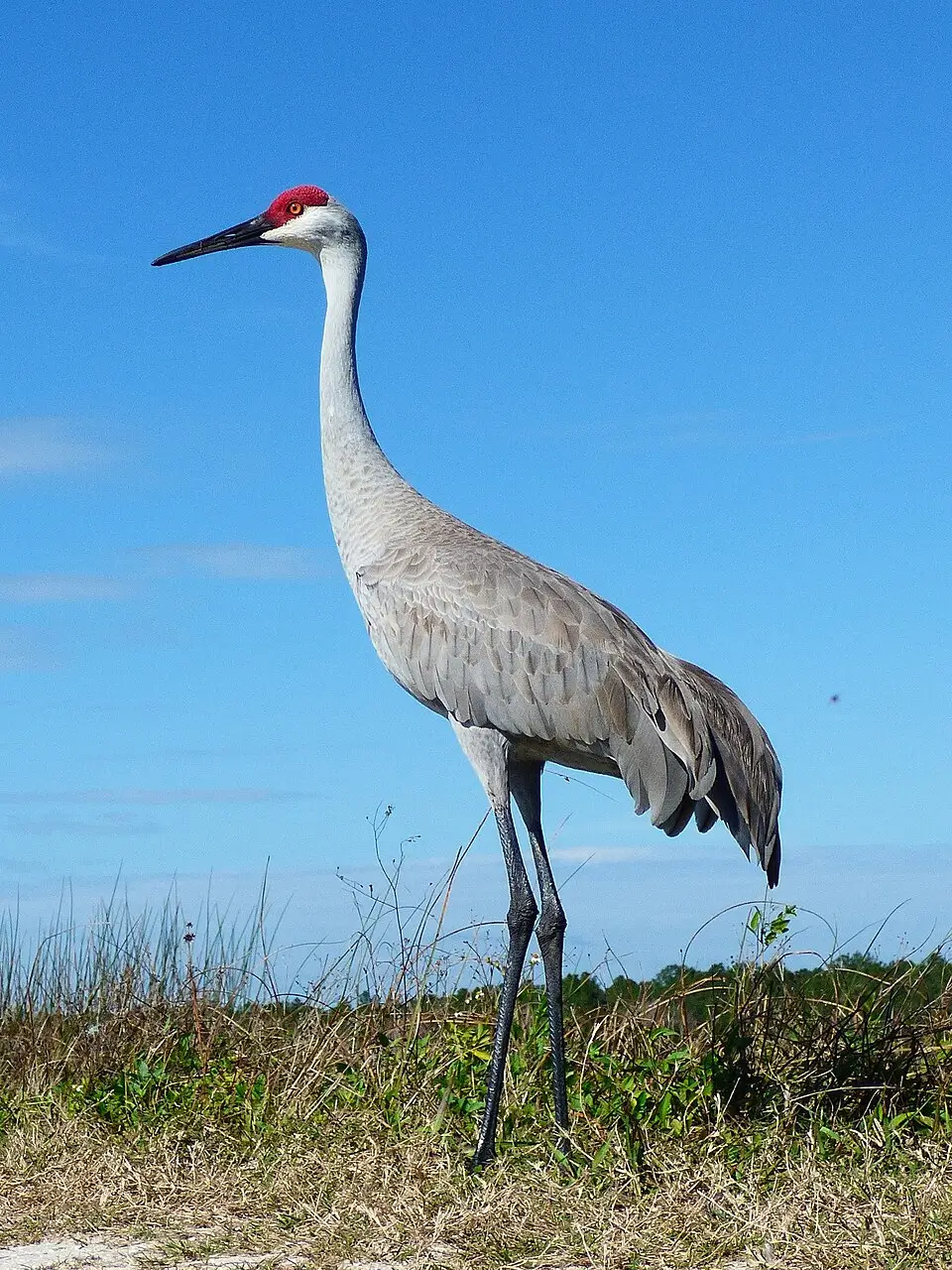
The Sandhill crane (Grus canadensis) is a large, long-legged, long-necked bird belonging to the family Gruidae — the true cranes. Adults are immediately recognizable by their predominantly gray plumage, often tinged with rusty-brown coloration during the breeding season due to the birds' habit of preening iron-rich mud into their feathers. One of the most distinctive physical features is the bare, bright red patch of skin on the crown of the head, which is a defining characteristic of adult birds.
Sandhill cranes are among the tallest birds in North America. Adults typically stand approximately four feet in height, and their wingspan can stretch to impressive dimensions, making them unmistakable in flight. When airborne, they extend their neck fully forward — a key distinguishing feature that separates cranes from herons, which fold their necks in flight — and their long legs trail behind them like a rudder.
The species is divided into several subspecies, which vary somewhat in size and range. The larger subspecies tend to be found in more northern latitudes, while smaller subspecies inhabit subtropical and tropical regions. The greater Sandhill crane, the lesser Sandhill crane, the Florida Sandhill crane, the Mississippi Sandhill crane, and the Cuban Sandhill crane are among the recognized subspecies, each occupying distinct portions of the overall range.
Vocally, Sandhill cranes are extraordinary. Their call — a loud, rolling, trumpeting bugle — can carry for miles across open terrain. This call is produced by a uniquely elongated trachea that coils within the breastbone, functioning like a natural amplifier. The sound is utterly distinctive and, once heard, is not easily forgotten. During courtship and pair bonding, mated pairs engage in elaborate "unison calling," a synchronized vocal display that reinforces their bond.
Sandhill cranes are also celebrated for their elaborate dancing behavior. Both males and females engage in dances that involve bowing, jumping, wing-spreading, and tossing objects into the air. This behavior is not limited to courtship — cranes of all ages and social contexts may dance, suggesting it also serves social and communicative functions beyond mate attraction.
These birds are monogamous and typically form long-lasting pair bonds. They construct large, mounded nests from plant material in or near water, and females generally lay two eggs per clutch. Both parents participate in incubation and in the care of the young, known as colts. The colts are precocial — they are capable of walking and swimming within hours of hatching — but remain with their parents for an extended period, learning migratory routes and other essential survival skills.
Sandhill cranes are omnivorous, consuming a wide variety of foods including seeds, grains, berries, insects, small mammals, reptiles, and amphibians. Their feeding behavior is highly adaptable, which has contributed to their ability to thrive across diverse habitats.
Habitat & Range
Sandhill cranes occupy an expansive and ecologically diverse range across North America, from the Arctic tundra to the subtropical wetlands of Florida and Cuba. They are broadly associated with open habitats — wet meadows, marshes, bogs, grasslands, and agricultural fields — where they forage and nest.
Migratory subspecies undertake remarkable seasonal journeys. Some populations travel thousands of miles between their northern breeding grounds in Canada and Alaska to wintering areas in the southern United States and northern Mexico. One of the most celebrated spectacles in North American wildlife is the annual gathering of Sandhill cranes along the Platte River in Nebraska each spring, where hundreds of thousands of birds congregate during their northward migration — a natural event that draws wildlife enthusiasts from across the world.
In New York State, Sandhill cranes have become a more familiar presence over recent decades. The state's diverse landscape — which includes the Adirondack region, the Finger Lakes, the Great Lakes shoreline, and extensive agricultural lands in the western and central portions of the state — provides suitable habitat for both migratory and potentially breeding birds. Observers in New York have increasingly reported sightings during both spring and fall migration, and in some areas, small numbers of cranes have established breeding territories.
New York's location in the northeastern United States places it along migration corridors used by cranes moving between their Canadian breeding grounds and their southern wintering areas. Wetlands, open farmland, and restored grassland habitats in the state serve as important stopover and staging areas for migratory flocks.
Hunting Information
Sandhill crane hunting is a recognized and legally regulated activity in a number of U.S. states and Canadian provinces where populations are sufficiently robust to support a harvest. In many parts of their range — particularly across the central and western flyways — Sandhill cranes are pursued as a game bird valued both for their challenging nature as a quarry and for their quality as table fare. Hunters who have pursued them often describe the Sandhill crane as a rewarding and demanding species to hunt, given their keen senses, large size, and open-country habitats.
The birds are sometimes referred to as "the ribeye of the sky" by hunters familiar with their culinary qualities, a testament to the dark, flavorful meat that sets crane apart from most other game birds.
However, with respect to New York State specifically, it is important to note that official hunting season information and licensing requirements for Sandhill cranes in New York are not currently available in the source data consulted for this article. Prospective hunters in New York should consult directly with the New York State Department of Environmental Conservation (NYSDEC) for the most current and accurate information regarding any seasons, permits, or regulations that may apply to Sandhill cranes within the state.
Hunters interested in pursuing Sandhill cranes in states or provinces where seasons are established should always ensure full compliance with all applicable federal migratory bird regulations, state or provincial licensing requirements, and any special permit or draw systems that may be in place. Because cranes are migratory birds, their harvest is regulated at the federal level in the United States under the Migratory Bird Treaty Act, in addition to any state-level regulations.
Those who wish to experience crane hunting while waiting for regulatory updates in their home state may consider planning trips to established crane hunting destinations in states such as Texas, Colorado, Kansas, Wyoming, or New Mexico, where populations and regulations may support open seasons.
Conservation
The conservation story of the Sandhill crane is one of the most encouraging in North American wildlife management. During the nineteenth and early twentieth centuries, many crane populations experienced significant pressure from habitat loss and unregulated hunting. However, through the implementation of federal protections under the Migratory Bird Treaty Act, habitat conservation efforts, and careful population management, most Sandhill crane subspecies have recovered strongly.
Today, the Sandhill crane is listed as a species of Least Concern by the International Union for Conservation of Nature (IUCN), reflecting the overall health and stability of the species across its range. Migratory subspecies populations number in the hundreds of thousands, and continued range expansion — including the recolonization of historic breeding territories in the eastern United States — speaks to the effectiveness of conservation measures over recent decades.
However, not all subspecies share the same status. The Mississippi Sandhill crane (Grus canadensis pulla) remains critically endangered, with a small population confined to coastal Mississippi and supported by dedicated captive breeding and recovery programs. The Florida Sandhill crane also faces ongoing habitat pressures related to wetland drainage and urban development.
For New York and the broader northeastern United States, the expanding presence of Sandhill cranes represents a remarkable conservation success. As wetland habitats are restored and protected, and as rural landscapes continue to provide open foraging grounds, the future for Sandhill cranes in the region appears bright.
Wildlife enthusiasts, hunters, landowners, and conservationists all have roles to play in sustaining and expanding the positive trajectory of Sandhill crane populations. Supporting wetland conservation initiatives, participating in citizen science monitoring programs, and engaging with state and federal wildlife agencies are all meaningful ways to contribute to the continued success of this extraordinary species.