Overview
Few animals capture the spirit of the American West quite like the mule deer. With its oversized, mule-like ears, distinctive bounding gait, and striking antlers, Odocoileus hemionus is one of the most recognizable and beloved big-game animals on the continent. Whether you're a seasoned hunter, a wildlife photographer, or simply an outdoor enthusiast, the mule deer commands attention and respect wherever it roams.
Known colloquially as "muleys" among hunters and wildlife watchers, mule deer are a cornerstone species of western North American ecosystems. They play a vital role in the food web, serving as prey for large predators such as mountain lions, wolves, coyotes, and bears, while also acting as important seed dispersers and grazers that help shape the plant communities they inhabit. Their presence on a landscape is often used as an indicator of overall ecosystem health, making them a species of interest not only to hunters but also to conservationists and land managers.
The scientific name Odocoileus hemionus is derived from Greek and Latin roots. Odocoileus translates roughly to "hollow tooth," a reference to the deer family's dental structure, while hemionus means "half-mule," a nod to the animal's famously large ears that so closely resemble those of a domestic mule. This name perfectly encapsulates one of the species' most immediately identifiable physical features and has stuck with the animal since its formal scientific description in the early 19th century.
Biological Traits
The mule deer is a medium-to-large ungulate belonging to the family Cervidae, which includes all deer, elk, moose, caribou, and their relatives. It is closely related to the white-tailed deer (Odocoileus virginianus), and the two species can and do hybridize in areas where their ranges overlap, though such hybrids are relatively uncommon and often less reproductively fit than either parent species.
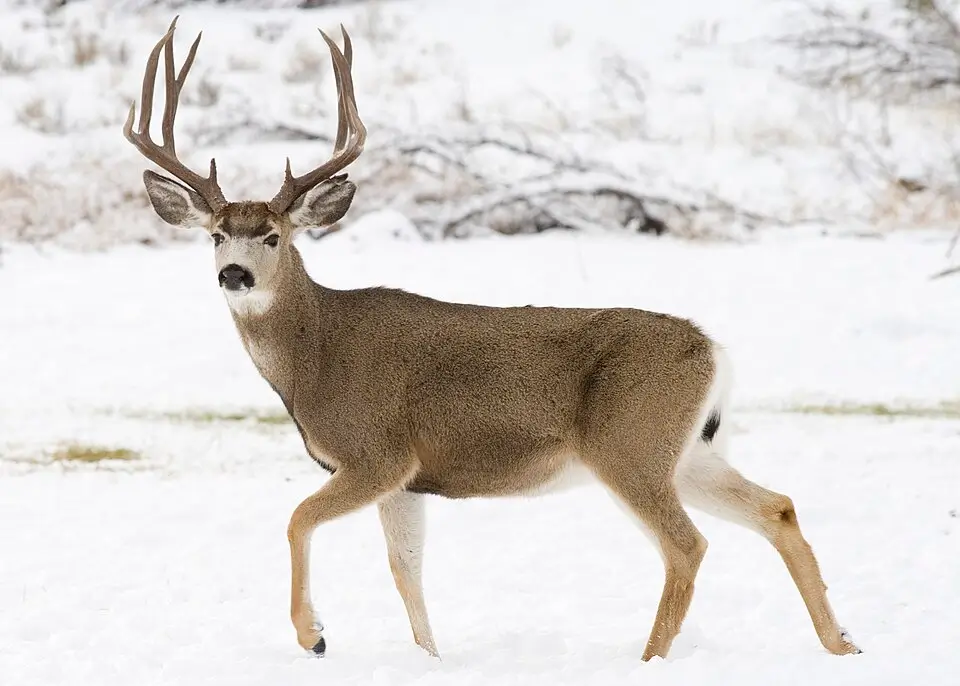
One of the most distinctive physical features of the mule deer is, of course, its ears. Large, mule-like, and highly mobile, these ears give the animal an exceptional sense of hearing, helping it detect predators and other threats from considerable distances. Their ears are also useful in thermoregulation, helping to dissipate body heat in the warm, arid environments many mule deer populations call home.
The mule deer's tail is another key identification feature. Unlike the white-tailed deer, which raises a large, bushy white tail like a flag when alarmed, the mule deer has a small, rope-like tail that is white with a black tip. This difference in tail appearance is one of the most reliable ways to distinguish the two species in the field.
Antlers are found only on male mule deer, known as bucks, and are grown and shed annually. Mule deer antlers are bifurcated, meaning they fork or branch in a distinctive Y-shape, rather than growing as a single main beam with tines projecting off it as seen in white-tailed deer. This bifurcated antler structure is considered one of the defining morphological characteristics of the species. Antlers begin growing in spring, covered in a soft, blood-rich tissue called velvet that supplies nutrients for rapid growth. By late summer or early fall, the velvet dries up and is shed, revealing the hardened bone beneath. Bucks use their antlers primarily during the rut — the breeding season — to compete with rival males for access to females, known as does.
Mule deer are also well known for their unique style of locomotion called "stotting" or "pronking." When alarmed, mule deer often bound away in a distinctive four-legged leap, pushing off with all four feet simultaneously and landing on all four feet together. This high, bouncy gait is quite different from the flat-out gallop of a white-tailed deer and is thought to serve as a signal to predators that the deer has detected them, potentially discouraging pursuit.
Like all deer, mule deer are ruminants, possessing a four-chambered stomach that allows them to digest tough plant material through a process of fermentation and regurgitation known as "chewing the cud." Their diet is highly variable depending on season and region but typically includes grasses, forbs, shrubs, and browse such as sagebrush, bitterbrush, and various woody plants.
Habitat & Range
The mule deer is primarily a species of western North America. Its range extends from the coastal regions of Alaska and British Columbia in the north, southward through the western United States and Mexico, and into the Baja California peninsula. The species is strongly associated with the diverse landscapes west of the Missouri River, including the Rocky Mountains, the Great Basin, the Mojave Desert, the Sierra Nevada, and the Pacific Coast ranges.
Within this vast range, mule deer occupy a remarkably wide variety of habitats. They are found in alpine meadows, dense conifer forests, open sagebrush steppes, chaparral shrublands, and even the margins of desert environments. One of the most important behavioral adaptations of mule deer is their tendency to migrate seasonally between summer and winter ranges. In mountainous regions, deer typically spend summers at higher elevations where food is abundant and temperatures are cooler, then migrate to lower elevations in fall and winter to escape deep snow and access better forage. These migration routes are often ancient, passed down through generations, and can span dozens or even hundreds of miles.
The mule deer shares its range with a recognized subspecies, the black-tailed deer (Odocoileus hemionus columbianus and O. h. sitkensis), which inhabits the dense coastal forests of the Pacific Northwest and is sometimes treated as a separate group within the broader mule deer complex. Other recognized subspecies occupy distinct geographic regions, each showing subtle adaptations to local conditions.
Hunting Information
Mule deer hunting is a deeply embedded tradition across the western United States and Canada. The species is one of the most sought-after big-game animals on the continent, drawing hunters from all over the world to states and provinces such as Colorado, Wyoming, Utah, Montana, Idaho, Nevada, and many others. Hunting seasons, license requirements, tag allocations, and legal hunting methods vary significantly from state to state and are managed by each jurisdiction's fish and wildlife agency to ensure sustainable harvest levels and healthy deer populations.
Hunters pursuing mule deer typically employ a variety of methods, including spot-and-stalk hunting — which involves glassing open terrain with binoculars or spotting scopes to locate animals from a distance before approaching on foot — as well as still hunting, stand hunting near water sources or travel corridors, and archery hunting during special early seasons. The open, rugged terrain that mule deer favor makes spot-and-stalk one of the most effective and rewarding techniques.
For hunters in New York State, it is important to note that mule deer are not a native species to the state and are not found in the wild in New York. The natural range of the mule deer does not extend to the northeastern United States. New York's deer hunting opportunities center entirely on the white-tailed deer (Odocoileus virginianus), which is abundant throughout the state's forests, agricultural lands, and even suburban areas. Hunters in New York who wish to pursue mule deer should plan a dedicated western hunting trip and consult the fish and wildlife agency of their chosen destination state for current season dates, tag requirements, and regulations.
Conservation
Mule deer conservation is an active and ongoing effort involving state and federal wildlife agencies, non-governmental organizations, tribal governments, and private landowners. Populations across portions of the species' range have faced challenges in recent decades, driven by a combination of factors including habitat loss and fragmentation, drought, disease, and changing predator dynamics. The loss and degradation of crucial seasonal migration corridors has been identified as a particularly significant concern, as these routes are essential for deer to access the high-quality forage they need to survive and reproduce successfully.
Conservation organizations such as the Mule Deer Foundation have worked for decades to protect and restore mule deer habitat, advocate for science-based management, and promote hunter-driven conservation funding. Hunters themselves have historically been among the most significant contributors to mule deer conservation, with license fees, tag revenues, and excise taxes on sporting goods — collected under the Federal Aid in Wildlife Restoration Act, commonly known as the Pittman-Robertson Act — funding a substantial portion of wildlife management and habitat work across the country.
Efforts to map and protect migration corridors have gained significant momentum in recent years, with researchers using GPS collar technology to document the precise routes deer travel each year. Several western states and the federal government have taken steps to incorporate migration corridor data into land-use planning and infrastructure decisions, helping to ensure that roads, fences, and development projects are designed to minimize barriers to deer movement.
The future of mule deer as a thriving, huntable population depends on continued collaboration between all stakeholders — hunters, conservationists, land managers, and the public — united by a shared appreciation for this remarkable animal and the landscapes it inhabits.