Overview
Few birds command attention quite like the hooded merganser (Lophodytes cucullatus), a compact and visually spectacular diving duck native to North America. Among the continent's waterfowl, this species stands in a category of its own — a bird so dramatically adorned that even seasoned birders and hunters stop in their tracks when one crosses their path. The male's bold, fan-shaped white crest, framed by jet-black borders, is one of the most arresting sights in the natural world, making the hooded merganser instantly recognizable across its range.
The hooded merganser is the smallest of the three merganser species found in North America, the other two being the common merganser (Mergus merganser) and the red-breasted merganser (Mergus serrator). Despite its diminutive size relative to its cousins, the hooded merganser more than compensates with sheer visual drama and fascinating behavioral traits. It is equally beloved by wildlife watchers, hunters, and conservationists, and it occupies an important ecological niche in the freshwater ecosystems of the eastern and northwestern United States and Canada.
In the context of New York State — a northeastern state bordering New England, Canada, Pennsylvania, and New Jersey, and home to more than 20 million residents — the hooded merganser is a celebrated part of the regional avian landscape. The state's diverse wetlands, rivers, and forested ponds provide ideal habitat for this species during migration and, in many areas, year-round residence.
Biological Traits
The hooded merganser belongs to the family Anatidae (ducks, geese, and swans) and is placed in the monotypic genus Lophodytes, meaning it is the sole species within its genus. Its scientific name, Lophodytes cucullatus, translates roughly to "crested diver with a hood," a fitting description for this remarkable bird.
Appearance
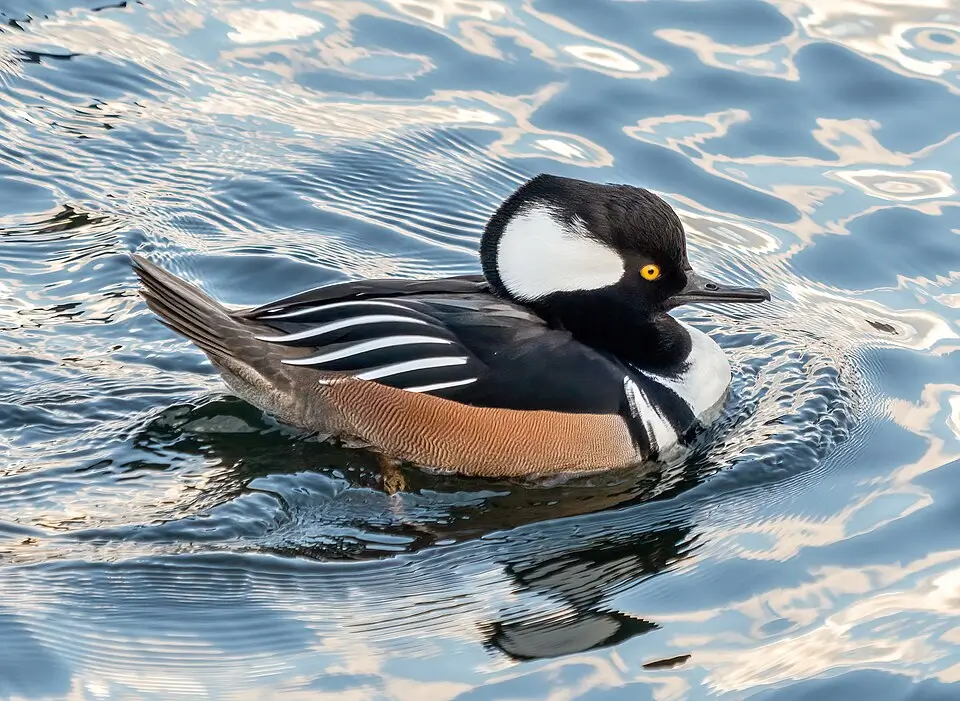
The sexual dimorphism of the hooded merganser is pronounced and spectacular. Adult males display a large, fan-shaped crest that is predominantly white with bold black borders — a feature that can be raised or lowered at will. The head and neck are otherwise black, while the breast is white with two distinctive vertical black stripes on each side. The flanks are rich rufous (reddish-brown), and the back is mostly black. The eyes of the male are a striking golden yellow.
Female hooded mergansers are considerably more subdued in coloration, as is common among many waterfowl species. They display a brownish overall plumage with a smaller, tawny-colored crest. While less visually dramatic than the male, the female's understated elegance is well-suited to nesting duties, providing camouflage in wooded wetland environments. Females also have golden-yellow eyes, a trait shared with the male.
Both sexes possess the characteristic serrated bill shared by all mergansers — a narrow, hooked, tooth-like structure perfectly adapted for gripping slippery fish and aquatic prey. This serrated edge distinguishes mergansers from most other ducks and is the reason they are sometimes called "sawbills."
Size and Physical Characteristics
The hooded merganser is a small but athletic bird. It is well-adapted for diving and underwater pursuit, with lobed feet set far back on the body — a configuration that makes it an exceptional swimmer but somewhat awkward on land. Its wings are narrow and pointed, enabling rapid flight, though it requires a running start across the water's surface to become airborne.
One of the most remarkable physiological adaptations of the hooded merganser is its ability to rapidly adjust the refractive power of its eyes while diving underwater. Like other diving birds, it can dramatically change the curvature of its lens to maintain sharp vision in an aquatic environment — an extraordinary biological feature that allows it to track and capture fast-moving prey beneath the surface.
Diet
The hooded merganser is a carnivorous diving duck. Its diet consists primarily of small fish, crayfish, aquatic insects, and amphibians. Using its serrated bill to grip prey, it dives beneath the surface and pursues food actively. This dietary profile distinguishes it from dabbling ducks, which feed primarily on plant matter at or near the water's surface.
Breeding and Nesting
The hooded merganser is a cavity-nesting species, making use of natural tree cavities and nest boxes in wooded wetland areas. This behavior places it in the same ecological guild as wood ducks (Aix sponsa) and buffleheads (Bucephala albeola), both of which also nest in tree cavities. Indeed, it is not uncommon for hooded mergansers to share or compete for nest sites with wood ducks.
Females lay clutches typically ranging from 7 to 15 eggs, and incubation lasts approximately 26 to 41 days. Shortly after hatching, ducklings leap from the nest cavity — sometimes from considerable heights — and follow their mother to the water. This early independence is a hallmark of cavity-nesting ducks.
The hooded merganser is monogamous on a seasonal basis, with pair bonds typically forming during winter and early spring. Males perform elaborate courtship displays, rapidly raising and lowering their dramatic crests while calling and posturing to attract females.
Habitat & Range
The hooded merganser is endemic to North America, meaning it is found nowhere else in the world. Its range spans much of the eastern and northwestern portions of the continent, with two primary population centers: one in the Pacific Northwest and another across the eastern United States and Canada.
The species favors small, wooded bodies of freshwater, including beaver ponds, swamps, marshes, forested rivers, streams, and lakes. Dense riparian and forested wetland habitats are particularly important, both for nesting — where cavity trees must be present — and for foraging in clear, shallow waters where prey is abundant.
In New York State, the hooded merganser finds abundant suitable habitat. The state's rich network of Adirondack lakes and ponds, Hudson Valley wetlands, Finger Lakes region waterways, and coastal marshes and estuaries all serve as important areas for this species. New York's position along the Atlantic Flyway — one of North America's four major migratory bird routes — makes it a critical corridor for migrating hooded mergansers moving between northern breeding grounds and southern wintering areas.
During migration and winter, hooded mergansers can also be found in brackish and coastal waters, particularly in bays and sheltered tidal areas where fish are accessible.
Hunting Information
The hooded merganser is a legally huntable waterfowl species in the United States, regulated under the Migratory Bird Treaty Act and managed jointly by the U.S. Fish and Wildlife Service and individual state wildlife agencies. As a migratory bird, it falls under federal oversight, with annual hunting frameworks established at the federal level and then adapted by states within those guidelines.
In New York State, waterfowl hunting — including hunting for mergansers — is regulated by the New York State Department of Environmental Conservation (NYSDEC). Hunters pursuing hooded mergansers in New York are required to hold appropriate state hunting licenses and migratory bird stamps as mandated by both state and federal law. However, specific season dates, bag limits, and licensing requirements for the current season are subject to annual regulatory updates and were not available in the source data consulted for this article. Hunters are strongly encouraged to consult the official NYSDEC website or the current New York State Hunting & Trapping Guide for the most up-to-date regulations.
From a hunting perspective, the hooded merganser presents a distinctive and challenging quarry. Its swift, direct flight — often hugging close to the water's surface and threading through wooded corridors — demands sharp shooting skills. Many waterfowl hunters specifically target mergansers for the challenge they present, as well as for the unique opportunity to observe one of North America's most visually striking birds at close range.
It is worth noting that mergansers are sometimes considered a secondary target among waterfowl hunters, as their fish-based diet can impart a stronger flavor to the meat compared to grain-feeding dabbling ducks. However, proper field preparation and cooking techniques — including soaking the meat and using robust marinades — can yield excellent table fare. Many experienced hunters regard merganser, when carefully prepared, as a rewarding and distinctive wild game meal.
Decoys, calls, and hunting from blinds near wooded wetland edges are among the most productive strategies for hooded merganser hunting. Because they favor small, tree-lined water bodies, hunting locations tend to be intimate and scenic. Early morning and late afternoon flights, particularly during the peak of migration, offer the best opportunities for encountering birds in numbers.
Conservation
The hooded merganser is currently listed as a species of Least Concern by the International Union for Conservation of Nature (IUCN), reflecting a generally stable and healthy population across its North American range. This positive conservation status is a testament to the species' adaptability and to the effectiveness of wildlife management practices implemented over the past several decades.
The Migratory Bird Treaty Act of 1918 has been a cornerstone of merganser conservation in the United States, providing legal protection for migratory birds and regulating hunting pressure to sustainable levels. Coordinated management between the U.S., Canada, and Mexico under this treaty framework has helped ensure that hooded merganser populations remain viable.
Habitat conservation is critically important for this species. The availability of mature trees with suitable cavities for nesting is a limiting factor in many areas. Conservation organizations and wildlife agencies have addressed this challenge through the installation of artificial nest boxes in appropriate wetland habitats — a strategy that has proven highly effective for hooded mergansers, much as it has for wood ducks. Wetland preservation and the protection of forested riparian corridors also contribute meaningfully to sustaining healthy populations.
In New York, the state's extensive network of wildlife management areas, state forests, and protected wetlands provides vital habitat for hooded mergansers and many other waterfowl species. The broader efforts of Ducks Unlimited and other conservation organizations to protect and restore North American wetlands further support the long-term outlook for this species.
Hunters themselves play a meaningful role in conservation through the excise taxes on firearms, ammunition, and archery equipment collected under the Federal Aid in Wildlife Restoration Act (Pittman-Robertson Act), which funds habitat acquisition, wildlife research, and management programs across the country.
Conclusion
The hooded merganser is, without question, one of North America's avian jewels. From its breathtaking physical appearance to its fascinating biological adaptations and its ecological role as a top-tier aquatic predator, this species captures the imagination of all who encounter it. For New York residents and visitors alike, the chance to observe or pursue hooded mergansers in the state's beautiful wetlands and waterways is a genuine privilege — one that speaks to the richness of North American wildlife and the importance of ongoing conservation stewardship.