Overview
Among the many waterfowl species that grace North America's lakes, rivers, and coastal waterways, the Greater scaup (Aythya marila) stands out as one of the most captivating and ecologically significant diving ducks on the continent. Known colloquially as "bluebills" among hunters and wildlife enthusiasts alike — a nickname earned from the distinctive pale blue bill that both sexes display — the Greater scaup is a hardy, wide-ranging species that commands attention wherever it appears. Whether observed in massive winter flocks rolling across the surface of a Great Lake or diving beneath the frigid waters of a coastal bay, this bird represents the very essence of wild, open-water waterfowl.
For hunters, birdwatchers, and conservationists across New York and throughout the broader northeastern United States, the Greater scaup holds a special place. Its arrival each autumn signals the turning of the season and the beginning of some of the most exciting waterfowl hunting opportunities available in the region. Understanding this bird — its biology, its habits, its range, and its conservation status — is the first step toward appreciating everything it has to offer.
Biological Traits
The Greater scaup (Aythya marila) belongs to the family Anatidae, the large and diverse family of birds that encompasses all ducks, geese, and swans. Within that family, it is classified in the genus Aythya, a group of diving ducks that share a common lifestyle centered on underwater foraging. The species name marila is derived from the Greek word for charcoal or coal embers, a reference that some taxonomists believe relates to the bird's plumage patterns.
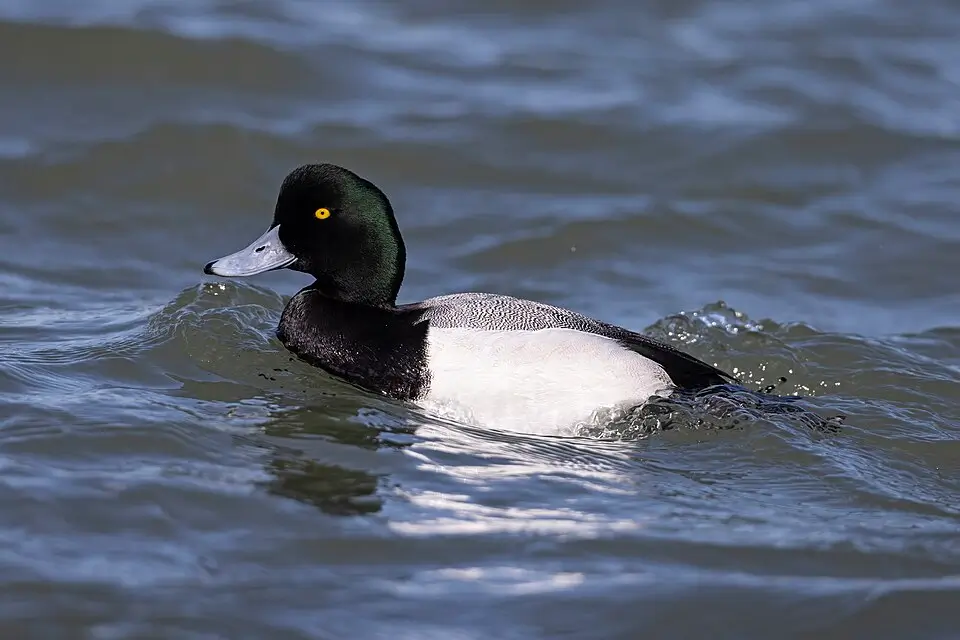
In terms of physical appearance, the Greater scaup is a medium-to-large diving duck with a robust, rounded body well-suited to life on open water. Adult males are striking birds during the breeding season, featuring a glossy, iridescent head that can appear green or purple depending on the angle of light, a clean white flank and belly, a black breast, and a finely vermiculated gray back. The bill, as the nickname "bluebill" suggests, is a pale blue-gray color with a small black nail at the tip. Females, by contrast, are more subdued in their coloration — primarily brown overall — but they share the same distinctive bill shape and a notable white facial patch at the base of the bill that makes them readily identifiable in the field.
One of the most useful field marks for distinguishing the Greater scaup from its close relative, the Lesser scaup (Aythya affinis), is the shape of the head. The Greater scaup possesses a rounder, more evenly domed head profile, while the Lesser scaup typically shows a more peaked crown. Additionally, the Greater scaup tends to show more white in the wing stripe during flight, extending further into the primary feathers than on the Lesser scaup — a distinction that experienced observers find invaluable when birds are on the wing.
Like all diving ducks, the Greater scaup is built for underwater pursuit. Its legs are set far back on its body, an anatomical adaptation that provides powerful propulsion underwater but makes walking on land somewhat awkward. These birds dive readily and can reach considerable depths in search of food, using their feet to propel themselves below the surface. Their diet is broad and opportunistic, consisting of mollusks, crustaceans, aquatic insects, and various aquatic plants. Mussels and other bivalves are particularly favored and constitute a significant portion of the diet on wintering grounds.
Greater scaup are highly social birds, particularly outside of the breeding season. They tend to congregate in large flocks — sometimes called "rafts" — on open water bodies, and these aggregations can number in the thousands of individuals. This flocking behavior provides safety in numbers and is a hallmark of the species during migration and winter.
Habitat and Range
The Greater scaup has one of the most expansive ranges of any duck in the Northern Hemisphere. As a circumpolar species, it breeds across a broad swath of the high Arctic and subarctic, from Alaska and northern Canada through Iceland, Scandinavia, and across northern Russia and Siberia. This makes it one of the few truly global waterfowl species, with populations that span multiple continents.
During the breeding season, Greater scaup favor open tundra and boreal forest habitats, typically nesting near lakes, ponds, rivers, and wetlands in these remote northern landscapes. Nests are built on the ground, often in dense vegetation near water, and females typically lay clutches of six to nine eggs. The male takes little role in incubation or brood rearing, leaving the female to raise the ducklings largely on her own.
As autumn advances and the Arctic begins to freeze, Greater scaup undertake long migratory journeys to their wintering grounds. In North America, the Atlantic Flyway is a critical migration corridor for this species, and New York occupies a prominent place within it. The Great Lakes — including Lake Ontario and Lake Erie, both of which border New York — serve as important staging and wintering areas for thousands of Greater scaup each year. The Atlantic Coast, including Long Island Sound, the bays of Long Island, and the broader New York Bight, also provides essential wintering habitat where birds can access their preferred mollusks and other invertebrates in the shallow coastal waters.
In New York, the Greater scaup is most reliably encountered from late autumn through early spring. Large concentrations can be observed from shore or by boat on the Great Lakes, the Hudson River, and numerous coastal locations. Birdwatchers and hunters alike plan outings around the arrival of these birds, and the spectacle of thousands of scaup riding the waves of a cold November lake is one of the iconic scenes of northeastern waterfowl country.
Hunting Information
The Greater scaup has a long tradition as a prized waterfowl quarry across its North American range, and New York is no exception. The state's diverse geography — encompassing the Great Lakes shoreline, the Hudson River Valley, Long Island's coastal bays, and numerous inland lakes and reservoirs — creates a wide variety of hunting opportunities for those pursuing bluebills and other diving ducks.
Hunting Greater scaup typically requires open-water setups, as these birds rarely venture far from deep lakes, large rivers, or coastal bays. Hunters traditionally employ large decoy spreads positioned on open water to attract passing birds, and layout boats, sneak boats, or shore blinds are all common methods used in New York's diverse waterfowl hunting landscape. The species' tendency to travel in large flocks and respond well to decoys makes it an exciting quarry for experienced divers hunters.
It is important for all hunters to note that waterfowl hunting in New York is regulated by both state and federal authorities, with season dates, bag limits, and licensing requirements established annually. Prospective hunters are strongly encouraged to consult the New York State Department of Environmental Conservation (NYSDEC) and the U.S. Fish & Wildlife Service for the most current and accurate regulations before heading afield. Regulations can change from year to year based on population assessments and conservation needs, and compliance is both a legal requirement and an ethical responsibility.
Hunters pursuing Greater scaup should also be attentive to the challenge of distinguishing them from Lesser scaup in the field, as regulations may differ between species. Developing strong identification skills before the season opens is an important part of responsible hunting practice.
Conservation
The Greater scaup, like many North American waterfowl species, has experienced population fluctuations over the decades, drawing attention from conservation biologists and wildlife managers. Research into the causes of any population changes has pointed to a range of potential factors, including changes on breeding grounds, shifts in food availability on wintering areas, and broader environmental changes in the Arctic. Conservation organizations and government agencies on both sides of the Atlantic continue to monitor populations closely and work to understand the dynamics driving population trends.
In the context of North American waterfowl conservation, the Greater scaup is managed under the cooperative framework established by the North American Waterfowl Management Plan, a landmark agreement between the United States, Canada, and Mexico that has guided waterfowl conservation efforts for decades. Wetland conservation, habitat protection on both breeding and wintering grounds, and carefully managed hunting seasons are all components of the strategy aimed at sustaining healthy Greater scaup populations for future generations.
For hunters, participating in waterfowl banding programs and reporting banded birds when encountered is one of the most direct ways individual sportspeople can contribute to scientific understanding and conservation of this species. These citizen science contributions provide invaluable data on migration routes, survival rates, and population connectivity.
New York's extensive network of wildlife management areas, national wildlife refuges, and protected coastal habitats all play a role in supporting Greater scaup during the critical winter period, making the state an important piece of the larger conservation puzzle for this wide-ranging species.
Conclusion
The Greater scaup is a bird that embodies the wildness and vitality of North America's open waters. From its circumpolar Arctic breeding grounds to the bays and lakes of New York, this resilient diving duck connects vast landscapes and seasons in a way that few other species can. Whether you are a hunter settling into a layout boat on a cold November morning, a birdwatcher scanning a winter flock through binoculars, or simply someone who appreciates the natural world, the Greater scaup rewards attention and respect. Understanding and supporting its conservation is a shared responsibility — and a shared privilege — for all who value the outdoors.