Overview
Few animals capture the imagination of wildlife enthusiasts, hunters, and outdoor adventurers quite like the elk. Known scientifically as Cervus canadensis, the elk — also commonly referred to as the wapiti, a name derived from the Shawnee and Cree word meaning "white rump" — stands as one of the largest members of the deer family (Cervidae) in North America. These magnificent animals are a cornerstone of North American wildlife heritage, representing both the wildness of vast mountain landscapes and the enduring success of conservation-minded wildlife management.
Whether encountered on a backcountry trail in the Rocky Mountains, spotted grazing in a meadow at dawn, or pursued during the thrilling rut season when bulls unleash their haunting bugle calls across the valleys, elk inspire a deep sense of awe and respect. Their sheer size, grace, and resilience make them one of the most celebrated large mammals on the continent. For hunters, naturalists, and wildlife photographers alike, the elk holds a place of profound significance in the North American outdoor tradition.
This article explores the biology, habitat, behavior, hunting traditions, and conservation story of Cervus canadensis — a species that continues to thrive thanks to dedicated management and passionate stewardship of wild places.
Biological Traits
The elk (Cervus canadensis) belongs to the family Cervidae and the order Artiodactyla (even-toed ungulates). It is closely related to other deer species such as the red deer (Cervus elaphus) of Europe and Asia, and the two species are so genetically similar that they were once considered the same species. However, modern taxonomic analysis recognizes them as distinct species, with elk being a uniquely North American (and introduced) phenomenon.
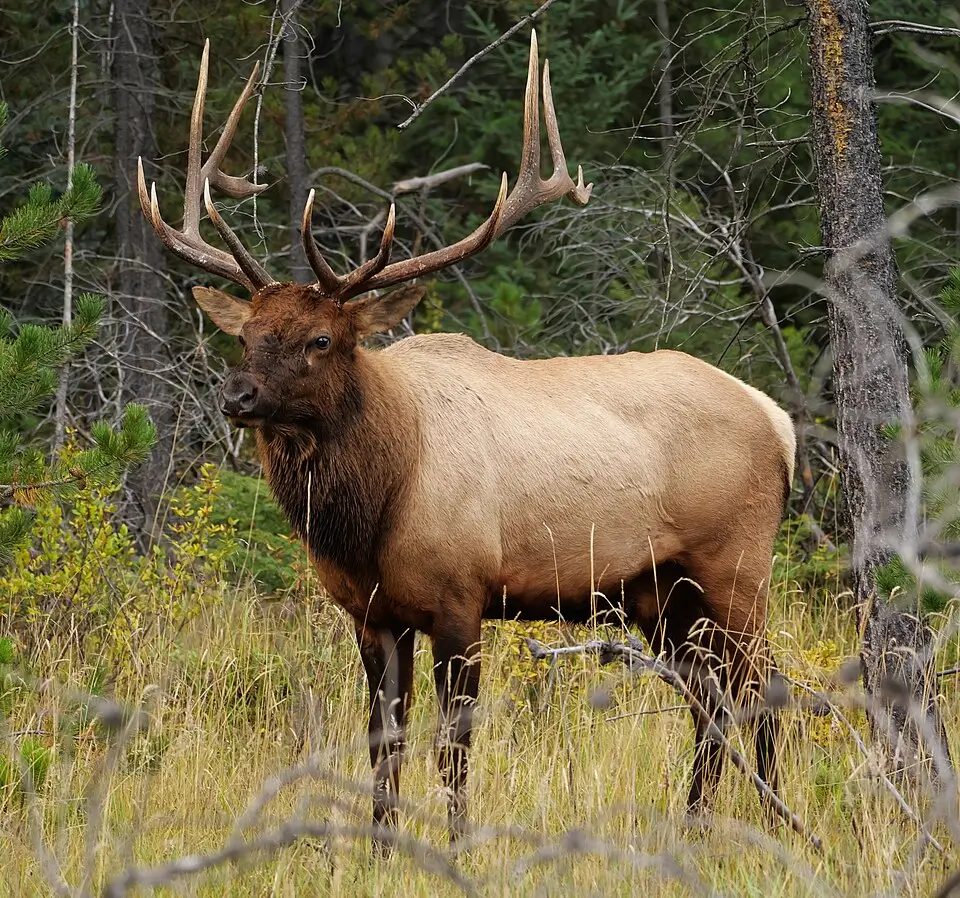
Elk are among the largest terrestrial mammals in North America. Adult bulls (males) are substantially larger than cows (females). Bulls typically weigh anywhere from 700 to over 1,000 pounds depending on subspecies and region, while cows are generally more modestly sized. Bulls carry an impressive set of antlers that grow anew each year, shedding the previous year's rack in late winter or early spring and then regrowing a new set through the spring and summer months. During the growth phase, antlers are covered in a soft, nutrient-rich tissue known as velvet, which supplies blood and nutrients for rapid bone development. By late summer, this velvet dries and is rubbed off by the bulls, revealing the hardened, polished bone beneath.
Elk antlers can grow to remarkable dimensions — large, mature bulls can carry antlers measuring five feet or more in length and weighing in excess of 40 pounds. The antlers of a mature bull typically feature a distinctive shape with multiple tines, and hunters commonly describe rack size in terms of the number of points per side (e.g., a "6x6" bull carries six points on each antler).
The coat of an elk changes with the seasons. In summer, elk sport a reddish-brown hide, while in the colder months they develop a thicker, darker coat to withstand frigid temperatures. The characteristic pale, cream-colored rump patch — which inspired the Algonquian name "wapiti" — is a distinctive field marking that helps hunters and wildlife observers identify the species even at a distance.
Elk are social animals. Cows and calves typically travel together in herds, while mature bulls tend to be more solitary outside of the breeding season. The rut, or breeding season, typically occurs in early autumn — generally peaking in September and into October across much of the elk's range. During this period, bulls become highly vocal and active, producing their iconic bugling calls to attract cows and challenge rival bulls. These high-pitched, resonant bugles are among the most distinctive sounds in the North American wilderness. Bulls also engage in dramatic sparring matches, locking antlers in tests of strength that can last many minutes.
Cows give birth to a single calf — rarely twins — in late spring, typically in May or June. Calves are born spotted, a natural camouflage adaptation, and are mobile within hours of birth. They grow rapidly during the summer months, fueled by their mother's rich milk and the abundance of summer forage.
Elk are herbivores and grazers-browsers, meaning they consume both grasses and forbs as well as shrubs and tree bark. Their diet shifts with the seasons, following the availability of nutritious vegetation. In summer, lush meadow grasses and wildflowers provide the bulk of their diet. In winter, elk may turn to woody browse such as aspen, willows, and conifer bark when snow covers the ground.
Habitat & Range
Historically, elk ranged across a vast swath of North America, from the Atlantic Coast to the Pacific, and from Canada deep into Mexico. Indigenous peoples across this enormous range relied upon elk as a primary source of food, clothing, and tools. Before European settlement, elk populations likely numbered in the tens of millions.
However, as European colonization expanded across the continent, elk populations were dramatically reduced through overhunting and habitat loss. By the late 19th and early 20th centuries, elk had been extirpated from much of their eastern and central range, with viable wild populations mostly restricted to the Rocky Mountain West, the Pacific Northwest, and portions of Canada.
Today, thanks to conservation efforts and reintroduction programs, elk can be found in a variety of habitats: from high-elevation alpine meadows and dense conifer forests to open grasslands, river valleys, and even semi-arid shrublands. They are most closely associated in popular culture with the iconic mountain landscapes of states like Wyoming, Montana, Colorado, Idaho, and Oregon — where some of the continent's largest herds roam freely.
Several subspecies of elk exist, each adapted to specific regional environments. The Rocky Mountain elk (Cervus canadensis nelsoni) is the most numerous and widely distributed subspecies. The Roosevelt elk (Cervus canadensis roosevelti), the largest subspecies, inhabits the temperate rainforests of the Pacific Northwest. The Tule elk (Cervus canadensis nannodes) is a smaller subspecies endemic to California, while the Manitoba elk (Cervus canadensis manitobensis) occupies the Great Plains and boreal forests of central Canada.
Hunting Information
Elk hunting is deeply woven into the fabric of North American hunting culture. Often regarded as one of the most challenging and rewarding big-game pursuits on the continent, elk hunting demands physical fitness, woodsmanship, patience, and skill. The animals' keen senses — including sharp eyesight, a highly developed sense of smell, and acute hearing — make them formidable quarry. Their tendency to inhabit remote, rugged terrain adds another layer of challenge and adventure to the pursuit.
Across the western United States, elk hunting is a managed and regulated activity overseen by state fish and wildlife agencies. Hunters typically apply for licenses and tags through a lottery or draw system, as elk tags can be in high demand. Seasons are carefully structured to align with population data, herd objectives, and the natural rhythms of the elk's life cycle. Common hunting methods include archery hunting during the early rut, muzzleloader seasons, and rifle seasons, each offering different levels of challenge and intimacy with the natural world.
Bull hunting during the rut is particularly celebrated among hunters. The ability to locate a bugling bull and call him within range — using cow calls, bull challenges, or simple patience — is considered one of the pinnacle experiences in North American hunting. Cow hunts, which are typically more accessible through over-the-counter tags in many western states, provide excellent opportunities for hunters seeking quality meat and a challenging backcountry experience.
Elk Hunting in New York State
For hunters in New York — the fourth-most populous state in the United States, located in the northeastern United States and bordering Canada, New England, Pennsylvania, and New Jersey — elk hunting is not currently an established hunting tradition in the way it is in western states. Elk were historically present in New York and across much of the northeastern United States but were extirpated from the region centuries ago due to overhunting and habitat change.
According to the currently available official hunting information for New York State, there are no established elk hunting seasons or licensing structures in place. Hunters in New York who wish to pursue elk must currently do so by traveling to western states or Canadian provinces that offer elk hunting opportunities. New York hunters interested in pursuing elk are encouraged to research license and tag application requirements through the wildlife management agencies of states with established elk populations.
It is worth noting, however, that there have been ongoing discussions and wildlife management studies in various eastern states regarding the potential for elk reintroduction. Conservation organizations and wildlife managers continue to assess habitat suitability and the long-term prospects for elk in parts of the East. Whether New York will one day support a huntable elk population remains an exciting possibility for the future.
Conservation
The conservation story of the elk is, in many ways, one of the great success stories in North American wildlife management. From populations severely reduced by the late 1800s, elk have made a remarkable recovery, thanks largely to the efforts of hunters, conservationists, state and federal wildlife agencies, and organizations such as the Rocky Mountain Elk Foundation (RMEF).
The modern North American Model of Wildlife Conservation — funded in significant part through hunting licenses, tags, and federal excise taxes on sporting goods under the Federal Aid in Wildlife Restoration Act (Pittman-Robertson Act) — has provided both the financial resources and the regulatory framework needed to restore elk across broad portions of their former range. Today, an estimated one million or more elk inhabit North America, a testament to what science-based management and conservation funding can achieve.
Reintroduction efforts have successfully restored elk to states such as Kentucky, Tennessee, Pennsylvania, and Michigan, where the species had long been absent. These programs demonstrate the feasibility of restoring elk to suitable eastern habitats. Conservation challenges remain, however, including habitat fragmentation, disease management (notably Chronic Wasting Disease, or CWD), predator-prey dynamics, and the encroachment of human development on migration corridors and winter range.
For all who love wild places and the magnificent animals that inhabit them, the ongoing stewardship of elk populations represents both a responsibility and a privilege — a commitment to ensuring that future generations can experience the haunting bugle of a bull elk echoing across a misty autumn valley.