Overview
Few birds in North America command as much respect from hunters and wildlife enthusiasts alike as the Common snipe (Gallinago gallinago). This remarkable shorebird has captured human imagination for centuries, lending its very name to the term "sniper" — a testament to both the bird's elusive nature and the extraordinary skill required to pursue it in the field. Whether you encounter one flushing unexpectedly from a marsh edge, hear its haunting winnowing call overhead on a spring evening, or spot it probing methodically through soft mud, the Common snipe is a species that rewards patience, knowledge, and a deep appreciation for the natural world.
In New York State, one of the most ecologically diverse states in the northeastern United States, the Common snipe finds abundant wetland habitat to support its life cycle. Home to over 20 million residents and encompassing more than 54,000 square miles of varied landscape, New York provides a compelling backdrop for understanding and appreciating this extraordinary bird. From the Adirondack bogs to the coastal marshes of Long Island, the Common snipe is a living symbol of the rich biodiversity that thrives even within reach of one of the most populous states in the nation.
This article explores the biology, habitat, behavior, hunting traditions, and conservation outlook of this fascinating bird, offering a well-rounded portrait of one of the most challenging and rewarding species a wingshooter can pursue.
Biological Traits
The Common snipe is a medium-sized wading bird belonging to the family Scolopacidae, which includes sandpipers, woodcocks, and their relatives. Its scientific name, Gallinago gallinago, derives from the Latin word for "hen" or "chicken," a nod to its roughly chicken-like proportions in early naturalist writings.
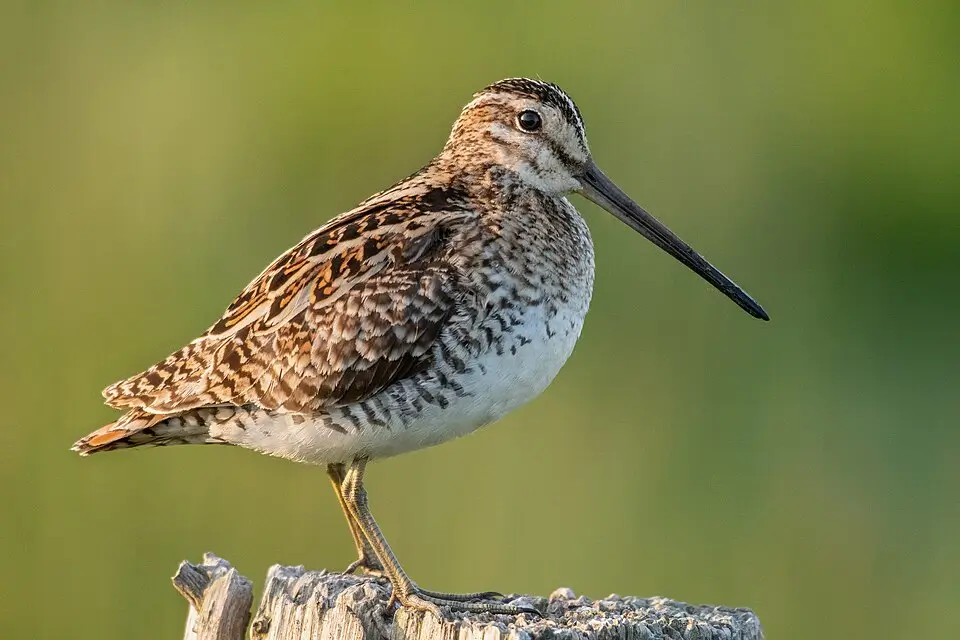
One of the most immediately recognizable features of the Common snipe is its extraordinarily long, straight bill — a precision instrument perfectly adapted for probing soft substrates in search of invertebrate prey. The bill tip is highly sensitive and can flex slightly, allowing the bird to grasp worms, insect larvae, crustaceans, and other small creatures deep within mud and saturated soil without even withdrawing the bill from the ground. This feeding technique is known as "rhynchokinesis," a fascinating biological adaptation shared among several shorebird families.
The plumage of the Common snipe is a masterwork of cryptic coloration. Bold stripes of buff, brown, black, and white run along the head and back, creating a disrupted pattern that blends seamlessly with dead vegetation, marsh grass, and leaf litter. When alarmed, a snipe will often crouch and freeze, relying entirely on its camouflage to avoid detection. Only when a threat comes very close will it burst into the air with a characteristic zig-zagging, twisting flight — a behavior that has challenged hunters and aerial predators alike for millennia.
In flight, the Common snipe produces a distinctive raspy call often described as a harsh "scaipe" or "scape," which typically erupts at the moment of flushing. This sudden call, combined with the bird's erratic flight pattern, has caused more than one hunter to miss a clean shot. During the breeding season, males perform aerial display flights called "drumming" or "winnowing," diving at steep angles and causing their stiffened outer tail feathers to vibrate in the airstream, producing a haunting, pulsing sound that carries far across open wetlands at dusk.
The Common snipe is not a large bird by any measure. It generally weighs between roughly 80 and 140 grams and measures approximately 25 to 27 centimeters in length, with a wingspan of around 44 to 47 centimeters. Despite its compact size, it is a strong and capable long-distance migrant, capable of covering thousands of miles between breeding and wintering grounds.
Habitat & Range
The Common snipe enjoys a remarkably wide global distribution, breeding across much of the northern Holarctic region, including Europe, northern Asia, Iceland, and across northern North America from Alaska through Canada and into the northern contiguous United States. It is most closely associated with wet, open habitats, particularly freshwater marshes, fens, bogs, wet meadows, flooded agricultural fields, and the edges of slow-moving streams.
The species favors areas with soft, moist soils where its long bill can be put to full use. Dense, low-lying vegetation provides essential cover for roosting and nesting, while adjacent open mudflats or shallowly flooded areas serve as primary foraging zones. Snipe are seldom found in dry upland environments and are almost always located in proximity to water.
In North America, Common snipe nest primarily in the boreal forests and subarctic wetlands of Canada and Alaska, where cold, waterlogged landscapes provide ideal conditions for raising young. As autumn arrives and northern habitats freeze, birds move southward along a broad migratory front, passing through states like New York in significant numbers before settling into wintering areas across the southern United States, Mexico, Central America, and the Caribbean.
In New York, snipe are present primarily as spring and fall migrants, though some birds may linger in areas with open water during mild winters. The state's diverse wetland landscape — encompassing the Great Lakes marshes to the west, the St. Lawrence River lowlands to the north, the Hudson Valley, and the coastal wetlands of Long Island — provides excellent habitat during migration. Hunters and birdwatchers visiting flooded fields, sedge meadows, and marsh edges during peak migration windows have the best chance of encountering this secretive species.
Hunting Information
The Common snipe holds a storied place in hunting tradition. The word "snipe" in its hunting context dates back centuries in England, where pursuing these birds in open marshes was considered one of the most demanding tests of a wingshooter's skill. Only the most accurate shots could regularly put snipe in the bag, giving rise to the term "sniper" to describe an expert marksman. Today, snipe hunting remains a respected and challenging pursuit for waterfowl and upland hunters throughout North America.
Hunting Common snipe in the United States is regulated under the Migratory Bird Treaty Act, which places snipe under federal protection and management. As a result, hunting seasons, bag limits, and license requirements are set through a combination of federal frameworks established by the U.S. Fish and Wildlife Service and individual state regulations issued each year.
In New York, prospective snipe hunters should consult the New York State Department of Environmental Conservation (DEC) for the most current season dates, bag limits, and licensing requirements, as these regulations are subject to annual review and may change. A valid New York State hunting license is generally required, along with federal and state migratory bird stamps as mandated by current regulations. Given that specific season dates and license details for Common snipe in New York were not available in the source data compiled for this article, hunters are strongly encouraged to verify all requirements directly with the New York DEC before heading afield.
Hunting snipe requires a different approach than many other game birds. Hunters typically work on foot through wet, muddy habitat — often wading through flooded fields, sedge meadows, or marsh edges. A well-trained pointing or flushing dog can be invaluable for locating birds and recovering downed snipe in dense cover. Light loads of small shot are standard, as snipe are not heavily built birds, and the emphasis is on quick, instinctive shooting as the bird rockets into the air and begins its characteristic evasive flight.
Despite the traditional phrase "snipe hunt" being used colloquially to describe a fool's errand, real snipe hunting is a deeply rewarding and legitimate pursuit enjoyed by dedicated wingshooters who appreciate both the challenge of the bird and the wild beauty of the wetland landscapes it calls home.
Conservation
The Common snipe is currently listed as a species of Least Concern on the IUCN Red List, reflecting a wide global range and a sufficiently large overall population. However, like many migratory shorebirds and wetland-dependent species, the Common snipe faces ongoing pressure from the loss and degradation of wetland habitats across its range.
Wetland drainage for agriculture, urban development, and changing hydrological patterns associated with a shifting climate all pose meaningful challenges to snipe populations in the long term. Conservation organizations, state wildlife agencies, and federal programs such as the North American Wetlands Conservation Act work actively to protect, restore, and enhance the wetland habitats that snipe and dozens of other species depend upon.
Hunters have historically been among the most passionate advocates for wetland conservation, recognizing that healthy wetlands are not only essential for game birds but also support water quality, flood mitigation, carbon storage, and broader biodiversity. Programs administered through organizations like Ducks Unlimited and supported by revenues from the Federal Duck Stamp have protected millions of acres of wetland habitat across the continent.
For the Common snipe to remain a vibrant part of North America's wildlife heritage — and a challenging quarry for future generations of wingshooters — continued investment in wetland conservation is essential. Every acre of marsh, flooded meadow, or sedge fen protected today is a direct investment in the long-term future of this remarkable bird.