Overview
Few birds capture the spirit of wild, windswept coastlines quite like the Common eider (Somateria mollissima). Bold in appearance, fascinating in behavior, and deeply woven into the cultural and ecological fabric of northern coastal regions, the Common eider stands as one of the most iconic waterfowl species in the world. As North America's largest native duck, this species commands attention whether it is riding the swells of a frigid Atlantic bay, nesting along a rocky Arctic shoreline, or gathering in enormous rafts offshore during the winter months. For birders, hunters, and naturalists alike, the Common eider represents the very best of wild coastal wilderness.
In the context of New York State — a state that stretches from the Canadian border to the Atlantic Ocean and encompasses diverse coastal ecosystems along Long Island and the Lower Hudson Valley — the Common eider holds a special place as a winter visitor and a species of genuine sporting and ecological interest. Understanding this remarkable bird means appreciating not only its striking biology but also its habitat requirements, its life history, and the thoughtful stewardship that keeps its populations thriving.
Biological Traits
The Common eider is a large, heavyset sea duck belonging to the family Anatidae and the genus Somateria, a name derived from Greek words meaning "wool body" — a direct reference to the species' extraordinarily soft and insulating down feathers. These are among the most thermally efficient natural fibers known to science, and they have been harvested sustainably by northern coastal communities for centuries to fill pillows, quilts, and sleeping bags.
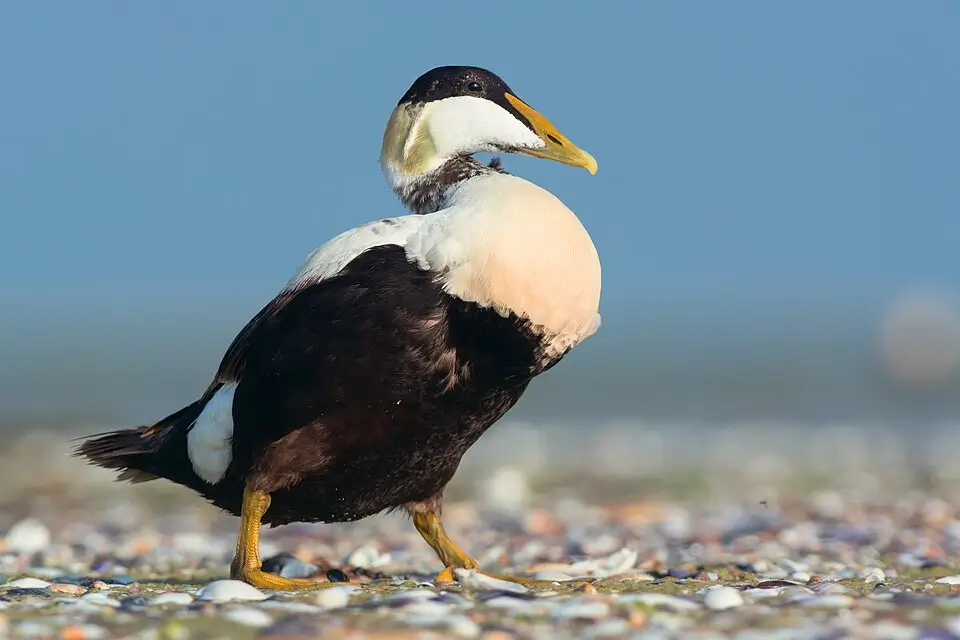
Adult male Common eiders are among the most visually striking of all ducks. In breeding plumage, the drake displays a crisp pattern of black and white, with a pale green wash on the nape of the neck, a blush of soft salmon-pink on the breast, and a distinctive sloping forehead that lends the bird its characteristic profile. The bill is large, wedge-shaped, and extends well up onto the forehead in a characteristic lobe — a feature unique to the eiders and instantly recognizable in the field.
Female Common eiders, by contrast, wear a rich, warm brown plumage barred with darker markings — cryptic coloration ideally suited to the demands of ground nesting in open tundra and rocky coastal terrain. This camouflage is critical to nesting success, as females rely heavily on staying hidden rather than fleeing when approached by predators.
The Common eider is notable for its diving ability. These ducks forage almost exclusively underwater, using their powerful wings and feet to propel themselves to the seafloor in search of their preferred prey: mussels, clams, sea urchins, crabs, and other hard-shelled invertebrates. Their powerful gizzards are capable of crushing mollusk shells with remarkable efficiency — a dietary specialization that makes them perfectly adapted to life in rocky intertidal and subtidal zones.
In terms of size, the Common eider is substantial. It is the heaviest duck native to North America, and its robust build is a direct adaptation to the cold, energetically demanding marine environments it inhabits. Its thick layer of insulating down — both in the plumage and as lining in the nest — helps it maintain body temperature in environments where wind chill and frigid water temperatures would challenge most other birds.
Vocalizations are another distinctive feature of this species. The male's soft, moaning ah-ooo call — often compared to the sound of a surprised person — is one of the more evocative sounds of the northern coast, frequently heard during courtship displays in late winter and early spring. Females produce a more guttural, growling call.
Habitat & Range
The Common eider has one of the broadest ranges of any sea duck in the Northern Hemisphere. As a circumpolar species, it breeds across Arctic and subarctic coastlines spanning North America, Greenland, Iceland, the British Isles, Scandinavia, and northern Russia. In North America, major breeding populations are found across northern Canada, Hudson Bay, Labrador, Newfoundland, and the coast of Maine — making the eastern seaboard a vital part of the species' range.
Habitat preferences are strongly tied to coastal marine environments. During the breeding season, Common eiders favor rocky shorelines, offshore islands, and tundra coastal zones where ground-nesting is possible and food resources are abundant. Nesting colonies can be remarkably dense, with females often nesting in close proximity to one another — a habit that may provide some collective defense against predators.
During the non-breeding months — autumn through early spring — Common eiders undertake migrations that bring large numbers of birds southward along the Atlantic Coast. In this season, they are characteristic birds of nearshore ocean environments: rocky jetties, protected bays, coastal inlets, and the open ocean itself. Flocks can be enormous, sometimes numbering in the thousands, and the sight of large rafts of eiders riding ocean swells just offshore is one of the defining spectacles of the Atlantic winter coast.
For New York State, the Common eider is primarily a winter visitor and occasional migrant, appearing along the coastlines of Long Island, the bays of the South Shore, and other coastal areas accessible from the Atlantic. New York's 127 miles of tidal coastline and its numerous barrier beaches and embayments provide suitable wintering habitat for this and other sea duck species. Birders and hunters visiting the coast in winter have excellent opportunities to observe Common eiders in their natural marine setting.
Hunting Information
The Common eider has a long and respected history as a game bird across its range. In communities stretching from Newfoundland to Scandinavia, sea duck hunting — including the pursuit of eiders — is a deeply rooted tradition that combines skilled seamanship, intimate knowledge of coastal environments, and an appreciation for the natural world.
Sea duck hunting for species like the Common eider typically takes place from boats, coastal blinds, or rocky shoreline setups in open or semi-protected ocean waters. It is a demanding and weather-dependent pursuit, often conducted in cold, windy conditions that require specialized equipment and a solid knowledge of tidal movements and bird behavior. Decoys are commonly used, and the ability to read approaching birds and place shots effectively at sea duck ranges is a skill that takes seasons to develop.
Because hunting regulations for migratory birds — including sea ducks like the Common eider — are governed at both the federal level (by the U.S. Fish & Wildlife Service) and the state level, hunters in New York should consult the most current New York State Department of Environmental Conservation (DEC) migratory bird hunting regulations for up-to-date information on season dates, bag limits, and licensing requirements. Regulations can change from year to year based on population surveys and management recommendations, and it is the responsibility of every hunter to obtain the appropriate federal duck stamp and any applicable state licenses before heading afield.
It is worth noting that sea duck hunting often requires specialized watercraft capable of operating in open ocean conditions, appropriate cold-weather and marine safety gear, and an awareness of the logistical challenges posed by hunting in exposed coastal environments. For hunters new to sea ducking, connecting with experienced guides or local hunting clubs along the Long Island coast can be an excellent way to learn the craft safely and responsibly.
Conservation
The Common eider is currently considered a species of relatively stable conservation status across much of its range, and it serves as a positive example of how thoughtful wildlife management and cultural stewardship can sustain wild populations over the long term. In Iceland and Norway, the tradition of sustainably harvesting eiderdown from nesting colonies — without harming the birds — has created a remarkable incentive for local communities to protect nesting habitat and guard colonies from predators, benefiting both the ducks and the people who depend on them.
In North America, Common eider populations are monitored by the U.S. Fish & Wildlife Service and Canadian Wildlife Service as part of broader sea duck management programs. Population surveys inform harvest regulations, ensuring that hunting pressure remains within sustainable limits. The species' reliance on healthy coastal marine ecosystems means that protecting water quality, shellfish beds, and coastal habitat is directly beneficial to eider conservation.
Climate change presents an emerging challenge for Arctic and subarctic breeding species like the Common eider, as warming temperatures alter sea ice dynamics, shift the timing of invertebrate prey availability, and affect the tundra and coastal habitats where these birds nest. Conservation organizations and wildlife agencies continue to monitor these changes and adapt management strategies accordingly.
For hunters, naturalists, and coastal residents of New York, the presence of Common eiders along the winter shoreline is a reminder of the broader northern wilderness that stretches far to the north — and of the interconnected ecosystems that link Arctic breeding grounds with the bays and inlets of the mid-Atlantic coast. Supporting conservation programs, following all applicable hunting regulations, and participating in citizen science efforts such as the Christmas Bird Count or eBird are all meaningful ways to contribute to the long-term well-being of this magnificent species.