Overview
Few sights in the natural world match the striking beauty of a Bufflehead in full breeding plumage as it skims across a glassy woodland pond or coastal bay. Bold, contrasting colors and an almost comically oversized head make this compact little duck instantly recognizable, even at considerable distance. Known scientifically as Bucephala albeola, the Bufflehead holds a special place in both the ecological fabric of North American wetlands and the hearts of waterfowl hunters and birdwatchers alike. Despite being the smallest diving duck in North America, the Bufflehead punches well above its weight in terms of personality, adaptability, and ecological significance. Whether you are a seasoned waterfowl hunter scanning a New York bay in the early morning light, a dedicated birdwatcher with binoculars in hand, or simply someone who appreciates the remarkable diversity of wildlife that this continent has to offer, the Bufflehead is a species well worth knowing.
This article explores the fascinating biology, habitat preferences, geographic range, hunting traditions, and conservation status of the Bufflehead — one of the most charismatic and beloved small ducks in the Northern Hemisphere.
Biological Traits
The Bufflehead's scientific name, Bucephala albeola, offers an immediate window into its most distinctive physical characteristic. The genus name Bucephala derives from the Greek words for "ox" and "head," a direct reference to the species' notably large, rounded head — a feature that is even more pronounced in displaying males. The species epithet albeola is derived from the Latin word for "white," pointing to the extensive white plumage that adorns much of the male's body.
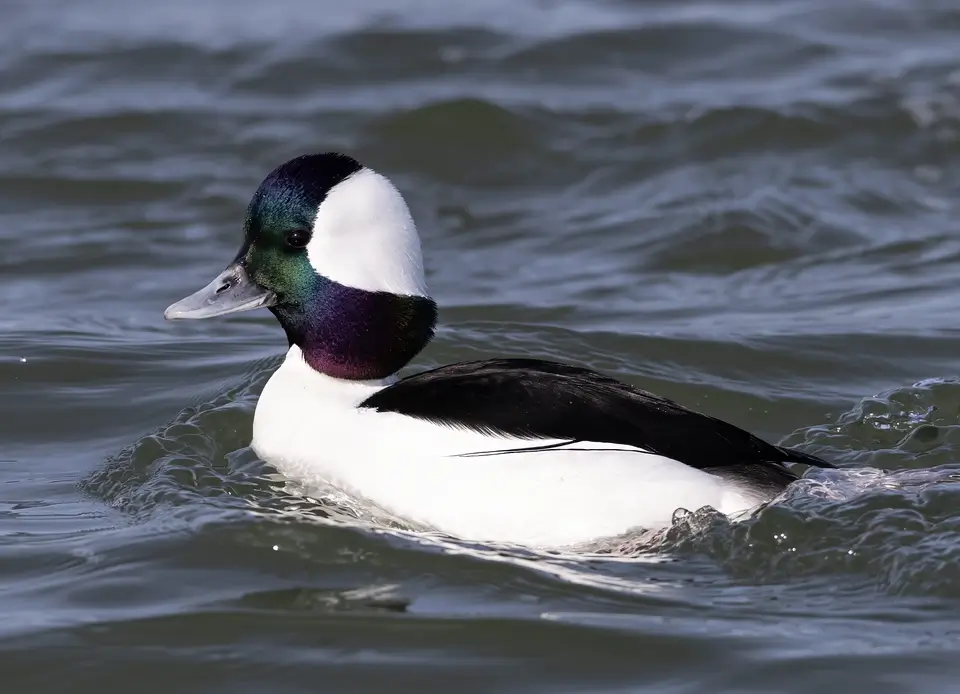
Male Buffleheads are among the most visually stunning ducks in North America. During the breeding season, a drake sports an iridescent head that shifts between deep purples, greens, and blues depending on the angle of light, with a bold, sweeping white patch that extends from behind the eye around the back of the head like a luminous bonnet. The body is strikingly bi-colored, with a gleaming white underside and chest contrasting sharply with a black back and wings. In flight, the male's white wing patches are large and highly conspicuous, making the bird easy to identify even at speed.
Female Buffleheads, as with most duck species, are considerably more subdued in their coloration. Hens are primarily dark brown and gray, providing excellent camouflage during the nesting season. They do possess a small, oval white cheek patch that is a reliable field identification mark. While far less flashy than the males, females possess an understated elegance that naturalists have long admired.
One of the most remarkable biological traits of the Bufflehead is its intimate relationship with woodpeckers, particularly the Northern Flicker (Colaptes auratus). Buffleheads are cavity nesters, meaning they rely on pre-existing holes in trees to lay their eggs and raise their young. Because their small body size — they are the smallest diving ducks in North America — allows them to fit into nest cavities excavated by Northern Flickers, a species that conveniently inhabits much of the same boreal forest landscape, the two species have developed a fascinating ecological interdependence. Buffleheads are extremely loyal to successful nest sites, with females often returning to the exact same cavity year after year.
The Bufflehead's diet consists primarily of aquatic invertebrates, insects, crustaceans, mollusks, and small fish. They are accomplished divers, propelling themselves underwater with powerful lobed feet to hunt prey along pond bottoms and shallow coastal areas. On freshwater, they tend to favor aquatic insects and their larvae, while on saltwater and brackish environments during migration and winter, they shift more heavily toward crustaceans and mollusks.
Buffleheads are notably fast flyers, capable of taking off almost directly from the water's surface — a feat most diving ducks cannot accomplish. This agility makes them a challenging and rewarding target for waterfowl hunters.
Habitat and Range
The Bufflehead is a migratory species with a broad continental range that spans much of North America across different seasons. Breeding populations are concentrated in the boreal forests of Canada and the northwestern United States, particularly in areas where lakes, ponds, and rivers intersect with mature forests containing suitable nest cavities. The species has a strong association with the boreal forest zone that stretches from Alaska eastward across Canada, where the presence of Northern Flicker-excavated cavities provides the nesting sites essential for successful reproduction.
During the winter months, Buffleheads undertake impressive southward migrations, spreading across a wide swath of the continent. Winter populations are found along both the Atlantic and Pacific coasts of North America, throughout the interior of the United States, and into northern Mexico. They are highly adaptable in their winter habitat preferences, occupying coastal bays, estuaries, tidal creeks, large inland lakes, reservoirs, and even sheltered ocean inlets.
In the northeastern United States — including New York State — Buffleheads are a familiar and welcome presence during the fall migration and winter months. New York, with its extraordinary diversity of aquatic habitats, provides exceptional wintering grounds for these small divers. The Hudson River, Long Island Sound, the numerous bays and harbors of Long Island, the Great Lakes, and countless inland lakes and reservoirs all serve as important wintering areas. Birders and hunters throughout the state eagerly anticipate the arrival of Buffleheads each autumn as a reliable signal that the waterfowl season is well underway.
Their preference for relatively open water means that Buffleheads tend to depart northward for their breeding grounds as winter loosens its grip and ice-free waters become available again in the spring.
Hunting Information
The Bufflehead has long been a part of North American waterfowl hunting culture. Their speed, agility, and tendency to decoy readily make them both a challenging and exciting quarry for duck hunters. Historically, Buffleheads were hunted extensively, but like all migratory waterfowl in the United States, they are now protected under the Migratory Bird Treaty Act and managed through a cooperative framework between the U.S. Fish and Wildlife Service and individual states.
Hunters pursuing Buffleheads in New York or any other state must comply with all applicable federal and state regulations, which include possessing a valid hunting license, a federal Duck Stamp, and any required state waterfowl stamps or permits. Season dates, bag limits, and shooting hours for Buffleheads are set annually through the federal migratory bird regulatory process in conjunction with state wildlife agencies.
In New York, waterfowl hunting takes place across a wide variety of settings — from the sheltered bays and tidal marshes of Long Island to the expansive waters of the Great Lakes and the Hudson River corridor. Because Buffleheads are present throughout the state during the regular duck season, they are a realistic and common part of a mixed-bag day of waterfowl hunting. Their small size means that hunters pursuing larger ducks sometimes overlook them, but dedicated divers hunters who set up over open water will frequently encounter these charismatic little birds.
Because specific season dates, bag limits, and license requirements for New York were not available in the source data consulted for this article, hunters are strongly encouraged to consult the New York State Department of Environmental Conservation (NYSDEC) directly for current, accurate regulatory information before heading afield. Regulations can and do change from year to year, and compliance is both a legal requirement and an ethical responsibility.
Conservation
The conservation outlook for the Bufflehead is generally positive. The species is currently classified as a species of Least Concern by major wildlife conservation authorities, reflecting stable population trends and a broad, healthy distribution across North America. Unlike some waterfowl species that have experienced dramatic declines due to habitat loss and hunting pressure, the Bufflehead has proven relatively resilient.
Several factors contribute to the Bufflehead's conservation success. Effective management under the Migratory Bird Treaty Act, which has regulated hunting seasons and bag limits for over a century, has helped prevent the kind of market hunting excesses that devastated other waterfowl populations in the late 19th and early 20th centuries. The establishment of protected wetland areas, national wildlife refuges, and conservation easements throughout the Bufflehead's range has also helped maintain the habitat upon which the species depends.
The Bufflehead's dependence on tree cavities for nesting does represent a potential vulnerability. Forest practices that remove mature trees — particularly those with existing woodpecker cavities — can reduce available nesting sites. However, the species' willingness to use nest boxes where natural cavities are scarce provides wildlife managers with a practical tool for supporting local populations.
Wetland conservation remains a cornerstone of Bufflehead management, as the loss or degradation of lakes, ponds, and coastal habitats during migration and winter would directly impact the species' survival and reproductive success. Conservation organizations, government agencies, and hunter-supported programs like the Federal Duck Stamp program collectively contribute to protecting and restoring these vital wetland ecosystems.
In New York, ongoing efforts to protect coastal and inland wetlands benefit not only Buffleheads but the entire community of migratory waterfowl that depends on the state's rich aquatic landscape each year.
Conclusion
The Bufflehead — small in stature but large in character — is one of North America's most delightful wild ducks. From its dramatic breeding plumage and fascinating nesting ecology to its adaptability across a wide range of aquatic habitats, this diminutive diver captures the imagination of everyone who encounters it. In New York and across the continent, the annual arrival of Buffleheads serves as a cherished reminder of the enduring rhythms of migration and the remarkable vitality of North American wildlife. Whether you pursue them with a shotgun, a camera, or a pair of binoculars, the Bufflehead is a species that richly rewards attention and respect.