Overview
Few birds in North America captivate hunters, birders, and wildlife enthusiasts quite like the American woodcock (Scolopax minor). Known by a colorful assortment of nicknames — including "timberdoodle," "bogsucker," "night partridge," and "Labrador twister" — this rotund, secretive shorebird has carved out a unique niche in the eastern woodlands of North America. Despite belonging to the shorebird family Scolopacidae, the American woodcock has largely abandoned coastal habitats in favor of moist, forested uplands, making it one of the most unusual and endearing birds on the continent.
For hunters, the American woodcock represents a beloved tradition, particularly in the northeastern United States. In states like New York, the autumn arrival of migrating woodcock is an eagerly anticipated event, drawing upland bird hunters and their flushing or pointing dogs into the damp thickets and alder runs that this bird calls home. Whether you are a seasoned timberdoodle hunter or simply a wildlife enthusiast curious about one of nature's most fascinating creatures, the American woodcock offers endless reasons for admiration.
This article explores the biology, habitat, hunting traditions, and conservation status of the American woodcock, with particular attention to its significance in New York State and the broader northeastern United States.
Biological Traits
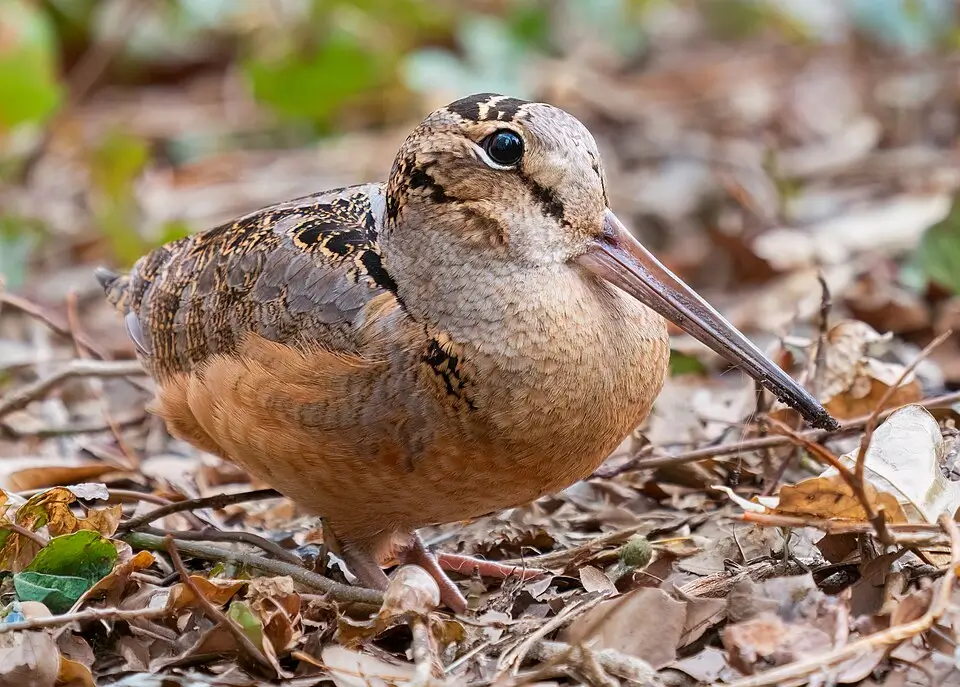
The American woodcock is a stocky, compact bird with one of the most distinctive silhouettes in the avian world. Its body is heavily built relative to its short legs, and its large, rounded head features one of the most remarkable anatomical arrangements found in any bird species. The woodcock's eyes are positioned high and far back on its skull, providing nearly 360-degree vision — a critical adaptation that allows it to watch for predators even while its long bill is probing deep into the soil for food.
That bill is itself a marvel of natural engineering. Long, flexible, and highly sensitive at the tip, the woodcock's bill is perfectly designed for its primary food source: earthworms. The bird is capable of probing its bill several inches into soft, moist soil and then opening just the tip — thanks to a prehensile upper mandible — to grasp and extract earthworms without withdrawing the bill entirely. Earthworms can make up the vast majority of a woodcock's diet, though the bird will also consume insects, millipedes, and other invertebrates.
The woodcock's plumage is a masterwork of cryptic coloration. Browns, blacks, tans, and russet tones blend together in intricate patterns that make a resting woodcock nearly invisible against a backdrop of dead leaves and forest debris. This camouflage is so effective that hunters often walk within feet of a woodcock before the bird flushes in a sudden, twisting burst of flight accompanied by a distinctive twittering sound produced by the bird's outer primary wing feathers.
One of the most celebrated aspects of American woodcock biology is its elaborate courtship display, known as the "sky dance." Performed by males on traditional display grounds called "singing grounds," the sky dance begins at dusk and dawn, primarily in spring. The male produces a distinctive nasal "peent" call from the ground, then launches himself into a spiraling, climbing flight that can reach heights of several hundred feet. At the apex of the flight, the male produces a series of liquid, bubbling chirps before tumbling back to earth in a zigzagging descent. This performance is repeated many times over and is considered one of the great wildlife spectacles of the eastern woodlands.
Males and females differ notably in size, with females being significantly larger — a relatively uncommon trait in birds, known as reverse sexual size dimorphism. Females handle all nesting and chick-rearing duties on their own. Clutches typically consist of four eggs, and chicks are precocial, meaning they are mobile and capable of some self-feeding very shortly after hatching.
The woodcock is primarily a nocturnal and crepuscular bird, meaning it is most active during the twilight hours and overnight. During the day, it typically roosts on the forest floor, relying on its camouflage for protection. Its unique brain anatomy — with the cerebellum positioned lower than in most birds — has long been noted by biologists as an adaptation that accommodates the unusual eye placement on its skull.
Habitat & Range
The American woodcock is found exclusively in eastern North America. Its breeding range extends from the Atlantic Coast westward through the Great Lakes region and into the central portions of the continent, reaching as far north as southern Canada, including parts of Manitoba, Ontario, Quebec, and the Maritime Provinces. Wintering grounds are located primarily in the southeastern United States, from the Gulf Coast states northward into the Carolinas and Virginia.
Migrating woodcock travel along well-established routes through the eastern United States each spring and fall, making them a highly seasonal presence in states like New York. The state of New York sits squarely in prime woodcock migration territory. With its mix of young forests, alder thickets, wet bottomlands, and regenerating clearcuts, New York offers excellent habitat for both resident breeding birds and the waves of migrants that pass through each autumn.
The woodcock's preferred habitat centers on young, second-growth forests with dense understory vegetation, particularly areas featuring alder, aspen, birch, and other early successional tree species. It favors moist, well-drained soils rich in earthworms, which drives its selection of stream corridors, wetland edges, and bottomland forests. Critically, woodcock require a mosaic of habitat types: dense young cover for roosting and escape, nearby openings or agricultural fields for nocturnal foraging, and singing grounds — typically open or semi-open areas — for courtship.
The dependence on young forest habitat has made the woodcock's long-term range and population trajectory closely linked to forest management practices. As forest succession advances and young second-growth matures into closed-canopy forest, woodcock habitat diminishes. Conversely, timber harvesting, managed burns, and other disturbance-based forest management practices that set back succession can create and maintain prime woodcock habitat.
Hunting Information
The American woodcock is one of the most cherished upland game birds in the eastern United States, occupying a special place in the traditions of bird hunting culture alongside the ruffed grouse. Woodcock hunting is a pursuit that places a premium on well-trained bird dogs, intimate knowledge of local cover, and the ability to make quick, decisive shots at a fast-flying, unpredictably twisting target.
In New York State, woodcock hunting is governed by federal migratory bird regulations, as the woodcock is a federally managed migratory species under the Migratory Bird Treaty Act. Specific season dates, bag limits, and licensing requirements are set annually through coordination between the U.S. Fish and Wildlife Service and the New York State Department of Environmental Conservation (NYSDEC). Hunters planning to pursue woodcock in New York should always consult the most current NYSDEC hunting regulations and ensure they have the appropriate New York State hunting license and any required federal migratory bird stamp or permits.
Woodcock hunting in New York typically takes place in the autumn, when migrating birds move southward through the state's forests and thickets. The timing of migration can vary from year to year depending on weather patterns, but hunters generally look for peak flight activity during cool frontal passages in October and November. Local birds begin the season, and northern migrants later swell the population as the season progresses.
Traditional woodcock cover in New York includes alder runs along streams, young aspen stands, birch thickets, overgrown agricultural fields transitioning to forest, and any moist lowland area with soft, earthworm-rich soils. Flushing breeds like Labrador retrievers and springer spaniels are popular among woodcock hunters, as are pointing breeds such as English setters, Brittanys, and German shorthaired pointers — dogs that can locate and hold a bird long enough for the hunter to get into shooting position.
Because woodcock flesh is considered a delicacy — rich, dark, and distinctive in flavor — the bird is prized not only as a sporting quarry but also at the table. Its reputation as fine table fare has only deepened the cultural reverence surrounding woodcock hunting traditions in the Northeast.
Conservation
The American woodcock is currently listed as a species of conservation concern in many parts of its range. Long-term population monitoring by the U.S. Fish and Wildlife Service, including the annual Singing Ground Survey conducted each spring, has indicated a gradual, multi-decade decline in woodcock populations across much of the eastern United States and Canada. These population trends have prompted increased attention from wildlife managers, conservation organizations, and the hunting community.
The primary driver of woodcock population decline is believed to be habitat loss and degradation, particularly the maturation and loss of young forest habitat across the eastern landscape. As farmland abandonment has slowed, suburban development has expanded, and second-growth forests have matured, the patchwork of early successional habitat that woodcock depend upon has contracted significantly over recent decades.
In response, numerous conservation initiatives have been launched to address woodcock habitat needs. The American Woodcock Society, the Ruffed Grouse Society, and various state wildlife agencies — including the NYSDEC — have invested in habitat management projects aimed at creating and maintaining young forest conditions. These efforts often align closely with the broader Young Forest Initiative, which advocates for the active management of early successional habitats across the northeastern United States.
Hunters have played an important role in woodcock conservation, both through direct habitat work and through the funding generated by hunting licenses, permits, and excise taxes on sporting equipment. The Federal Aid in Wildlife Restoration Act (commonly known as the Pittman-Robertson Act) directs funds from taxes on firearms and ammunition toward wildlife management and habitat restoration projects that benefit species like the woodcock.
New York State, with its rich patchwork of state forests, Wildlife Management Areas, and privately managed lands, provides important opportunities for woodcock habitat management. Conservationists and hunters alike share a vested interest in ensuring that the landscapes necessary to support healthy woodcock populations remain available well into the future.
Conclusion
The American woodcock is a bird unlike any other — a shorebird that lives in the forest, a master of camouflage that performs breathtaking aerial courtship displays, and a beloved game bird that has inspired generations of hunters and naturalists across eastern North America. In New York and throughout its range, the timberdoodle occupies a cherished place in the natural and cultural heritage of the region. Through continued attention to habitat conservation, responsible hunting practices, and ongoing population monitoring, there is every reason to hope that the woodcock's distinctive "peent" call and spiraling sky dance will continue to echo through the twilight forests of the East for generations to come.