Overview
Few animals in North America command as much immediate recognition — and instinctive caution — as the striped skunk (Mephitis mephitis). With its bold black-and-white coloration and legendary chemical defense, the striped skunk has earned a permanent place in the cultural imagination of the continent. Yet beyond its famous reputation, this fascinating mammal is a remarkably adaptable, ecologically important creature that thrives across an enormous geographic range, including the wide-open landscapes of Montana.
The striped skunk is one of the most widespread members of the family Mephitidae, the skunk family, which was reclassified from the weasel family (Mustelidae) in the early 2000s based on genetic evidence. Its scientific name, Mephitis mephitis, is derived from the Latin word for a noxious or poisonous vapor — a fitting tribute to the animal's most celebrated trait. But there is far more to this species than its pungent spray. Understanding the striped skunk's biology, behavior, and ecological role offers a deeper appreciation for one of the wild world's most unique and capable survivors.
Whether you are a wildlife enthusiast hoping to catch a moonlit glimpse of one foraging across a Montana meadow, a trapper interested in the species' historical and contemporary harvest, or simply a curious reader wanting to learn more, this guide provides a thorough look at the striped skunk and its place in the natural world.
Biological Traits
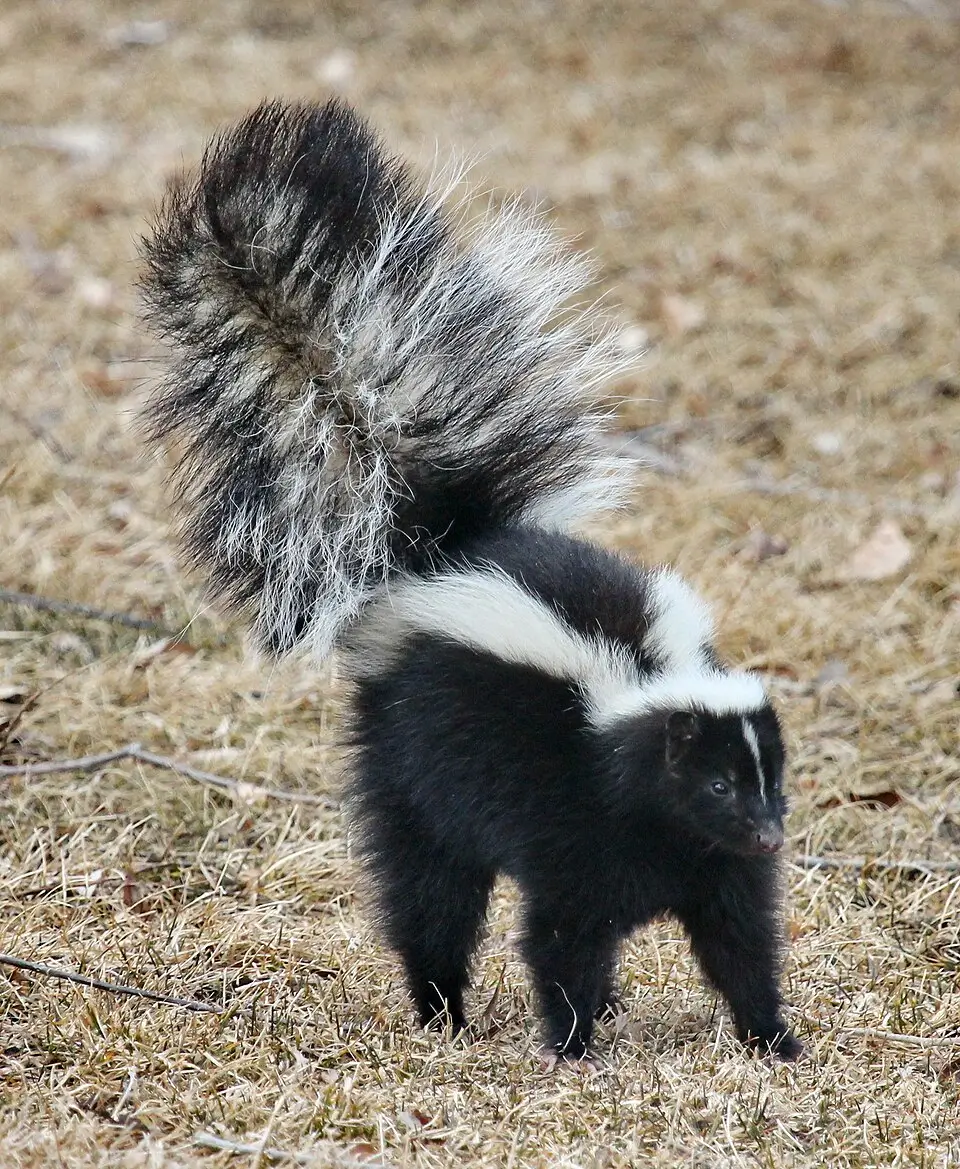
The striped skunk is a medium-sized mammal instantly identifiable by its striking coat: a jet-black body adorned with a prominent white stripe that typically runs from the top of the head and splits into two stripes that travel down either side of the back toward the tail. The tail itself is large, bushy, and often tipped with white, making it a conspicuous visual signal to potential predators. Individual variation in stripe width and pattern does occur, and some individuals display more white than others, but the basic pattern remains consistent across the species.
In terms of body size, striped skunks are comparable to a domestic cat, though with a stockier, low-slung build suited to a life spent foraging close to the ground. They possess strong, curved front claws that are well-adapted for digging — a critical skill used both in hunting for grubs and invertebrates and in excavating or enlarging dens. The skunk's compact muscular body, short legs, and broad feet all reflect its lifestyle as a terrestrial omnivore that spends long hours rooting through leaf litter, soil, and debris in search of food.
The striped skunk is, of course, most famous for its chemical defense. Located in two anal scent glands, a sulfur-containing chemical compound — primarily composed of thiols (also known as mercaptans) — can be accurately sprayed at threats from a distance of up to 10 feet or more. The skunk typically provides clear warning signals before resorting to spray, including foot-stomping, hissing, arching the back, and raising and fluffing the tail. A skunk that has turned its backside toward you has issued its final warning. The spray can cause significant eye irritation, temporary blindness, and of course the notorious, long-lasting odor that has made the skunk legendary.
As omnivores, striped skunks consume a remarkably varied diet. Insects and their larvae form a major portion of their diet during warmer months, and they are particularly adept at locating and excavating ground-nesting bee and wasp colonies. Small mammals, bird eggs, frogs, crayfish, fruits, berries, nuts, and carrion all supplement their diet depending on season and availability. This dietary flexibility is one of the key reasons the striped skunk has been so successful across such a broad range of habitats.
Striped skunks are primarily nocturnal, typically becoming active at dusk and returning to their dens before dawn. During the coldest winter months, they are not true hibernators, but they do enter periods of torpor — extended rest during which their body temperature drops slightly and metabolic activity slows. They may remain in their dens for weeks at a time during severe cold snaps, but they will emerge to forage during warmer winter spells. Females may den communally during winter, while males tend to be more solitary.
Breeding typically occurs in late winter, and after a gestation period of approximately 60 to 75 days, females give birth to litters of typically four to seven young, known as kits. The kits are born blind and helpless but develop quickly, and by late summer the young skunks are generally independent. Females reach sexual maturity within their first year. Life expectancy in the wild is typically only two to three years, with predation, disease, and vehicle strikes being primary mortality factors. In captivity, skunks can live considerably longer.
Habitat & Range
The striped skunk is one of the most habitat-flexible mammals in North America. Its range extends from southern Canada throughout most of the contiguous United States and into northern Mexico. The species is conspicuously absent only from the most extreme desert environments and the highest mountain elevations.
In Montana — the fourth-largest state by area, stretching from the mountain ranges of the west to the open plains of the east — striped skunks are found across a wide variety of landscapes. Montana's diverse geography, which includes everything from dense coniferous forests and river bottoms to rolling grasslands and agricultural fields, provides ample habitat for this adaptable omnivore. Skunks in Montana tend to favor edge habitats — areas where forest meets open ground, or where agricultural fields border woodland — as these zones offer both food diversity and ready access to shelter.
Striped skunks are closely associated with human-modified landscapes. They thrive around farms, suburban neighborhoods, and rural homesteads, where they find reliable food sources such as garden insects, garbage, and pet food left outdoors. Brush piles, rock walls, old buildings, and culverts all serve as convenient den sites. While skunks do inhabit more remote wild areas, their success in human-dominated environments has helped sustain and even expand their populations in many parts of Montana and across North America.
For denning, skunks may dig their own burrows, but they more commonly take over abandoned dens from groundhogs, foxes, or other burrowing animals. They are not highly territorial and may share den sites, particularly during winter.
Hunting and Trapping Information
The striped skunk has a long history of harvest in North America, both for its fur and as part of pest management efforts. Historically, skunk fur was a commercially valuable product, and the species featured prominently in the North American fur trade. While the commercial skunk fur market is considerably diminished compared to its historical peak, trapping skunks remains a legal and traditional activity in many states.
In Montana, specific regulations regarding the hunting or trapping of striped skunks — including season dates, license requirements, and bag limits — are managed by Montana Fish, Wildlife & Parks (FWP). Because regulatory information for striped skunks was not available in the data reviewed for this article, hunters and trappers are strongly encouraged to consult the official Montana FWP website or contact their local FWP office directly for the most current and accurate information before pursuing this species. Regulations can change from year to year, and compliance with all applicable state laws is essential.
From a practical standpoint, trappers in Montana who target skunks typically use cage traps or body-gripping traps set along travel corridors, near dens, or adjacent to food sources. Proper handling precautions are important when working with live-trapped skunks. Experienced trappers develop techniques for approaching and dispatching trapped skunks in ways that minimize the risk of being sprayed, though some spray is often an unavoidable occupational hazard.
Beyond regulated harvest, landowners and wildlife managers across Montana sometimes address skunk conflicts — such as skunks denning under structures or raiding poultry coops — through trapping and relocation or removal programs. Anyone undertaking such activities should verify applicable state requirements.
Conservation
The striped skunk is currently classified as a species of least concern by the International Union for Conservation of Nature (IUCN), reflecting its widespread distribution, large overall population, and high adaptability. In most parts of its range, including Montana, the striped skunk is not considered threatened or endangered.
That said, the species does face ongoing pressures. Roadway mortality is a significant source of skunk deaths, as their slow, deliberate movement makes them particularly vulnerable to vehicle strikes. Skunks are also among the primary wildlife reservoirs for rabies in North America, particularly in the central and southern United States, which occasionally leads to localized population declines following rabies epizootics. Disease dynamics are therefore an important aspect of skunk population ecology.
Despite these challenges, the striped skunk's adaptability, reproductive productivity, and broad omnivorous diet allow populations to recover relatively quickly from localized declines. Its ecological role as an insect and small rodent predator, as well as a seed disperser, contributes meaningfully to the health of the ecosystems it inhabits. In agricultural settings, the skunk's appetite for cutworms, grubs, and other crop pests provides genuine economic benefit to farmers and landowners.
In Montana and across its range, the striped skunk remains a healthy, fascinating component of the native wildlife community — a survivor whose combination of chemical ingenuity, dietary flexibility, and behavioral adaptability has made it one of the continent's most enduring wild animals.