Overview
Few birds in North America inspire the kind of devoted following that the American woodcock commands among those lucky enough to encounter one. Known affectionately by a colorful roster of nicknames — timberdoodle, bogsucker, mud snipe, Labrador twister — this small, rotund shorebird has carved out a unique ecological niche far from the coastlines typically associated with its shorebird relatives. With its cryptic plumage, extraordinary eyes, and one of the most captivating courtship displays in the avian world, the American woodcock (Scolopax minor) is a bird that rewards patience, curiosity, and a genuine love of wild places.
Whether you are a birdwatcher standing quietly at the edge of an alder thicket at dusk, or an upland hunter working a dog through young aspen stands, the American woodcock offers an experience unlike any other. This article explores the biology, habitat, hunting traditions, and conservation story of one of North America's most fascinating and beloved birds.
Biological Traits
The American woodcock belongs to the family Scolopacidae, the large and diverse family of sandpipers and snipes. Despite this shorebird lineage, the woodcock has adapted almost entirely to life in moist, forested uplands — a remarkable evolutionary departure from its coastal and wetland relatives.
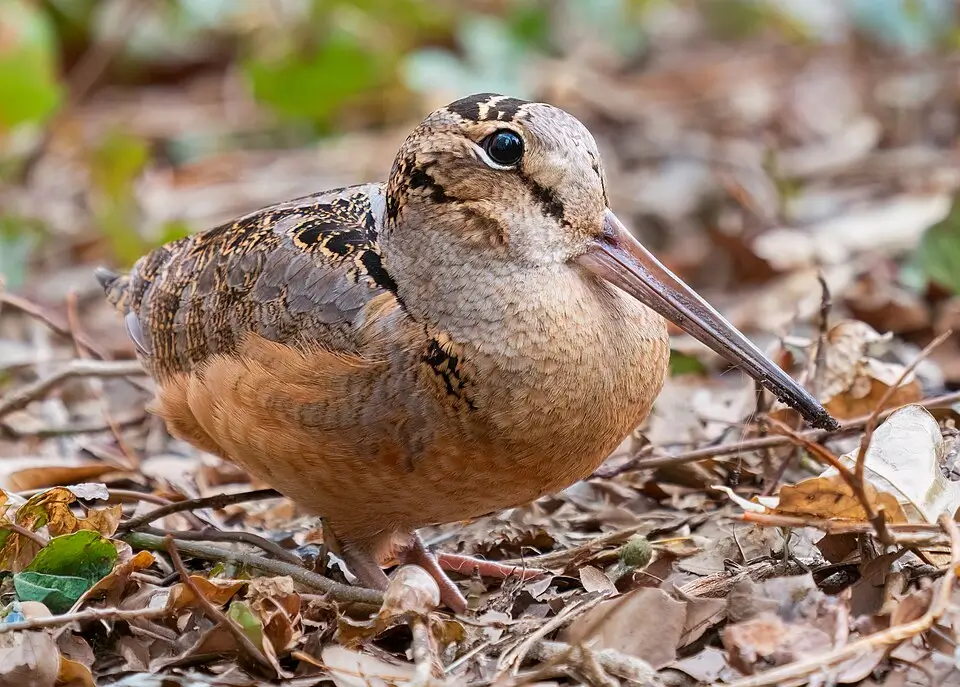
In terms of body plan, the American woodcock is instantly recognizable once you know what to look for. It is a compact, barrel-chested bird with remarkably short legs, a rounded head, and an extraordinarily long, prehensile bill that can reach up to nearly three inches in length. This bill is one of the bird's most specialized tools: the flexible tip can be opened and closed independently while the bill is plunged into soft soil, allowing the woodcock to grasp earthworms — its primary food source — deep underground.
The woodcock's eyes are another standout feature. Set high and far back on the skull, these large, dark eyes provide nearly 360-degree vision, giving the bird an almost unobstructed field of view in all directions — including behind its own head. This wide-angle visual system is a superb adaptation for detecting predators while the bird's head is buried in the leaf litter or soil.
The plumage of the American woodcock is a masterwork of camouflage. Rich, warm tones of russet, brown, buff, and black create an intricate pattern of streaks and bars across the bird's back and crown. When a woodcock "freezes" on the forest floor, it becomes extraordinarily difficult to see, blending seamlessly with dead leaves and fallen debris. The breast is a warm orange-buff, and the undertail coverts are a soft white, though these colors are rarely observed until the bird flushes or is held in hand.
Perhaps the most celebrated aspect of the woodcock's biology is its spring courtship ritual, known as the "sky dance." Beginning at dusk and again at dawn, male woodcocks perform an elaborate aerial display to attract females. The male begins by issuing a nasal "peent" call repeatedly from the ground, then launches himself into the sky in a spiraling, ascending flight that can reach several hundred feet in altitude. At the peak of his ascent, he produces a rich, liquid, twittering song before plummeting back to earth in a zigzagging descent, landing near the same spot where he began. This display, repeated night after night through the spring, is one of the most anticipated events of the natural calendar for wildlife enthusiasts across the eastern United States and Canada.
Habitat & Range
The American woodcock is found across a broad swath of eastern North America. Its breeding range extends from the Canadian Maritime provinces and Great Lakes region southward through the eastern United States, while wintering birds concentrate in the South, from Texas across to the Atlantic coast states.
The species is intimately tied to young, dense forest habitats — particularly moist alder, aspen, and birch thickets, river bottoms, and regenerating clearcuts — wherever soft, moist soils support healthy earthworm populations. The woodcock is essentially following its food source: earthworms thrive in loose, rich, well-aerated soils, and so the woodcock gravitates toward habitats where those conditions exist. During the day, birds often rest in nearby upland forests and shrubby areas, while feeding activity intensifies at dawn and dusk, and on overcast days.
Migration is a significant part of the woodcock's annual cycle. As a migratory species, woodcock travel at night, often in loose, informal groups, following a broad migratory corridor through the heart of eastern North America. Weather plays a significant role in triggering migration, with birds moving south ahead of cold fronts in autumn and pressing northward in spring as temperatures moderate.
Regarding Montana specifically, it is worth noting that the American woodcock is not a common resident of the state. Montana is a largely landlocked Western state, and the core of the woodcock's range lies well to the east. However, occasional vagrant woodcock have been recorded in Montana, and the state's eastern portions are geographically closer to the fringe of the species' range than its mountainous western half. Hunters and birders in Montana should be aware that any woodcock encounter in the state would be a genuinely rare and exciting event.
Hunting Information
The American woodcock occupies a cherished place in American upland hunting tradition. Woodcock hunting is a pursuit with deep cultural roots, particularly in New England, the Great Lakes states, and the Canadian Maritime provinces, where generations of hunters have worked pointing dogs and flushers through alder runs and willow thickets in pursuit of this elusive bird.
Hunting woodcock is a sport that emphasizes dog work, habitat knowledge, and a willingness to wade through dense, wet cover. The classic woodcock hunt involves a well-trained pointing or flushing dog quartering through young forest edges, alder bottoms, and brushy stream corridors. When a woodcock flushes, it typically does so with a distinctive twittering of wings, rising steeply through the canopy before leveling off — offering a challenging, fast-moving shot for even experienced wingshooters.
Woodcock are typically hunted with lightweight, open-choked shotguns, and light loads of small shot are standard given the bird's relatively modest size and the close-range, dense-cover conditions typical of most woodcock shoots. A classic 20-gauge or 28-gauge over-under loaded with No. 8 shot is a popular choice among experienced woodcock hunters.
In states where woodcock populations are part of the regular upland game season, hunting is managed federally through the U.S. Fish and Wildlife Service, which sets season frameworks and bag limits for migratory woodcock across different flyways. Hunters are required to possess a valid hunting license and, in most states, a federal migratory bird hunting and conservation stamp (commonly known as the Duck Stamp) to legally hunt woodcock.
For hunters in Montana, it is important to consult Montana Fish, Wildlife & Parks (FWF) for the most current and specific season dates, bag limits, and licensing requirements before pursuing any migratory bird species. Because the American woodcock is not a regularly abundant species in Montana, hunters should verify current regulations carefully and temper expectations accordingly.
Conservation
The American woodcock has experienced population declines across much of its range over the past several decades, a trend that has drawn the attention of wildlife managers, conservation organizations, and the hunting community alike. The primary driver of these declines is habitat loss — specifically, the ongoing maturation and loss of the young forest habitats that woodcock depend upon for nesting, feeding, and raising their young.
Young forest — sometimes called "early successional habitat" — is one of the most threatened habitat types in eastern North America. As abandoned farmlands grow into mature forest and active forest management practices shift away from clearcuts and short-rotation harvests, the brushy, regenerating thickets that woodcock rely upon are becoming increasingly scarce across the landscape.
Conservation initiatives led by organizations such as the American Woodcock Society, the Ruffed Grouse Society, and various state wildlife agencies have focused on creating and restoring young forest habitat through targeted timber harvests, prescribed burning, and other land management tools. These efforts benefit not only woodcock but a wide suite of early-successional species, including ruffed grouse, New England cottontail, golden-winged warbler, and many others.
The hunting community has played an important and positive role in woodcock conservation. Hunters and conservation organizations have partnered to fund habitat work and population monitoring, and the beloved tradition of woodcock hunting provides strong cultural and economic incentives to protect and restore the landscapes these birds call home. Harvest data collected through wing collection surveys also provides wildlife managers with valuable information about age and sex ratios of harvested birds, informing annual management decisions.
The American woodcock is a species that reminds us how dynamic and interconnected our forests and fields truly are — and how meaningful it is to protect them.