Overview
Few sights in the natural world are as stirring as a flock of Sandhill Cranes moving across an open sky, their bugling calls carrying for miles across wetlands, prairies, and mountain valleys. Among North America's most ancient and recognizable birds, the Sandhill Crane (Grus canadensis) has captured the imagination of wildlife enthusiasts, birders, and hunters alike for generations. These magnificent birds — standing nearly as tall as a human child and sporting wingspans that can stretch four feet and beyond — are a living testament to the resilience of wildlife on this continent.
Whether you encounter them staging in massive migratory flocks, dancing in elaborate courtship displays, or striding purposefully through a golden Montana meadow, Sandhill Cranes leave an impression that is difficult to forget. They are creatures of habit and remarkable intelligence, navigating thousands of miles each year between breeding grounds and wintering areas with a precision that continues to inspire scientific study. This article explores everything you need to know about this extraordinary species — from its biology and habitat to its place in hunting culture and conservation history.
Biological Traits
The Sandhill Crane is one of the largest birds in North America and belongs to the family Gruidae, a group of tall wading birds found on nearly every continent. The species name canadensis reflects its strong association with Canadian breeding grounds, though its range extends far beyond national borders.
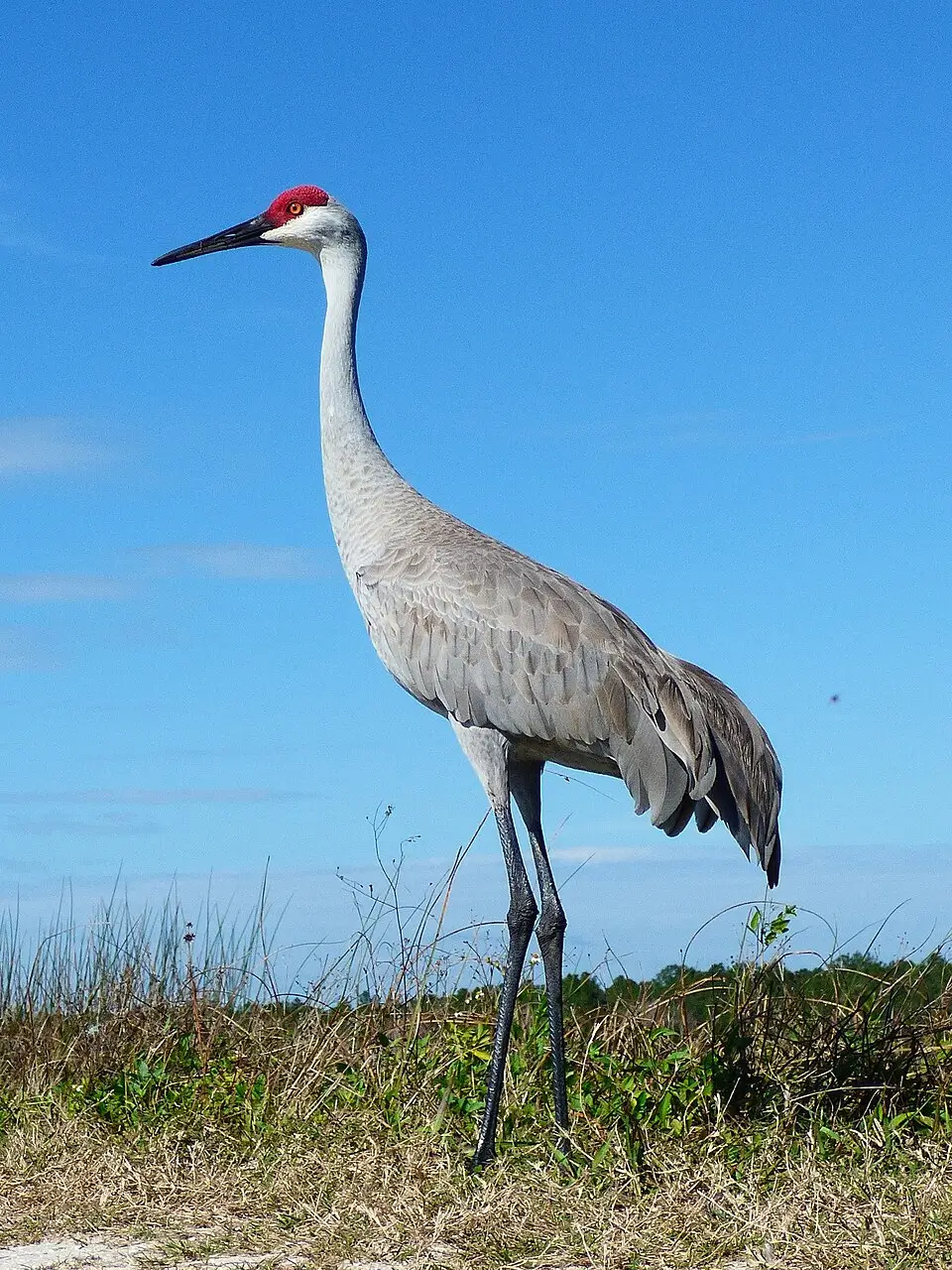
Adult Sandhill Cranes are easily identified by their predominantly gray plumage, long legs, and long necks built for scanning open terrain. One of their most distinctive features is the bare, red-skinned patch atop the head — a defining characteristic of the species that becomes more vivid during the breeding season. Their faces are also marked with white cheeks and a dark, pointed bill well adapted for probing into soil and shallow water in search of food.
Sandhill Cranes are omnivores with a broad and opportunistic diet. They consume a wide variety of foods depending on the season and habitat, including seeds, berries, small mammals, insects, worms, snails, frogs, and agricultural grains such as corn and wheat. This dietary flexibility has helped them adapt successfully across a range of environments.
One of the most celebrated behaviors of the Sandhill Crane is its elaborate courtship dance. Pairs — which often mate for life — engage in synchronized displays that include leaping, bowing, wing spreading, and vocalizing together. These rituals are not limited to the breeding season; they also serve as a way for bonded pairs to reinforce their relationship year-round. Few wildlife displays are as dramatic and captivating to witness.
Sandhill Cranes are also among the longest-lived birds in North America. In the wild, individuals can live for 20 years or more, and captive birds have been known to reach even greater ages. This longevity, combined with relatively low annual reproductive output — pairs typically raise one or two chicks per season — makes each individual bird ecologically significant.
Vocally, the Sandhill Crane is unmistakable. Their rolling, rattling calls — often described as a bugle or a prehistoric trill — can carry for more than a mile and are produced by an elongated trachea that loops within the sternum, functioning somewhat like a natural instrument. These calls serve a variety of purposes, from maintaining pair bonds and communicating between family groups to coordinating movements during migration.
There are several recognized subspecies of the Sandhill Crane, ranging from the Greater Sandhill Crane to the Lesser and Canadian Sandhill Cranes. These subspecies vary somewhat in size and migratory behavior, but all share the fundamental characteristics that make this species so recognizable.
Habitat & Range
Sandhill Cranes are remarkably adaptable in terms of the habitats they occupy throughout the year, but they consistently favor open landscapes with access to shallow wetlands. During the breeding season, they gravitate toward freshwater marshes, bogs, sedge meadows, wet prairies, and the edges of open boreal forests. These wetland environments provide both nesting cover and the food resources necessary to raise young chicks.
The species' breeding range spans an enormous geographic area, from the Arctic tundra of Alaska and Canada southward through the Great Plains and into parts of the American Southeast and Midwest. Some populations are non-migratory, such as the Florida Sandhill Crane, which resides year-round in the wetlands of the Southeast. However, the vast majority of Sandhill Cranes undertake spectacular long-distance migrations.
During migration, Sandhill Cranes are famous for staging — gathering in enormous concentrations at key stopover sites where food and shelter are abundant. The Central Platte River Valley in Nebraska is perhaps the most celebrated staging ground in the world, where hundreds of thousands of cranes congregate each spring. This phenomenon draws visitors from across the globe and represents one of the greatest wildlife spectacles on the continent.
In the western United States, Montana serves as important habitat for Sandhill Cranes both during migration and as a breeding ground. The state's vast network of river valleys, wetlands, and open grasslands provides ideal conditions for cranes to nest, forage, and rest during their journeys north and south. Montana's geographic position makes it a natural corridor for migrating birds traveling between northern breeding grounds and southern wintering areas in states like New Mexico, Texas, and California, as well as parts of Mexico.
During winter, migratory populations of Sandhill Cranes concentrate in agricultural regions and wetland complexes across the southern United States and northern Mexico, where mild temperatures and abundant food resources allow them to build up the energy reserves they will need for spring migration and breeding.
Hunting Information
Sandhill Cranes hold a special place in the world of bird hunting. Hunters who have pursued them often describe the experience as among the most thrilling and memorable in all of upland and waterfowl hunting. The birds are large, challenging to decoy, and they inhabit some of the most spectacular open landscapes North America has to offer. Their meat, often described as the "ribeye of the sky," is widely regarded as among the finest table fare available from any game bird.
Crane hunting in the United States is regulated at the federal level by the U.S. Fish and Wildlife Service under the Migratory Bird Treaty Act, with individual states and flyway management councils playing a key role in setting specific season frameworks, bag limits, and licensing requirements. Not all states with crane populations have open seasons, and regulations can vary significantly from one location to the next.
For hunters interested in pursuing Sandhill Cranes in Montana specifically, it is essential to consult directly with Montana Fish, Wildlife & Parks (FWP) for the most current and accurate season dates, permit requirements, and regulations. Because the source data available for this article does not include specific season dates or license details for Montana, we strongly encourage prospective crane hunters to visit the official Montana FWP website or contact their regional FWP office before planning any hunt. Regulations for migratory game birds — including cranes — are updated on an annual basis and may change from year to year.
Montana's wide-open spaces, diverse wetland systems, and position along major migration corridors make it a promising destination for crane hunters. The birds are commonly encountered in river valleys and agricultural areas during fall migration, where they may be found feeding in harvested grain fields. Hunters typically employ large, realistic decoys and use calls to mimic the birds' distinctive vocalizations in order to bring them within range.
Regardless of where or how you hunt them, pursuing Sandhill Cranes demands patience, scouting, and a deep respect for the birds themselves. Many hunters approach crane hunting with the same reverence they bring to pursuing elk or whitetail deer — an acknowledgment that these are extraordinary animals deserving of thoughtful, ethical pursuit.
Conservation
The story of the Sandhill Crane's conservation is, in many ways, one of North America's great wildlife success stories. During the early and mid-twentieth century, crane populations across the continent faced serious pressure from habitat loss and market hunting. Regulatory protections established under the Migratory Bird Treaty Act of 1918, combined with decades of collaborative habitat conservation efforts, have allowed most Sandhill Crane populations to recover remarkably well.
Today, the overall population of Sandhill Cranes is considered healthy and stable, with some populations actually growing over time. This positive trajectory stands as a testament to the power of science-based wildlife management and the dedication of conservation-minded hunters, birders, landowners, and government agencies working together toward shared goals.
Wetland conservation remains central to the long-term future of the Sandhill Crane. Organizations focused on preserving and restoring wetland habitats across the breeding, migration, and wintering ranges of the species play a critical role in ensuring that cranes continue to thrive. Hunters who purchase federal and state migratory bird licenses and stamps contribute directly to these conservation funding streams through the mechanisms established by laws such as the Federal Duck Stamp program.
The Sandhill Crane's resilience and current population health make it an excellent example of sustainable wildlife management — demonstrating that with appropriate protections, habitat stewardship, and regulated hunting, even large, slow-reproducing species can recover and flourish.