Overview
Few birds capture the imagination of upland hunters and wildlife enthusiasts quite like the ruffed grouse. Known scientifically as Bonasa umbellus, the ruffed grouse is one of North America's most iconic game birds, celebrated for its elusive nature, dramatic displays, and the challenging hunting experience it provides to those who pursue it through dense woodland cover. Whether you encounter one flushing explosively from beneath your feet in a northern forest or spot a male drumming on a mossy log in the early morning mist, the ruffed grouse leaves a lasting impression on all who cross its path.
Across its extensive range, the ruffed grouse has earned a devoted following among hunters, birders, and naturalists alike. Its remarkable adaptability, fascinating biology, and important ecological role make it one of the most studied and celebrated upland birds on the continent. In states like Montana — a vast, wild landscape of mountain forests, river corridors, and rugged terrain — the ruffed grouse occupies a special place in the outdoor tradition, offering hunters and wildlife watchers alike a chance to connect with one of North America's most engaging wild species.
This guide explores the biology, habitat, range, hunting traditions, and conservation status of the ruffed grouse, drawing on established natural history knowledge to paint a comprehensive picture of this remarkable bird.
Biological Traits
The ruffed grouse (Bonasa umbellus) belongs to the family Phasianidae and the order Galliformes, placing it in the same broad family as pheasants, turkeys, and quail. It is a medium-sized bird, stout and compact in the way that ground-dwelling birds tend to be, built for life among the understory of North American forests.
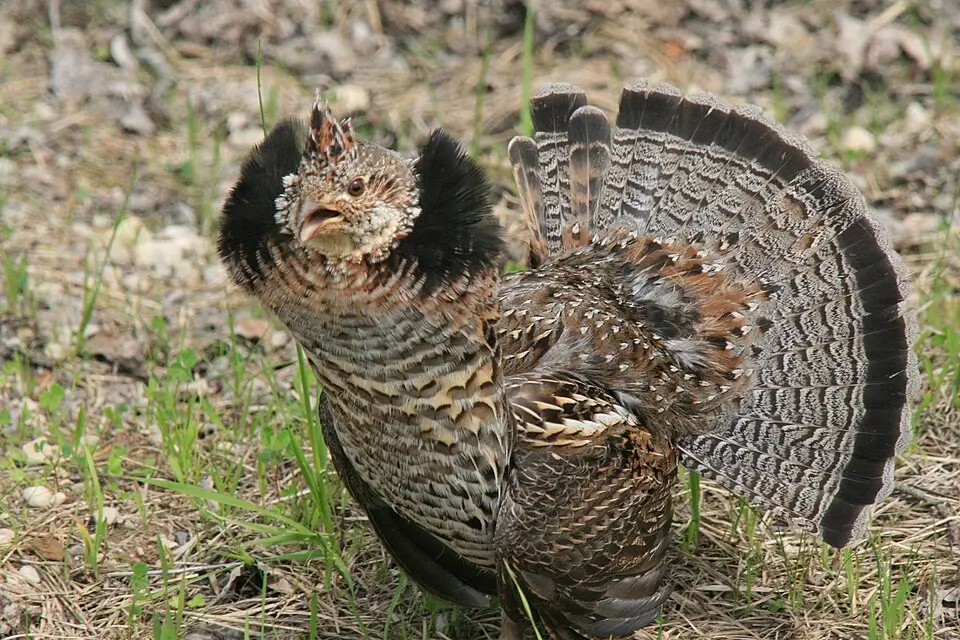
One of the most distinctive features of the ruffed grouse is the namesake "ruff" — a set of iridescent black or dark brown feathers located on either side of the neck. These feathers are normally held flat against the body, but during courtship or defensive displays, the bird fans them outward dramatically, creating a striking collar that gives the species its common name. The tail is another notable feature: a broad, fan-shaped structure barred in gray or brown, with a distinctive dark subterminal band near the tip that helps observers identify the bird in flight.
Ruffed grouse occur in two primary color morphs — gray and brown (rufous). The gray morph tends to be more common in the northern and western portions of the range, while the rufous morph is more prevalent in the southern and eastern parts. This variation in plumage is not strictly tied to sex; both males and females can occur in either morph. The cryptic patterning of the plumage — intricate combinations of brown, gray, black, and white — provides exceptional camouflage against the leaf litter and bark textures of the forest floor.
Perhaps the most famous behavioral trait of the ruffed grouse is the "drumming" display performed by males. A male grouse will select a slightly elevated surface — most often a large, fallen log — and beat his wings in a rapid, accelerating sequence that produces a deep, resonant thumping sound. This drumming carries surprisingly well through the forest and serves both to attract females and to establish territory with rival males. The sound has often been described as resembling a distant engine starting up, beginning with slow, distinct beats that accelerate into a blur of sound before fading away.
Ruffed grouse are primarily ground-dwelling birds, spending most of their time foraging among leaf litter, low shrubs, and forest floor vegetation. However, they are capable fliers and will roost in trees, particularly conifers, during cold weather. In deep snow, ruffed grouse exhibit a remarkable cold-weather survival strategy: they will dive directly into loose snow and use the insulating properties of the snowpack to shelter themselves from frigid temperatures, remaining buried for hours or even overnight.
The diet of the ruffed grouse shifts with the seasons. During spring and summer, birds consume a wide variety of insects, berries, seeds, and green plant material. In fall, they feed heavily on fruits, nuts, and the catkins of trees such as aspen. Winter diets tend to become more specialized, with buds and catkins — particularly those of aspen (Populus spp.) — forming the backbone of the cold-season menu. This strong reliance on aspen makes the presence of aspen stands a critical habitat factor for ruffed grouse populations throughout their range.
Habitat & Range
The ruffed grouse is a bird of North American forests, and its range stretches in a broad arc from the Appalachian Mountains in the east, through the Great Lakes states and the boreal forests of Canada, and westward into the northern Rocky Mountain region, including parts of Idaho, Montana, and the Pacific Northwest. The species is closely associated with early successional and mixed-age forest habitats — places where timber harvests, natural disturbances, or forest succession have created a mosaic of young and mature woodland.
Dense young forests with abundant shrub layer cover, particularly those featuring aspen, birch, alder, and similar deciduous species, provide the most productive ruffed grouse habitat. The birds thrive where there is both protective cover near the ground and accessible food resources, and they tend to avoid large, open areas or heavily shaded old-growth forests where the understory has been suppressed.
In Montana, ruffed grouse occupy suitable forest habitats primarily in the western portions of the state, where the influence of the Pacific Northwest climate supports lush, complex forest ecosystems. River corridors, mountain slopes, and forested valleys with adequate moisture and deciduous cover provide hospitable conditions for ruffed grouse in this region. Montana's expansive wildlands, which encompass portions of the Rocky Mountains and numerous national forests and wilderness areas, support populations of ruffed grouse alongside other upland species such as blue grouse, spruce grouse, and sharp-tailed grouse.
Hunting Information
The ruffed grouse is considered one of the premier upland game birds in North America, prized both for the challenging hunting it provides and for its quality table fare. Hunting ruffed grouse typically involves walking through forested cover — often thick, brushy second-growth woodland — with or without pointing or flushing dogs. When a bird is flushed, it erupts from cover with a thunderous burst of wingbeats and typically twists and turns through the trees, making for a demanding shooting situation that tests even experienced wingshooters.
Hunters pursuing ruffed grouse in Montana should consult the Montana Fish, Wildlife & Parks (FWP) agency for current season dates, bag limits, and licensing requirements. Specific season information and regulations were not available in the source data used for this article, and regulations can change from year to year. It is always the hunter's responsibility to obtain the most current and accurate regulatory information before taking to the field.
Dogs can be tremendously effective for ruffed grouse hunting, with pointing breeds such as setters, pointers, and Brittanys performing well in the cover types the birds favor, as do versatile hunting dogs and well-trained flushing spaniels. The key to success in ruffed grouse hunting is understanding the habitat — finding the right combination of cover, food sources, and woodland structure that birds are using at any given time of the season.
Early in the season, birds may be found in lighter cover near openings and forest edges. As autumn progresses and hunting pressure increases, ruffed grouse often retreat deeper into denser cover, making them more challenging to approach and flush within shooting range. This behavioral adaptation is part of what makes the ruffed grouse such a respected quarry among upland hunting enthusiasts.
Conservation
Ruffed grouse populations are subject to natural cyclical fluctuations, a well-documented phenomenon in which populations rise and fall on a roughly ten-year cycle across much of their northern range. These cycles are influenced by a complex interplay of predator-prey dynamics, habitat conditions, and other ecological factors. Wildlife managers and researchers have devoted considerable attention to understanding and managing these population trends.
Habitat management is the cornerstone of ruffed grouse conservation. Because the species depends on young, early successional forest habitats, maintaining a supply of these forest types through active management — including timber harvesting, prescribed fire, and deliberate creation of forest openings — is essential to supporting healthy grouse populations over the long term. Organizations such as the Ruffed Grouse Society have played an important role in advocating for habitat management practices that benefit grouse and the many other wildlife species that share their forest environments.
In Montana, the protection and careful management of western forest ecosystems benefit not only ruffed grouse but the broader community of wildlife that depends on diverse, structurally complex forests. Hunters and conservation organizations working together with state and federal wildlife agencies continue to advance the cause of healthy, productive grouse habitat across the state and throughout the species' range.