Overview
There are few wildlife encounters on the North American continent that rival the sight of a pronghorn sprinting across an open grassland. Moving with breathtaking speed and grace, this remarkable animal has roamed the plains and prairies of the American West for millions of years — a living relic of an ancient era when large predators pushed the evolution of swift, agile ungulates. The pronghorn (Antilocapra americana) is not merely another deer-like creature blending into the western landscape. It is a singular, irreplaceable species — the only surviving member of its family, Antilocapridae — and one of the most fascinating large mammals on Earth.
Whether you are a wildlife enthusiast driving the back roads of Montana, a seasoned bowhunter glassing a windswept basin, or simply someone who loves the untamed beauty of the American West, the pronghorn commands attention and respect. Understanding this animal — its biology, its behavior, its place in the ecosystem, and the hunting traditions built around it — is a journey into the very soul of the western wilderness.
Biological Traits
The pronghorn (Antilocapra americana) occupies a truly unique position in the animal kingdom. Its scientific name translates loosely to "American goat-antelope," reflecting the early difficulty naturalists had in classifying it. Despite popular usage of the term "pronghorn antelope," the animal is not a true antelope in the Old World sense. It shares only a superficial resemblance to African antelopes and is, in fact, more closely related to giraffes and okapis than to any Old World antelope species. It stands alone as the sole living representative of the family Antilocapridae — a family with deep roots in North American prehistory.
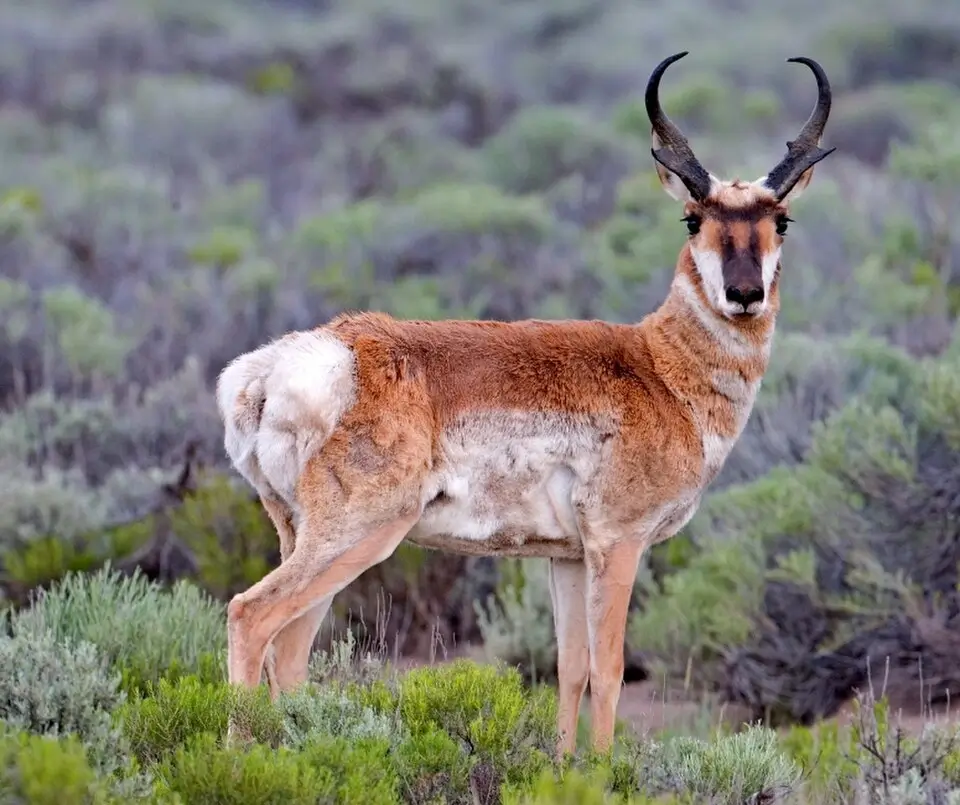
One of the pronghorn's most distinctive physical features is its horns. Unlike the antlers of deer, which are made of bone and shed annually, or the true horns of cattle and bison, which are never shed, the pronghorn's horns are composed of a keratin sheath over a bony core — and uniquely, those sheaths are shed and regrown each year. Both males (bucks) and females (does) typically grow horns, though the male's are significantly larger and feature the characteristic forward-pointing prong that gives the species its common name.
The pronghorn's most celebrated biological attribute is its extraordinary speed. Widely recognized as the fastest land animal in the Western Hemisphere, the pronghorn can sustain speeds that leave virtually every North American predator far behind. Unlike the cheetah, which achieves its top speed in brief, explosive bursts, the pronghorn is built for endurance — capable of maintaining high speeds over long distances. This remarkable cardiovascular and musculoskeletal system is thought to be an evolutionary legacy from the Pleistocene epoch, when North America was home to a variety of swift, large predators including American cheetahs and other now-extinct carnivores.
Beyond speed, the pronghorn possesses extraordinary eyesight. Its large, prominent eyes provide a wide field of vision, and its visual acuity is often compared to that of an 8x binocular — allowing it to detect movement at remarkable distances. This keen eyesight, combined with a habit of positioning itself in open terrain where sight lines are unobstructed, makes the pronghorn one of the most vigilant and challenging animals for hunters to approach.
Pronghorns are also notable for their unique digestive system. As ruminants, they have a multi-chambered stomach that allows them to efficiently extract nutrition from a wide variety of vegetation, including many plants that other ungulates find unpalatable. Their diet shifts seasonally, encompassing grasses, forbs, shrubs, and cacti depending on what is available in their range.
The pronghorn's coat is another marvel of adaptation. Its tan-and-white coloration provides camouflage on open grasslands, but perhaps more importantly, the hollow hair shafts provide exceptional insulation against both the blistering heat of summer and the brutal cold of northern winters. When alarmed, pronghorns can erect a patch of white rump hair, creating a flashing signal visible to other animals from great distances — an elegant biological communication system on a landscape where visual signals travel far.
Habitat & Range
The pronghorn is quintessentially a creature of open spaces. It thrives in the short-grass and mixed-grass prairies, sagebrush steppe, and semi-arid shrublands that dominate the American West. Its range stretches across much of the interior West, from southern Canada through the Great Plains and intermountain basins of the United States and into the deserts and grasslands of northern Mexico.
Montana, as one of the largest and most sparsely populated states in the nation, provides some of the most expansive and high-quality pronghorn habitat remaining anywhere in North America. The eastern two-thirds of Montana consist largely of rolling grasslands, sagebrush flats, and river breaks — precisely the open, semi-arid terrain that pronghorns favor. Montana is bordered by Wyoming to the south, the Dakotas to the east, and Canada to the north, and this broad swath of connected habitat allows pronghorn populations to move freely across a landscape that has changed relatively little in character since the days of Lewis and Clark, who famously encountered these animals during their expedition through the region.
One of the pronghorn's most ecologically important behaviors is migration. Some pronghorn populations undertake seasonal migrations of significant distance, moving between summer and winter ranges in response to changes in vegetation and weather. These migration corridors, which in some cases cross highways, fences, and developed areas, are a conservation priority across the West. Unlike deer or elk, pronghorns are not well-adapted to jumping over fences, and traditional barbed-wire fencing can present serious obstacles to their movement. Efforts by ranchers, conservation organizations, and wildlife agencies to modify fencing — raising the bottom wire and lowering the top wire — have proven highly beneficial for pronghorn movement across the landscape.
Hunting Information
The pronghorn holds a cherished place in the western hunting tradition. Pursuing pronghorns on the open plains demands a unique combination of skills: patience, precision marksmanship, superior glassing ability, and mastery of long-distance spot-and-stalk techniques. The very qualities that make the pronghorn such a survivor — its speed, its eyesight, its preference for open terrain — make it one of the most demanding and rewarding animals to hunt on foot.
Montana is broadly recognized as one of the premier pronghorn hunting destinations in North America, thanks to its vast tracts of public land and healthy pronghorn populations spread across the eastern plains and central grasslands. Hunters in Montana have access to millions of acres of Bureau of Land Management (BLM) land, state trust land, and other public ground where pronghorn hunting opportunities exist.
Hunting pronghorn on the open range typically involves extensive glassing from elevated positions, identifying quality bucks, and then planning a careful stalk that accounts for the animal's wide field of vision and the general lack of cover on the plains. The use of terrain features — coulees, ridgelines, dry creek beds — becomes essential for closing the distance. Archery hunters face a particularly steep challenge, as getting within bow range of an animal with the pronghorn's visual acuity and instinct for open ground requires exceptional skill and often a great deal of patience with decoy setups and water sources.
Prospective hunters in Montana are strongly encouraged to consult the Montana Fish, Wildlife & Parks (FWP) agency directly for the most current and accurate information regarding license requirements, season dates, district boundaries, and application deadlines. Pronghorn hunting in Montana, like in most western states, often operates on a limited-entry or controlled-draw basis for some units, meaning that applying early and understanding the draw system is an important part of the planning process. Regulations can change from year to year, and official state resources are always the definitive source for current hunting requirements.
Conservation
The story of pronghorn conservation in North America is, in many ways, a story of remarkable resilience and human stewardship. At the dawn of the 20th century, pronghorn populations had been devastated by market hunting, habitat loss, and competition with domestic livestock, falling to critically low levels across their range. Through the combined efforts of wildlife managers, conservation organizations, and regulated hunting programs, pronghorn populations recovered substantially throughout the 20th century.
Today, the pronghorn is not considered a threatened species across most of its range, standing as a testament to what thoughtful wildlife management can achieve. Hunters have played a central role in this recovery, with license fees and excise taxes on hunting equipment — channeled through programs like the Federal Aid in Wildlife Restoration Act (Pittman-Robertson Act) — funding critical habitat work and population monitoring.
Ongoing conservation priorities for the pronghorn include protecting and restoring migration corridors, managing fencing to facilitate movement, addressing the challenges of energy development in key habitat areas, and maintaining the healthy grassland and sagebrush ecosystems upon which pronghorn depend. Climate change, drought, and invasive plant species also pose long-term challenges to sagebrush steppe habitats across the West.
Organizations such as the Pronghorn Foundation, the Wild Sheep Foundation, and various state-level hunting and conservation groups continue to advocate for pronghorn habitat and work collaboratively with ranchers, agencies, and communities to ensure that this iconic species remains a fixture of the western landscape for generations to come.