Overview
Few animals embody the spirit of North America's wetlands quite like the muskrat (Ondatra zibethicus). This semi-aquatic rodent has thrived across the continent for thousands of years, carving out a niche in marshes, ponds, rivers, and streams from the Atlantic coast to the Pacific. Resilient, adaptable, and surprisingly fascinating in its behavior, the muskrat is both an ecological cornerstone and a species of longstanding interest to trappers, hunters, and naturalists alike.
In a state as geographically diverse as Montana — the fourth-largest state by area, stretching from the rugged peaks of the Rocky Mountains in the west to the sweeping plains and river corridors of the east — the muskrat finds ample habitat. Montana's rivers, wetlands, irrigation canals, and prairie potholes provide ideal conditions for this resourceful creature, making it a part of the natural landscape that outdoor enthusiasts may regularly encounter. Whether you are a trapper, a wildlife watcher, or simply a curious hiker along one of Montana's many waterways, understanding the muskrat adds richness to your experience in the wild.
This article explores the biology, habitat, behavior, and cultural significance of the muskrat, while also touching on what hunters and trappers in Montana should know about pursuing this species responsibly.
Biological Traits
The muskrat (Ondatra zibethicus) is the sole member of its genus, Ondatra, which places it in a unique position within the family Cricetidae — the large family of rodents that also includes voles, lemmings, and hamsters. Despite its common name and its resemblance to certain other semi-aquatic mammals, the muskrat is not closely related to the true rats of genus Rattus. It is, however, a true rodent, and its biology reflects millions of years of adaptation to life in and around water.
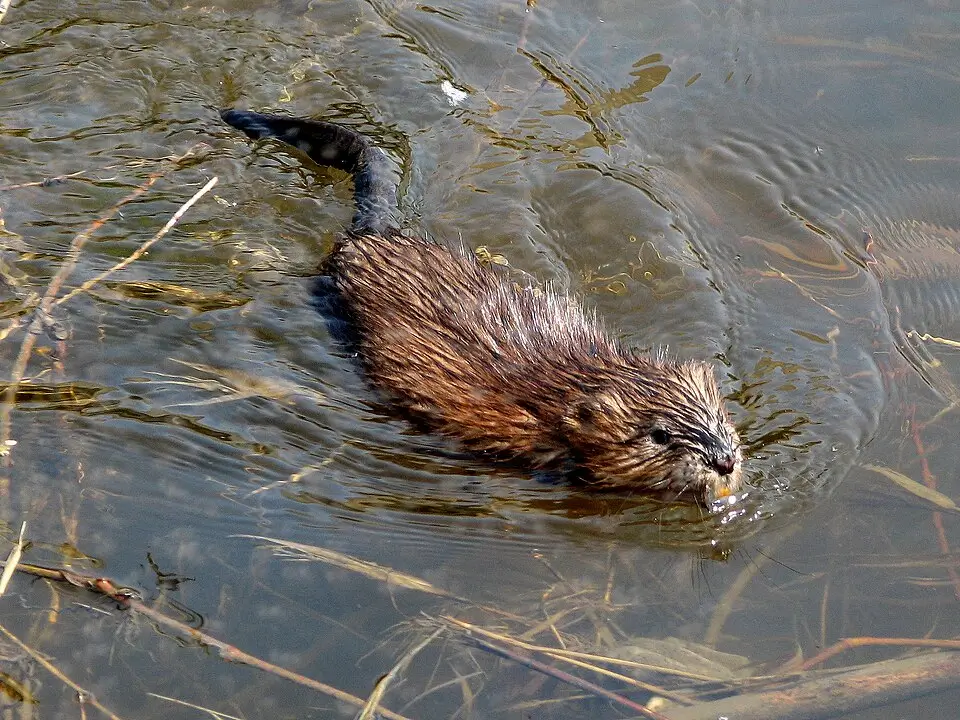
Adult muskrats are medium-sized rodents, typically weighing between one and four pounds, with a body length that can reach up to two feet when the tail is included. The tail itself is one of the most distinctive features of the species — long, scaly, and laterally flattened, it serves as a rudder when the animal swims. This characteristic sets the muskrat apart from the beaver, with which it is often compared; the beaver's tail is broad and paddle-shaped, while the muskrat's is narrow and blade-like.
The muskrat's coat is dense and richly layered, consisting of a soft, waterproof underfur covered by longer, coarser guard hairs. This fur, which ranges in color from dark brown on the back to lighter gray or buff on the belly, has historically been prized in the fur trade. The waterproofing quality of the fur is critical for an animal that spends a great deal of its life submerged or partially submerged in cold water.
The name "muskrat" is derived from the animal's well-developed musk glands, which are located near the base of the tail. These glands produce a musky-smelling secretion used in communication, particularly for marking territory and attracting mates. This scent plays an important role in the animal's social and reproductive life, especially during the breeding season.
Muskrats are equipped with partially webbed hind feet, which contribute to their impressive swimming ability. They can remain submerged for up to 15 to 20 minutes under ideal conditions, and they are capable swimmers even in swift currents. Their eyes and nostrils are positioned high on the head, allowing them to maintain awareness of their surroundings while swimming at the surface — a classic adaptation seen in many semi-aquatic mammals.
As herbivores, muskrats feed primarily on aquatic and semi-aquatic vegetation, including cattails, bulrushes, water lilies, and various sedges and grasses. They will also consume roots, rhizomes, and tubers, which become especially important food sources during winter when surface vegetation is buried beneath ice and snow. Occasionally, muskrats supplement their diet with invertebrates, small fish, frogs, or crayfish, particularly when plant matter is scarce.
Habitat & Range
The muskrat's scientific name, Ondatra zibethicus, reflects both its genus-level uniqueness and its musky scent — zibethicus being derived from a Latin word relating to civet-like musk. The species enjoys one of the broadest distributions of any semi-aquatic mammal in North America, ranging from the Arctic tundra of Canada and Alaska southward through the continental United States and into Mexico.
Muskrats are creatures of the water's edge. They are most commonly found in marshes, ponds, lakes, streams, rivers, and irrigation ditches — anywhere that slow-moving or still water is fringed by dense aquatic vegetation. The presence of cattails, bulrushes, and similar emergent plants is often a reliable indicator of muskrat activity, as these plants provide both food and building material.
In Montana, the species inhabits a wide variety of aquatic environments. The state's extensive river systems — including the Missouri, Yellowstone, Clark Fork, and Flathead Rivers — provide corridors of suitable habitat. Prairie wetlands, irrigation canals, and stock ponds in eastern and central Montana offer additional territory, while montane lakes and marshy meadows in the western part of the state round out the picture. Montana's position as one of the least densely populated states in the nation means that large tracts of muskrat habitat remain relatively undisturbed.
One of the muskrat's most remarkable behavioral adaptations is its lodge-building behavior. In marshes and shallow ponds, muskrats construct dome-shaped lodges from cattail stems, reeds, mud, and other plant material. These structures, which can be several feet in diameter and height, serve as both shelter and nursery. Muskrats are also capable of burrowing into the banks of rivers and streams, where they dig tunnels that lead to a chamber above the waterline. In winter, the lodge becomes a critical refuge, with the thick walls providing insulation against freezing temperatures.
Hunting and Trapping Information
The muskrat has been a target of North American trappers for centuries, and its fur trade history is both deep and culturally significant. Indigenous peoples across the continent utilized muskrat for food and clothing long before European contact, and the species became an important commodity in the colonial fur trade. Even in the modern era, muskrat remains one of the most commonly trapped furbearing mammals in North America, valued for its warm, water-resistant pelt.
For those interested in pursuing muskrats in Montana, it is important to note that specific season dates, license requirements, and regulatory information are managed by Montana Fish, Wildlife & Parks (FWP). As regulations can change from year to year and vary by location, hunters and trappers are strongly encouraged to consult the Montana FWP website or contact the agency directly for the most current and accurate information before heading afield. The source data available for this article does not include specific season dates or license details, and it would be irresponsible to speculate on those specifics.
Generally speaking, muskrat trapping across North America traditionally takes place in the fall and winter months, when the animal's fur is at its thickest and most valuable. Common trapping methods include the use of foothold traps, body-gripping traps, and cage traps placed at run entrances, along mudslides, or near lodge openings. Trappers often look for signs of muskrat activity — such as feeding platforms, lodge structures, trails through vegetation, and fecal droppings — to identify productive trapping locations.
Muskrat meat, while not as widely consumed today as it once was, is also edible and has been a traditional food source in many parts of North America. The meat is dark and fine-grained, and it has been described as having a mild, slightly sweet flavor when properly prepared.
For anyone pursuing muskrats in Montana, ethical practices, proper licensing, and adherence to state regulations are paramount. Responsible trapping not only supports wildlife management goals but also helps ensure that healthy muskrat populations continue to thrive in Montana's wetlands for future generations.
Conservation
The muskrat is currently classified as a species of least concern by wildlife conservation organizations, reflecting its broad range, high reproductive rate, and overall population stability. Females can produce multiple litters per year, each containing several young, which allows populations to recover rapidly from declines caused by trapping pressure, harsh winters, or habitat loss.
That said, the muskrat is not immune to the pressures facing wetland ecosystems more broadly. Habitat degradation, water pollution, drought, and changes in land use can all negatively affect local muskrat populations. In Montana and across the West, the health of wetland ecosystems is closely tied to water availability — an increasingly important concern in an era of changing precipitation patterns and competing demands on water resources.
Interestingly, muskrats play an important ecological role as what biologists sometimes call "ecosystem engineers." Their feeding and construction activities can reshape wetland habitats in ways that benefit other species. By harvesting cattails and other emergent vegetation, muskrats create open water areas that attract waterfowl and other wildlife. Their lodges and burrows can also provide habitat for various birds and other small animals.
Healthy muskrat populations are often viewed as an indicator of wetland health, and their presence in Montana's waterways is a positive sign for the broader ecosystem. Conservation efforts that protect and restore wetland habitats — such as those supported by Ducks Unlimited, the U.S. Fish and Wildlife Service, and Montana FWP — indirectly benefit muskrats along with a wide range of other species.
Conclusion
The muskrat is a quiet but vital thread in the fabric of North America's wetland ecosystems. From its remarkable physiological adaptations for aquatic life to its centuries-long relationship with human hunters and trappers, Ondatra zibethicus is a species worthy of respect and attention. In Montana, where wild landscapes and clean waterways remain abundant, the muskrat continues to go about its industrious business — building lodges, raising young, and enriching the wetland habitats that so many species depend upon.
Whether you encounter one gliding silently across a prairie pond at dusk or discover one of its reed-built lodges along a river bank, the muskrat offers a window into the intricate and often overlooked world of North America's aquatic wildlife.