Overview
Few animals capture the spirit of the American West quite like the mule deer. With its oversized, mule-like ears, distinctive bounding gait, and regal antlers, Odocoileus hemionus stands as one of the most recognizable and beloved big game animals on the continent. From the rugged coulees of eastern Montana to the sun-baked canyon country of the Southwest, the mule deer has carved out a legendary reputation among hunters, wildlife photographers, and naturalists alike. Whether you encounter a massive buck silhouetted against a mountain sunset or watch a doe lead her twin fawns across a sage flat, the experience is one that stays with you for a lifetime.
Mule deer occupy a special place in the cultural heritage of the American West. For generations of hunters, pursuing a mature mule deer buck — often called a "muley" — has represented one of the most rewarding and challenging pursuits in North American hunting. These animals are not just game animals; they are a symbol of wild, open country and a keystone species in the ecosystems they inhabit. Understanding the biology, behavior, and habitat preferences of mule deer is the first step toward appreciating just how extraordinary these animals truly are.
Biological Traits
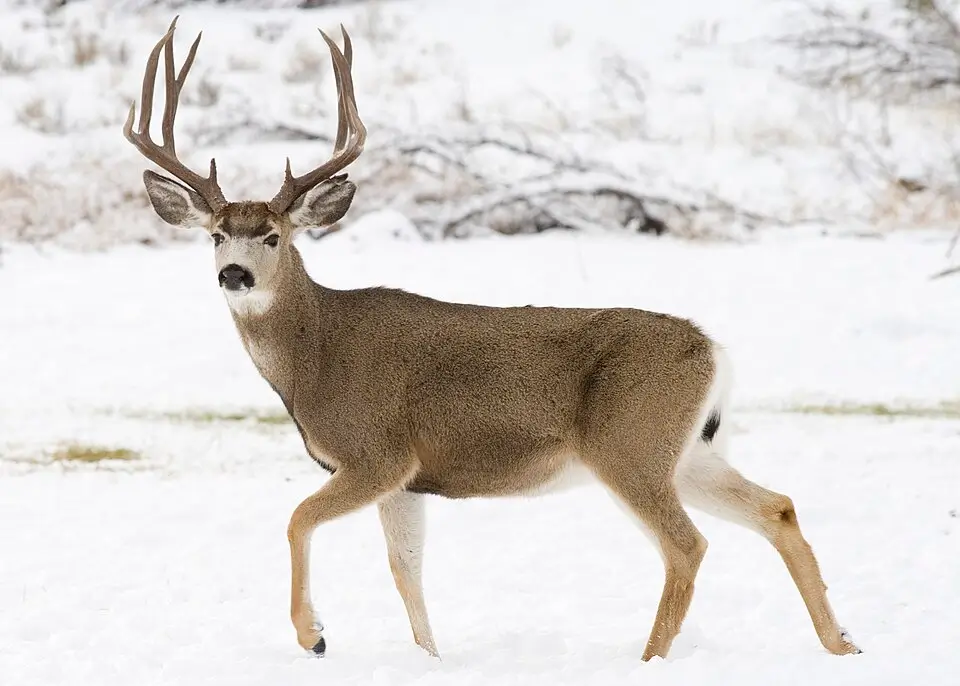
Mule deer belong to the family Cervidae and the genus Odocoileus, which they share with their close relative, the white-tailed deer (Odocoileus virginianus). The species name hemionus comes from the Greek word for "half mule," a direct reference to the animal's most conspicuous feature: its large, heavily furred ears that can measure up to 11 inches in length and rotate independently to detect the faintest sounds from any direction.
One of the most immediately recognizable features of a mule deer, beyond its ears, is its antler structure. Unlike white-tailed deer, whose antlers grow in a single main beam with tines projecting upward, mule deer antlers bifurcate — meaning they fork repeatedly into equal branches. This distinctive "forked" antler configuration is a reliable way to distinguish a mule deer buck from a whitetail in the field. A mature mule deer buck can grow an impressive, symmetrical rack that spreads wide and scores high on the Boone and Crockett system, making trophy-class muleys a sought-after prize for serious hunters.
Mule deer are medium- to large-sized deer. Bucks are significantly larger than does, as is typical in cervids. Bucks generally weigh between 150 and 300 pounds on average, though exceptionally large individuals can exceed that range depending on habitat quality and geographic location. Does are considerably smaller and lighter. The coat of a mule deer changes seasonally: in summer, it appears reddish-brown or tawny, while in winter it transitions to a grayish-brown hue that blends beautifully with dormant sagebrush and rocky terrain.
Perhaps one of the most distinctive behavioral traits of mule deer is their unique form of locomotion known as "stotting" or "pronking." When alarmed, mule deer often bound away in a stiff-legged, four-footed gait where all four hooves leave the ground simultaneously. This bouncy, pogo-stick-like movement — quite unlike the smooth gallop of a white-tailed deer — is thought to help them navigate rough, rocky terrain and may also serve as a signal to predators that they have been detected. It is an instantly recognizable behavior that every mule deer hunter and wildlife observer comes to know well.
Mule deer are primarily browsers, meaning they feed on a wide variety of shrubs, forbs, grasses, and woody vegetation rather than relying heavily on a single food source. Their diet shifts with the seasons and with what is available in their particular habitat. Sagebrush, bitterbrush, mountain mahogany, serviceberry, cliffrose, and various forbs are among the preferred food items, though mule deer will take advantage of agricultural crops, grasses, and other vegetation when available. This dietary flexibility is part of what makes mule deer so adaptable across such a wide geographic range.
Mule deer are seasonally polygamous, and the rut — the breeding season — typically occurs in late fall. During this period, bucks become intensely focused on locating and pursuing does, often abandoning their typical wariness and covering vast distances in search of receptive females. Dominant bucks may gather harems of does, and dramatic sparring between rival bucks is a common sight during the peak of the rut. Fawns, typically one or two per doe, are born in late spring or early summer after a gestation period of approximately 200 days. Newborn fawns are spotted and largely odorless, adaptations that help conceal them from predators during their most vulnerable early weeks.
Habitat & Range
The mule deer is a creature of the American West in every sense. Its range encompasses a vast swath of western North America, stretching from the coastal ranges of the Pacific Northwest and British Columbia eastward across the Rocky Mountains and Great Plains, and southward through much of Mexico and into Baja California. Several recognized subspecies exist across this range, adapted to environments as varied as coastal rainforests, high alpine meadows, arid desert canyons, and rolling prairie grasslands.
At its core, mule deer country is characterized by open, rugged landscapes punctuated by woody shrubs, rocky outcroppings, and transitional zones between different vegetation types. These deer thrive in areas where they can exploit diverse food resources while utilizing terrain for escape from predators. Steep, rocky slopes and broken canyon country are quintessential mule deer habitat, offering both thermal cover and vantage points from which deer can survey their surroundings.
Many mule deer populations are migratory, making seasonal movements between summer range at higher elevations and lower-elevation winter range. These migrations can cover substantial distances and are driven by snowfall, temperature, and the availability of food. The fidelity that mule deer show to traditional migration corridors makes the preservation of these travel routes critically important for population health.
In Montana specifically, mule deer are found across much of the state, with particularly strong populations in the eastern prairie coulees, the Missouri River Breaks, and the foothills and mountain ranges of the central and western portions of the state. Montana's diverse landscape — from vast grasslands and badlands in the east to towering mountain ranges in the west — provides a mosaic of habitats that supports healthy mule deer populations. The state's enormous size and relatively low human population density make it one of the premier destinations in North America for mule deer hunting.
Hunting Information
Hunting mule deer is a tradition deeply woven into the fabric of western culture, and Montana ranks among the finest destinations on the continent for pursuing this iconic species. The state's vast public lands, including millions of acres managed by the U.S. Forest Service, Bureau of Land Management, and other agencies, provide exceptional access opportunities for hunters from all walks of life.
Mule deer hunting in Montana offers a range of experiences, from spot-and-stalk hunting in the open prairie coulees of the east to pursuing high-country bucks in the alpine basins of the Rocky Mountain ranges to the west. The Missouri River Breaks region is particularly renowned among serious mule deer hunters, with its labyrinthine canyons and dense buck populations producing some of the most memorable hunting experiences in the West.
Because specific season dates, license requirements, and tag availability for Montana mule deer are subject to change on an annual basis and vary by hunting district, prospective hunters are strongly encouraged to consult Montana Fish, Wildlife & Parks (FWF) directly for the most current and accurate regulatory information. Regulations can differ significantly between general and special-draw hunts, and understanding the specific rules that apply to your chosen hunting area is essential for a legal and successful hunt.
Spot-and-stalk is the most common and traditional method for hunting mule deer in open western terrain. The approach involves glassing from elevated vantage points with quality optics — binoculars and a spotting scope are essential tools — locating a target buck, and then carefully planning and executing a stalk to get within shooting range. Patience, physical fitness, and an intimate knowledge of the terrain are all critical assets. Many hunters also have success hunting along migration corridors in the late season as deer move to lower elevations ahead of winter weather.
Archery hunters pursuing mule deer face an even greater challenge, requiring a close approach to within ethical bow range, often 40 yards or less. Early archery seasons can offer encounters with bucks still in velvet, providing both a visual spectacle and a distinct hunting challenge. Rifle hunters, meanwhile, can take advantage of the open terrain and long sight lines that characterize much of Montana's best mule deer country.
Conservation
Mule deer populations across the West face a range of challenges, including habitat fragmentation from development and energy extraction, disease, predation pressure, and the long-term effects of climate change on vegetation communities and winter range conditions. Conservation organizations, state wildlife agencies, and federal land managers have increasingly focused attention on protecting and restoring critical mule deer habitat, including winter range and migration corridors.
Hunters play a vital and direct role in mule deer conservation through license and tag fees, as well as through contributions to organizations dedicated to habitat work and scientific research. The North American Model of Wildlife Conservation, funded in large part through hunter spending, has been instrumental in maintaining healthy mule deer populations across the West. Responsible, ethical hunting — including adherence to regulations, respect for private and public land access, and a commitment to fair-chase principles — remains one of the most important contributions that hunters can make to the long-term health of mule deer populations.
Montana's wide open spaces and thoughtful wildlife management continue to provide a strong foundation for mule deer conservation, and the future of muleys in Big Sky Country looks bright for generations of hunters and wildlife enthusiasts to come.