Overview
Few animals in North America command as much respect and admiration as the mountain goat. Perched on impossibly steep cliffs, navigating frost-covered ledges with effortless grace, and staring down the harshest alpine winters with stoic endurance, the mountain goat (Oreamnos americanus) stands as one of the continent's most iconic and awe-inspiring large mammals. Whether you are a wildlife enthusiast scanning talus slopes with binoculars, a seasoned hunter pursuing one of North America's most challenging and coveted big game trophies, or simply someone who marvels at the raw tenacity of life in extreme environments, the mountain goat offers something truly extraordinary.
Known colloquially across the American West and Canada as the "monarch of the mountains," this remarkable hoofed mammal has carved out an ecological niche that few other large animals dare to occupy. Its territory is vertical, its climate is brutal, and its lifestyle demands a level of physical and physiological adaptation that borders on the miraculous. In states like Montana — a vast, ruggedly beautiful state bordering Canada and sharing a landscape defined by the northern Rocky Mountains — the mountain goat is not merely a wildlife species. It is a symbol of the wild, untamed character that defines the Mountain West.
This article explores the biology, habitat, hunting traditions, and conservation status of this remarkable animal, with a particular focus on its presence in Montana's spectacular mountain terrain.
Biological Traits
The mountain goat, classified scientifically as Oreamnos americanus, belongs to the family Bovidae and the subfamily Caprinae, making it a relative of Old World chamois, takins, and serows rather than a true goat in the strictest taxonomic sense. Despite its common name, it is more accurately described as a "goat-antelope," a term that reflects its intermediate position within its subfamily.
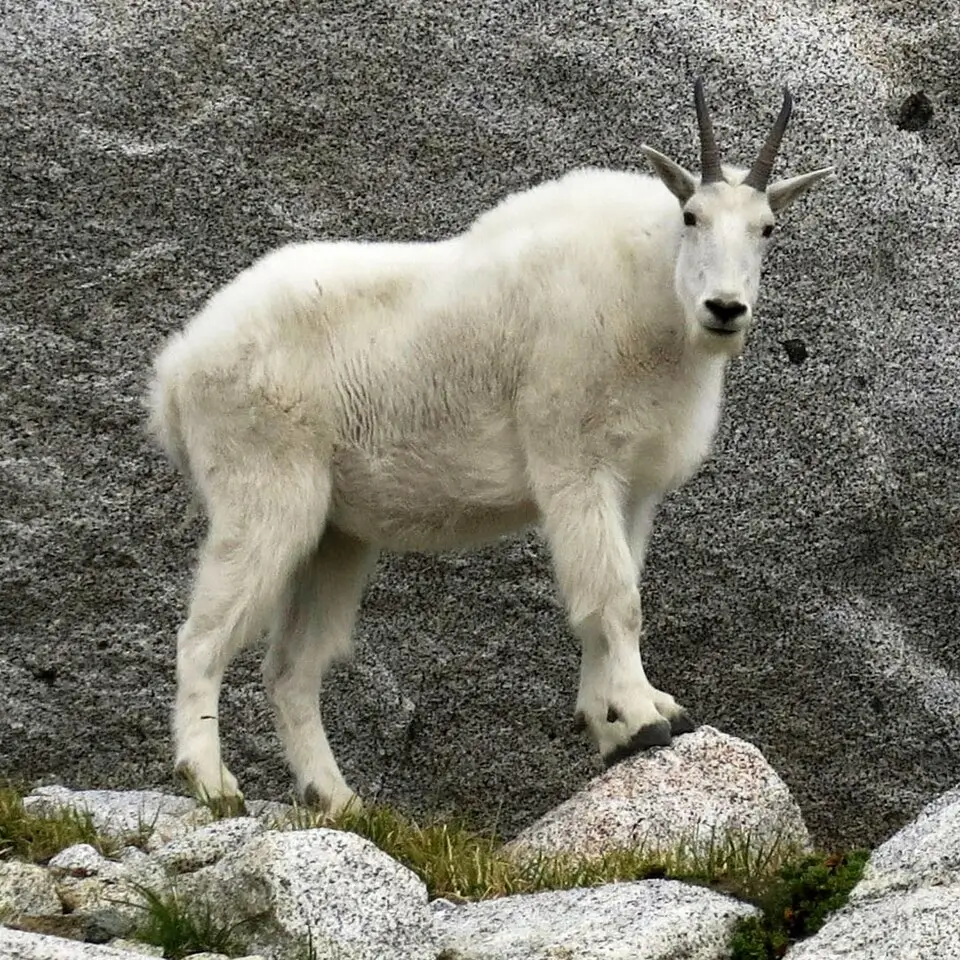
One of the most immediately recognizable features of the mountain goat is its striking white coat. This dense, double-layered fur serves as both insulation against the punishing cold of alpine winters and effective camouflage against the snow and pale rock of its high-altitude home. The outer layer consists of long, coarse guard hairs that shed moisture and wind, while the inner layer provides exceptional thermal insulation. During the warmer months, mountain goats shed their heavy winter coat, appearing somewhat scraggly and patchy during this molting process before growing their pristine white fleece back in preparation for winter.
Both males (known as billies) and females (known as nannies) carry short, sharp, black horns. These horns are permanent and grow throughout the animal's lifetime, never shedding like antlers do in deer or elk. The horns of billies tend to be slightly thicker at the base and more curved than those of nannies, though distinguishing between sexes requires a trained eye. A mature billy may stand around three to four feet tall at the shoulder and weigh anywhere from 125 to over 300 pounds, with females being noticeably smaller.
Perhaps the most extraordinary biological feature of the mountain goat is its hooves. Each hoof is specially designed for life on near-vertical rock faces. The outer edge is hard and sharp, providing grip on rocky surfaces much like the edge of a crampon, while the inner pad is soft and rubbery, functioning like a natural climbing shoe to generate friction on smooth rock. This dual-purpose hoof structure, combined with powerful musculature and a low center of gravity, allows mountain goats to navigate terrain that would be impassable to virtually any other large mammal.
Mountain goats are herbivores, subsisting on a diet of grasses, sedges, herbs, shrubs, mosses, and lichens. Their ability to extract nutrition from the sparse and hardy vegetation of alpine environments is a testament to their highly specialized digestive systems. During winter, when food becomes scarce, mountain goats will descend somewhat in elevation to find accessible forage, though they rarely venture far from the safety of steep terrain.
Socially, mountain goats are not strongly gregarious animals. Nannies often form small nursery groups with their young offspring, called kids, while billies tend to be more solitary outside of the breeding season. The rut typically occurs in late fall, during which time billies may travel considerable distances to find receptive females. Kids are born in late spring or early summer, and nannies are famously protective and attentive mothers.
The lifespan of a wild mountain goat typically ranges from 9 to 12 years, though some individuals may live longer in favorable conditions with low predation pressure. Natural predators of mountain goats include wolves, cougars, grizzly bears, and golden eagles — the latter of which may prey upon kids.
Habitat & Range
The mountain goat is a species endemic to North America, meaning it is found nowhere else on Earth in its natural state. Its native range spans the mountainous regions of the Pacific Northwest, the northern Rocky Mountains, and southern Alaska and Canada. In the United States, significant populations exist in Alaska, Montana, Idaho, Washington, Oregon, Colorado, and several other western states where populations have been introduced.
The species is, by nature and by necessity, an alpine specialist. Mountain goats are most commonly found at elevations above the treeline, inhabiting cliff faces, rocky outcrops, glaciated terrain, and steep alpine meadows. This preference for extreme elevation is not merely incidental — it is a survival strategy. The near-vertical terrain that mountain goats favor is largely inaccessible to most large predators, providing a natural refuge that compensates for the goat's relatively modest speed compared to open-country prey species.
Montana is a particularly significant state for mountain goats. As the fourth-largest state in the United States by land area, Montana encompasses a breathtaking diversity of mountain terrain, including portions of the Rocky Mountain Front, the Cabinet Mountains, the Beartooth Range, Glacier National Park, and the Mission Mountains, among many others. The western half of the state, characterized by rugged ranges and deep river valleys, provides ideal habitat for mountain goats, and populations can be found distributed across numerous mountain ranges throughout the state. Montana's proximity to Alberta and British Columbia in Canada means that its mountain goat populations are part of a broader trans-boundary population that benefits from contiguous habitat.
Hunting Information
The mountain goat is one of the most coveted and challenging big game trophies available to North American hunters. Pursuing a mountain goat is not simply a hunt — it is an expedition, a test of physical fitness, mental endurance, and backcountry skill. The terrain these animals inhabit is some of the most demanding in the world, and reaching mountain goat country often requires days of strenuous hiking, technical scrambling, and careful glassing from ridgelines and high vantage points.
In Montana, as in most states and provinces where mountain goats are legally hunted, the species is managed under a highly controlled permit system. Because mountain goat populations are naturally limited by their specialized habitat requirements and relatively slow reproductive rates — nannies typically give birth to only one kid per year — harvest levels must be carefully managed to ensure population stability. This typically means that the number of permits issued each year is quite limited, making a mountain goat tag one of the most difficult to draw in the Western United States.
For hunters fortunate enough to draw a Montana mountain goat tag, the experience is often described as a once-in-a-lifetime adventure. The pursuit demands exceptional physical conditioning, proficiency with a rifle or bow at varying angles and distances, and a thorough understanding of mountain safety and navigation. Many successful mountain goat hunters engage professional outfitters and guides who are intimately familiar with the terrain and the animals' seasonal movements.
It is important for prospective mountain goat hunters in Montana to consult directly with Montana Fish, Wildlife & Parks (FWP) for the most current and accurate information regarding season dates, permit availability, licensing requirements, and specific hunting unit regulations, as these details are subject to change from year to year and were not available in the source data used for this article.
Conservation
The mountain goat is currently listed as a species of Least Concern by the International Union for Conservation of Nature (IUCN), reflecting the fact that global populations remain reasonably stable and that the species is not facing imminent extinction. However, this designation should not be interpreted as meaning that mountain goats are without challenges or vulnerabilities.
Because mountain goats are specialized alpine animals, they are particularly sensitive to habitat disturbance at high elevations, including mining activity, off-road vehicle use in alpine zones, and — perhaps most significantly over the long term — climate change. As temperatures rise and snowpack patterns shift, the alpine ecosystems that mountain goats depend upon are gradually changing, and there is growing scientific interest in understanding how these changes may affect goat populations over the coming decades.
Wildlife managers in Montana and other western states actively monitor mountain goat populations through aerial surveys, harvest data, and research partnerships. These management efforts aim to ensure that hunting remains a sustainable activity that complements rather than undermines the conservation of the species.
Hunters themselves have historically played a major role in mountain goat conservation. Permit revenues contribute directly to wildlife management budgets, and hunter-conservationist organizations have long advocated for the protection of high-elevation habitat and responsible harvest management.