Overview
Few birds capture the imagination of hunters, wildlife enthusiasts, and casual observers quite like the Mallard (Anas platyrhynchos). With its instantly recognizable emerald-green head, brilliant yellow bill, and confident waddle along the water's edge, the Mallard stands as perhaps the most familiar waterfowl species in the Northern Hemisphere. From city park ponds to remote prairie wetlands, from flooded agricultural fields to the winding river corridors of Montana's mountain valleys, the Mallard has established itself as a ubiquitous and beloved presence in the natural world.
For hunters across North America, the Mallard holds a place of special reverence. It is the benchmark species against which all duck hunting is measured — the bird that inspired generations of decoy carvers, called countless hunters to the blind before dawn, and filled more game straps than perhaps any other waterfowl species on the continent. Understanding the Mallard — its biology, behavior, habitat preferences, and the hunting traditions it has inspired — is a rewarding pursuit for anyone who appreciates the outdoors.
Montana, the fourth-largest state by area and a jewel of the American West, provides exceptional context for exploring the Mallard's world. With its vast river systems, prairie potholes, mountain lakes, and diverse wetland habitats, Montana represents some of the finest Mallard country in the United States. Whether you are a lifelong waterfowler or a newcomer discovering the sport for the first time, the Mallard in Big Sky Country is a subject well worth exploring in depth.
Biological Traits
The Mallard (Anas platyrhynchos) belongs to the family Anatidae and the genus Anas, placing it among the dabbling ducks — a group of waterfowl characterized by their tendency to feed at or near the water's surface rather than diving beneath it. The scientific name itself is descriptive: platyrhynchos derives from the Greek words for "flat" and "bill," a direct reference to the species' broad, spatulate bill that is so perfectly adapted to filtering food from water and mud.
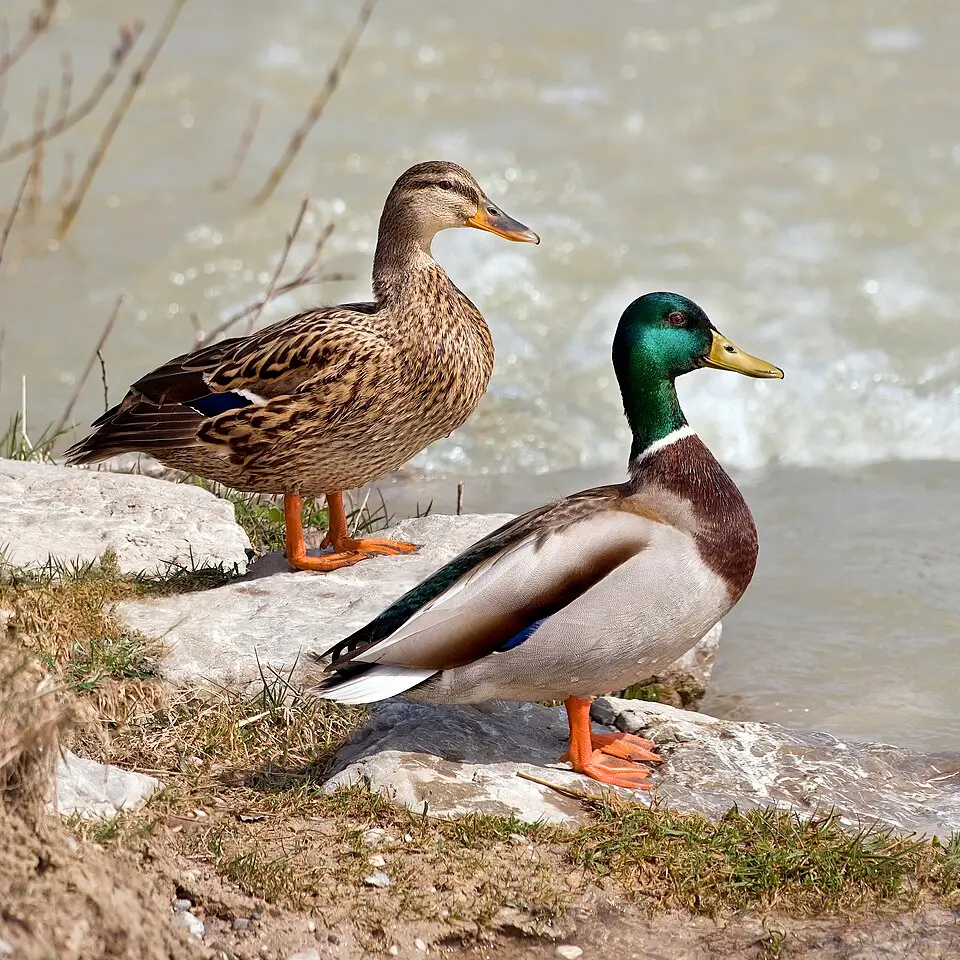
One of the most striking aspects of the Mallard is the pronounced sexual dimorphism between males (drakes) and females (hens). The breeding drake is a spectacular sight — his iridescent green head shimmers in sunlight, transitioning to a white neck ring and a rich chestnut-brown breast. His back is a complex tapestry of gray and brown feathers, while his tail features distinctive upward-curling feathers that serve as a visual indicator of reproductive fitness. The drake's bill is a clean, bright yellow-orange.
The hen, by contrast, wears the practical garb of a nesting bird. Her plumage is a mottled brown, providing exceptional camouflage among reeds, grasses, and leaf litter when she is incubating eggs. Her bill is orange with darker mottling. Both sexes display a brilliant iridescent blue-purple speculum — a patch on the secondary wing feathers bordered by white — that flashes brilliantly in flight and is one of the most reliable field identification marks for the species.
Mallards are among the larger dabbling ducks. Adults typically measure between 20 and 26 inches in length, with a wingspan that can range from roughly 32 to 39 inches. Their body weight varies seasonally and by individual, but adults generally weigh between two and three pounds, with some large northern drakes occasionally exceeding that range.
Like all dabbling ducks, Mallards feed by tipping forward in shallow water, submerging their head and neck to reach aquatic vegetation, invertebrates, seeds, and other food sources on the bottom. On land and in agricultural areas, they are equally adept at foraging, consuming waste grain, grasses, and a wide variety of plant material. This dietary flexibility is one of the key reasons the Mallard thrives across such a broad range of environments.
The Mallard's call is perhaps the most universally recognized bird sound in North America. The classic "quack" that most people associate with ducks is, in fact, the call of the female Mallard. Drakes produce a softer, raspy sound — a quieter, more nasal note that is quite different from the hen's loud, descending quack. This hen call is the basis for nearly every duck call produced commercially and is the foundational sound of waterfowl hunting culture.
Mallards are seasonally monogamous, forming pair bonds during the winter and early spring that typically last through the nesting season. Nests are built on the ground, typically in dense vegetation near water, and clutches generally consist of around eight to thirteen eggs. Incubation lasts approximately 27 to 28 days and is performed almost exclusively by the hen. Ducklings are precocial — meaning they are born with downy feathers and are capable of following their mother and feeding themselves within hours of hatching.
Habitat & Range
The Mallard boasts one of the most extensive distributions of any waterfowl species in the world. Across the Northern Hemisphere, it breeds from the Arctic tundra southward through temperate regions, and its wintering range extends across much of the continental United States, Mexico, Europe, and Asia. In North America, the Mallard is present year-round across a broad swath of the continent, with northern populations undertaking significant seasonal migrations to warmer wintering areas.
The species is remarkably adaptable in its habitat preferences. While Mallards are strongly associated with wetland environments — marshes, lakes, ponds, rivers, and flooded fields — they are equally at home in agricultural landscapes, suburban parks, and even urban waterways. This adaptability has allowed the Mallard not only to persist but to thrive in a human-modified world, making it a success story among waterfowl.
In Montana, the Mallard finds an extraordinarily diverse array of suitable habitats. The state's western half, dominated by the Rocky Mountain ranges, provides mountain lakes, glacial tarns, and cold, clear river systems that attract and support Mallard populations during the breeding season and migration. The eastern portion of the state transitions to rolling plains and prairie, where natural potholes, stock ponds, reservoirs, and seasonal wetlands provide critical stopover and breeding habitat along the Central Flyway — one of North America's great migratory bird highways.
Montana's major river systems — including the Missouri, Yellowstone, Clark Fork, and Flathead rivers — serve as migration corridors and year-round habitat for resident Mallard populations. Riparian corridors lined with cottonwoods, willows, and dense shrubs offer ideal nesting and loafing habitat, while the adjacent agricultural lands provide rich foraging opportunities, particularly during the harvest season when waste grain is abundant in harvested fields.
Hunting Information
Mallard hunting is among the oldest and most deeply ingrained hunting traditions in North America, and Montana offers exceptional opportunities for waterfowlers pursuing this iconic species. The state's position within the Central Flyway means that significant numbers of migrating Mallards pass through or stage in Montana each fall, supplementing resident breeding populations with birds that have traveled from breeding grounds in Canada and the northern United States.
Duck hunting in Montana is regulated at both the federal and state levels, with season dates, bag limits, and licensing requirements established in coordination with the U.S. Fish and Wildlife Service and the Montana Fish, Wildlife & Parks agency. Because waterfowl are migratory birds, their management falls under the federal Migratory Bird Treaty Act, and all hunters are required to possess both a valid state hunting license and a federal Duck Stamp in addition to any applicable state waterfowl licenses. Prospective hunters should always consult the most current Montana Fish, Wildlife & Parks regulations for up-to-date season dates and bag limits, as these are set annually based on population surveys and can change from year to year.
Mallard hunting in Montana takes many forms. Pass shooting along river corridors, decoying birds over flooded grain fields, and jump shooting along beaver ponds and backwater sloughs are all productive and time-honored methods. Many hunters set out careful arrangements of Mallard decoys — often featuring a mix of drake and hen decoys in relaxed feeding and resting postures — and use mouth-blown or electronic calls to bring birds within range. The dawn flights of Mallards trading between roost sites and feeding areas are among the most memorable experiences in all of waterfowl hunting.
For those new to the sport, Montana's public lands, Wildlife Management Areas, and navigable waterways provide substantial access opportunities. Scouting before the season — identifying where birds are roosting, feeding, and traveling — is an essential part of successful Mallard hunting and deepens any hunter's understanding of and appreciation for the species.
Conservation
The Mallard is currently classified as a species of Least Concern by the International Union for Conservation of Nature (IUCN), reflecting its broad range and robust global population. North American Mallard populations are monitored annually through the Waterfowl Breeding Population and Habitat Survey conducted by the U.S. Fish and Wildlife Service and Canadian Wildlife Service, providing wildlife managers with the data necessary to set sustainable harvest levels each year.
Conservation of Mallard habitat — particularly the prairie pothole region of the northern Great Plains and the wetland systems of the intermountain West — remains a priority for waterfowl managers and conservation organizations. Wetland drainage, agricultural conversion, and drought can all affect local Mallard populations, making habitat conservation efforts critically important for the long-term health of the species. Organizations such as Ducks Unlimited have invested heavily in wetland conservation and restoration throughout North America, benefiting Mallards and a wide range of other waterfowl and wetland-dependent wildlife.
In Montana, the conservation of riparian corridors, prairie wetlands, and the associated upland habitats that Mallards depend upon for nesting is supported through a combination of state programs, federal conservation easements, and the work of dedicated sportsmen and conservation organizations. Hunters, through the purchase of Duck Stamps and participation in voluntary conservation programs, have historically played and continue to play a central role in funding the habitat conservation that sustains Mallard populations across the continent.
The story of the Mallard is, in many ways, a conservation success story — a testament to what science-based management, international cooperation, and the sustained commitment of hunters and wildlife enthusiasts can achieve.